Sunday, October 27, 2013

Satantango - László Krasznahorkai

Almost two year ago, I finished reading 'Melancholy of Resistance' and was in awe of this writer. The book wasn't easy to get into, for its long sentences, the super slow narration and the general bleakness of the subject. He has an uncanny knack of creating the eery atmosphere around which grows into you, and will constantly keep you disturbed until you finish reading ( and even after you closed the book). The break down of the system, the near apocalyptic events, the town/village caught in the whirlpool of the event and the general feeling of something else is behind all these occurrences who is omnipresent but invisible. Bela Tarr's adaptation followed the writer to the precise. His first ever novel is now available ( well, over an year now released in 2012) which supposed to have established Laszlo Krasznahorkai as one of the leading writers of the world in the current generation.

Satantango, has the similar voice and surroundings as in the case of Melancholy of resistance. The same isolated town/village, the slow uncovering of events , the helpless inhabitants being guided by unknown force, lead to their sad end, the collapse of the system, the visible decay of everything under the sun as well as the imminent disaster that is expected to befall at any time. The same eeriness, the same uneasiness the same helplessness which I am familiar seems to have originated from here.  If it was the mysterious circus company that was haunting the people in 'melancholy' , it was the arrival of Irimias, whom people thought is dead already, to their hamlet causing all that trouble. The 'estate' where a dozen or so families live (includes a mechanic, a headmaster, a doctor, and a couple of village whores), is a farmers collective, which is in clear decay. As few smart people are prepared to receive whatever compensation they can obtain for their cattle and move to places where they can re-build their life leaving the rest of the peasants to their fate, the cunning, devilish charm of Irimias, casts his spell on them. 

In an awesomely beautiful opening the book starts with the signs of imminent danger.

"One morning near the end of October not long before the first drops of the mercilessly long autumn rains began to fall on the cracked and saline soil on the western side of the estate (later the stinking yellow sea of mud would render footpaths impassable and put the town too beyond reach) Futaki woke to hear bells"

The novel starts with a plot be few inhabitants to escape with the money they have, but the plan was shelved with a news of the expected arrival of Irimias to the estate. There seems to be the intelligentsia at work with a clear plan to quell this movement ( as we witness in the meeting of Irimias and Petrina with the State Security in the initial chapter).  They are apprehensive of his motive but are , at the same time, hoping that he will come to their rescue, as he had done once before, prior to his absence( as people thought of him as dead). As one after other vying to get on the better side of him, offering themselves under his mercy to find a way out of this place, Irimias does what he is assigned to perform, despite few occasional moments of self doubt.  As he arrives at the estate after a long walk in the rain ( the rain is omnipresent through out the events, not as a witness, but as a catalyst), to an exhausted crowd of drunken and fallen peasants, after 'stantango' a treacherous nonstop dance orgy, with the news of the death of the young girl Esti, driven to suicide by the estate people themselves. In a remarkable chapter ( Heavenly vision or Hallucination) we witness the resurrection of the dead child ( exactly on the third day of her death) causing all sorts of visions of apocalypse to the trio ( Irimias, Petrina and the young brother of Esti, who joins them on their pursuit). Though Irimias reject the vision - “It doesn’t matter what we saw just now, it still means nothing, Heaven? Hell? The afterlife? All nonsense.” -  the other two aren't very convinced. In the meanwhile, guilty as accused for the girls death, the villagers give all their savings, before setting off to the Manor, for further instruction. With all their money in possession, Irimias and Petrina, leaves for town to appraise the authorities, and to plot and scheme larger things :“the network, that enormous spider web, as woven and patented by me, Irimiás.”

This book has the typical style of Krasznahorkai, long sentences, no paragraph breaks and descriptive narrative style with extreme slow action. His ability to get into the characters thoughts emotions to the minutest details. Split into two parts of six chapters each ( I to VI ascend in the part 1 and VI to I descend in the part 2) the first one awaiting the arrival of the devil ( or the prophet depending on how you want to look at it) and the other on the aftermaths of the arrival of Irimias and Pertina. Krasznahorkai does not give any clear indications or references to the overall moralistic view of the book. It can be a bit confusing, and mind boggling at times. One can deduce their own interpretations or assumptions as he deem fit. The writer himself does not give any further explanation as he says this in an interview, “The reader must content themselves with these lone concrete, but vague, indications, quite simply because what I describe…can happen anywhere."

The book was written and published before the fall of the communist regime in Hungary. There are suggestions that this might have targeted on the decay of the system and the clever manipulation of the individuals by the authoritarian system. Any direct references would have made the book shelved under cold storage, and hence the setting has to be clever with a symbolic or fantastic place. Irimias and Petrina ( the henchman) represents the devilish arms of the state trying to subjugate the hapless citizens.

The book published long ago ( in 1985) , is also made into a 7hr 40 minute long movie by Bela Tarr. The movie notorious for its overall length, shot in black and white, deploys mostly long shots ( of 14-15 minutes each) is considered as one of the great movies ever produced. Someone joked that for a change the reading of the book will take lesser time than to watch the movie. At times, it is easy to see that his novels are written with this in mind. It progresses from one frame to the other with clear visual and characteristic elaboration at each frame ( page or chapter). The writing is stunning and breathtaking at many places. The narration is brisk, despite the slow actions that emerge. The rain itself plays out a major part in the events ( 'fall at once, in one sack full') and the estate is 'stinking yellow sea of mud' due to this. His characterisation is impeccable, the novelistic vision is intact, the perspective is complete from every characters point of view. One of the best writers on the contemporary literature, with a unique style and narrative voice. Outstanding writer and brilliant piece of literature.

------------------------------------------
Satantango ( 1985 )

László Krasznahorkai ( translated from Hungarian by Georges Szirtes in 2012)

Atlantic Books

276 Pages
-------------------------------------------
NY Books, Words without Borders, Bookslut, Guardian, Three percent, NY Times

Saturday, October 26, 2013

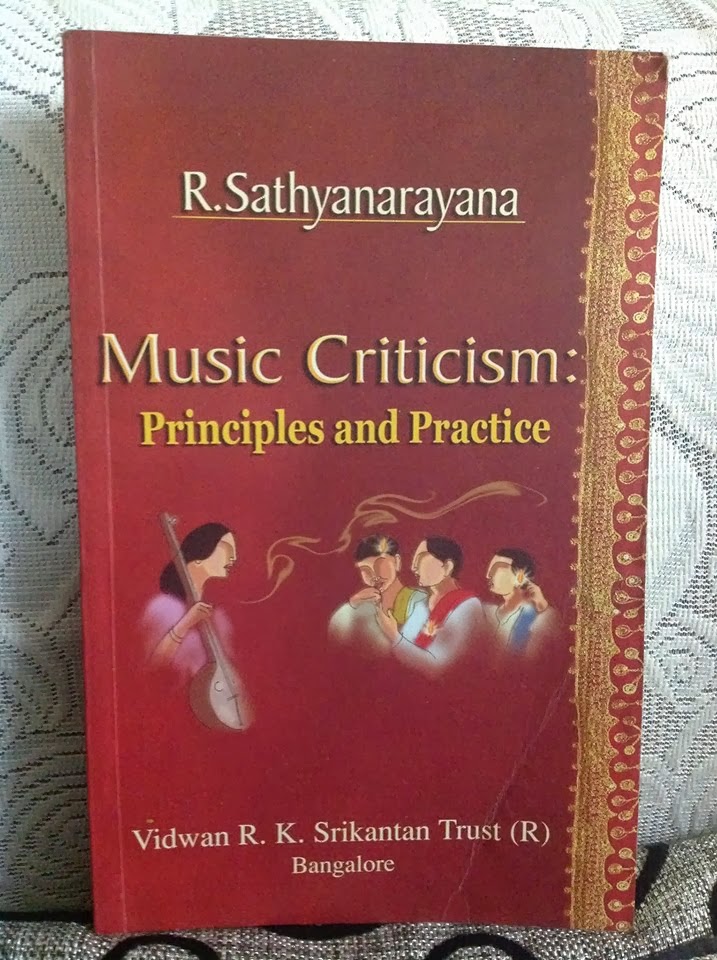
Music Criticism: Principles and Practice - R Satyanarayana

I have been following the south Indian Carnatic classical music for a while. For the past 7-8 years, I am attempting to writer some of my concert experiences in a blog, more as a reference than being a critical review. Because I have no formal training in the music, all that I could do was to cover the superficial aspect of the concert from a 'rasika's point of view, than to do an in depth critical and analytical view of the music that was presented to the public. I had a correspondence with one of the leading artist in Bangalore, around 6 months back, and while discussing on the subject of concert review, he said, this form of  hasn't been explored to the fullest with the current generation of writers and press. We were to discuss this aspect at length, but it hadn't been materialised until now. In the meanwhile, this book was recommended to read.

R Satyanarayana, a leading musicologist with a number of highly acclaimed books and lectures under his name, is also a musician, a Veena exponent. His articles on various aspect of music has been very popular. He has been awarded by the Sangeetha Nataka Academy in 2009 among various other recognition. His scholarly research and publications are largely on the aspect of creativity in music and the interpretation of various schools of music and his study of umpteen manuscripts. However, in this book, he decided to look at the aspect of music criticism for a detailed study.

The book, as the title says, is divided into two parts ( or three with a study of a composition at length). the initial part looks the music criticism in its principles and the key aspects of music criticism. The second part is largely a collection of critical essays on music by some of the stalwarts in the scene, which provide the testimony of the theoretical aspect that was discussed in part one. The second part ends with a critical analysis of a composition ( SrI subrahmaNyAya namastE in kAmbOji by Muddusvami Dikshita').

Art Experience

"The primary concern of the music critic is understanding and explaining, interpreting or commenting upon musical experience".  Experience for a grown up person a complex and multilayered, says Satyanarayana. It is dynamic to multiple factors. It has both conscious and subconscious state or the describable and undescribable content.  The  knowledge or awareness element is derived from sensory sources. These are then structured into definite patterns shaping their awareness. All conscious experiences are referential, its either external or internal. This experience is objective..from 'object to sensory organs, to the mind and to the soul is the progress of the perceptive experience. However, art experience if non-referential. Art experience results form 'contemplation' ( charvana) of the imaginative situation created by the artist.  Artist contribute his power of creative activity. The listener ( connoisseur ) offers his share of imaginative contemplation , sympathetic understanding and feeling which are akin to the artist  ( sa-hrdaya) and reproduces the art product within himself, before sharing his experience with the rest of the world.

Sri Satyanarayana, uses a vast of references from the ancient texts and scriptures and establish the connection of art experience and aesthetic value associated with art. He compares the tradition both in the Indian context and western context. While the western form of aesthetics are largely taken as beauty, the Indians use a much more complex word ' rasa' to describe the same. Aesthetic experience is conditioned by both objective and subjective elements. Moreover, aesthetic elements focusses on the feelings and emotion rather than reasoning and intellection.

The most important responsibility and duty of the art critic is to develop, propagate and sustain good taste in the arts in the members of his society. Taste may be defined as a faculty of mind by which it perceive beauty. While taste can widely differ from person to person, it may be possible to enunciate some fundamental criteria for good taste for the art in general. The ideal of art experience that the artist's practice of the art and the connoisseur's response to it.

Art Criticism
Criticism can be defined as a skill involved in evaluating , reviewing or judging the quality of a literary or artistic work which includes the implicit and explicit interpretation of the meaning and value of such art form.  There fore aesthetics, art philosophy and art criticism together constitutes one single system of thought. A critic can improve the scope and quality of his criticism by exposing himself continuously to the aesthetic experience of his choice.It helps him to develop insight into the nature of the art as well as to the working mind of the artist. A work of art is significant in many ways, it is a reflection of aesthetic ideals, concepts and imaginations of its author, the representation of the cultural milieu of its time and the social demand and aspirations of the society. Art criticism is always contemporary and relevant. Art criticism ( for that matter the art form itself) can not escape from the 'cultivated' versus 'mass' conflict.

History of art and Music criticism in the West and India
Moving on from here, he discusses the aspects of music criticism in the West and in India. The music criticism in the Europe begun with the raise of new world of creative composers, in the 17th century. Germany, once the breeding ground for composers were again lead the way in the musical criticism. Germany produced numerous journals on music in the last quarter of 18th century, which not only published the new compositions of Mozart, Haydn and Beethovan, but also the first criticism on them. In the later centuries, the field of music criticism improved over the years shifting from the romanticism to the aesthetics and creative techniques. This period also produced the "composer - critics" in the field. Composers like Wagner, who wrote critical essays mostly for boosting or defending his own compositions. Tchaikovsky was the music critique for Gazette of Moscow. As is the case today, there were conflicts between the critic versus the artist /composor. For eg comments like' the immoral profession of music criticism should be abolished" ( by Wagner himself) were regular against the critics. Many literary bigwigs of Europe were also noted for their music criticism. Play Wright  George Bernard Shaw produced some excellent , often witty, critical essays on music.. Anatole France and Roman Roland were few other writers who contributed to the music criticism scene. In the US, this was caught up in the second half of the 19th century and for now, they surpass the Europe and other parts of the world as the centre of musicological and historiographical scholarship.

In India, the art criticism can be linked to as early as the time of Bharatamuni. He is the earliest known authority on the model of art criticism. His writing ( naatyashaastra) covered all aspects of the performing art and was the pioneering effort in this aspect. On the subject of music, the first known writing is the 'Sangeetha Ratnakara (AD 1230) of Shaarangadeva, describing the qualities of the composer, the performer and the percussion artists. Various other writings in Sanskrit and other Indian Languages covers various aspects of the music, dance and craft forms over the years.

Musical Forms

Musical form is central to all music activities - composition, performance and experience. The process of musical criticism there for consists of analysis of the musical form and its structure.  Art is created when form emerge out of symbols signifying beauty under trained and rational workman. Indian music by and large are textual , comprising of word ( pada), tone(swara)  and duration (taala). They are lyrical or poetic based compositions. Few forms like mallari, jatiswara and rare cases thillana are without meaningful words ( they use unintelligent syllable for rhythmic pattern).   As a consequence there are very few instrumental compositions in Carnatic music. In the recent past a few instrumental performers are trying to experiment with this aspect, creating compositions suiting their style while adherence to the grammar of the raaga or scale ( the western styled notes popularised by Madurai Mani Iyer, the 'raagapravaaham' seen in the concerts of violin duo Ganesh and Kumaresh are few examples, apart from the mallari usually played by Nagaswaram vidwans).

The music forms of Carnatic music can be summarised into 16 style : geetham, swarajathi, jatiswara ( without saahitya) , varnam, kriti, devarnama, ugabhoga-vachana,padam, javali, pallavi, ashtapadi, daru, tarangam,tillana,raagamalika and shlOka.  In this the kriti, which typically written and performed in 'pallavi', 'anupallavi' and  'charanam' (PAC) format contributes to the majority part of the concert.  From the musical form we move to the presentation form as the artist choose to align and structure his repertoire to be presented to the audience within the stipulated ( stated or assumed) time.

The Music critic

The criticism is the process of translating and grading the aesthetic experience, in line with its impact it created in the critics mind. The musicians task is to create with music and the critics role is to re-create the same experience with words. Critic means to judge, but in the real sense he functions in the role of an interpreter.

He continue to describe the role of a critic and the need to be truthful to the music and not the performer. A music critic faces many a problem as the art form unlike painting, sculpture or architecture are not fixed in time or space.  A music that is delivered ( especially to Indian music) can not be repeated exactly. While we can record and listen the same again, it can not reproduce the same ambience, same state of mind and same cohesion of all that contributed to the experience in the same way. Hence memory plays an important part in the perception and appreciation of the performance.  There for the concept, principle and rules of aesthetics vary for music over other forms of art. There is also this subjective-objective dilemma. While criticism is largely subjective ( based on the aesthetic experience), under the guiding principle, it is important to have a balance of subjective and objective element.

Sri Satyanarayana says ( in detail)  the moral obligation of the critic should be, first and foremost, to the music itself, followed by the listener, the composer and then the performer. He also list down the qualification of a music critic.

  • he should possess a knowledge of technical and theoretical principles of music
  • knowledge of history of music and music scholarship
  • general education coverving as many subjects as possible as cognate with music
  • able to think clearly and write lucidly
  • an insight into the workings of creative imagination
  • have an integrated philosophy of life of his own.
  • an endless curiosity and willingness to learn
  • should know his own limitations and limitations of his profession
  • a mythical superman ( who combines in himself at the same time the qualities of total absorption, yet distance, consonance with musician yet critical acumen)
  • avoid being a cultural broker, a mere translator, or a public relation agent
  • evolve an aesthetical theory of musical experience.
  • should not fall prey to temptations of money, influence and power.
  • insight into the creative states and mood of pre-expressional and expressional phases of the performer
  • more than livelihood, it must be a way of living, a commitment , a dedication
  • sensitive to the artistic values of the medium
  • must have a command of language adequate to express his ideas

The second part of the book looks at the practice of music criticism in India, largely on the carnatic musical arena. Indian Musical criticism developed into the current state largely during the mid 20th century. The newspapers , as can be imagined, lead the way by publishing brave, venturesome critical reviews with little or no encouragement from the public or music fraternity. From the nascent stage of musical reviews , this has now grew multi folds with regular reviews in almost all the leading dailies and few limited musical journals ( shruthi magazine, for example). These reviews included portraits of the musician, critics on music criticism, views of the artist on music critic, reviews of the performance itself ( both live and recorded) and reviews of music books.

The rest of the pages is filled with notable reviews from the established critics in South India ( and a few from West as well, in which the essays of George Bernard Shaw were awesome) - Tamilnadu, Karnataka and Andhra- appeared in various publications.

Critical essays of E Krishna Iyer, N R Bhuvarahan, BRC Iyengar and concert reviews of SVK, Subbudu, Ranee Kumar, S V Seshadri and Interviews of artist and critics 'Gowri Ramnarayanan', of artists T N Seshagopalan ( who was very critical on the critics) , K S Mahadevan a book criticism by Sulochana Pattabhiraman , On a music sabha (  Mysore V Subramanya on Chowdiah Memorial Hall) were few notable inclusion. The section concluded with a brilliant study of the music of Gangubhai Hangal by Sri R Satyanarayana himself.

The last chapter is spent on the critical analysis of a musical composition. While we see lesser study in this aspect, with most of the musicians prefer to perform the well established compositions, I was wondering why wasn't there any serious study done in this aspect of the music criticism. The only critical, usually with admiration and praise, study of the new composers and their compositions are limited to the lecture demonstration by one of the performer, who uses this to sing and introduce the creative aspect ( historical background) of the composition, rather than the creative merits and demerits of the product. Sri Satyanarayana chose a well known composition of Muddusvai Dikshita, in kAmbOji ( Sri Subramanyaya Namaste) to introduce this aspect of critical stud

A first of its kind book, dedicated to musical criticism is treasure for the likes of me. The highly informative and deep understanding of the aspect of art and music in the initial part is not only scholarly, but a very well thought out presentation. The second part is not as dense and elegant, but it provided ( some of them at least) a better understanding of the subject that was discussed in the part one. Despite the abundant use of Sanskrit words ( with English equivalent), inevitable due to the references to the ancient texts,  this was very readable and easy to understand. The structure, the language used, the examples and references were appropriate. A few spelling errors that crept in could have been avoided.

A great reference to creative writers and those writing about arts in general and on carnatic music in particular. I am expected to do a better job with my writing armored with new understanding of this genre of writing.

------------------------------------------
Music Criticism: Principles and Practice (2006 )

R Satyanarayana

Vidwan R K Srikantan Trust

277 Pages
-------------------------------------------
The Hindu,

Friday, October 25, 2013

Snow Country - Yasunari Kawabata

A couple of weeks back, I read one of his later works which did not impress me greatly. I remember the lasting impressions his other books ( Snow Country, Thousand Cranes, House of sleeping beauties) on me when I read them. That was a long long ago, and I started wondering why did that make such a lasting impact on me. One grow as a reader over the years and the tastes get refined and somewhat polished. While this seems to be a progression as a reader, on the negative side it prevents you from the enjoyment and entertainment you derive out of a work of literature.  It was thus, I decided to go back to one of his works again to see if I over rate his works earlier. Now that I read the book again, I am quite happy and relieved ( ! ), and  my previous impression is now reinstated. Not only I loved the second read, but it also gave me a lot more insight to the writer and his style.

Shimamura, a wealthy loner travels back to the west coast of Japan, to the small hot spring town. A small love affair, or his closeness to the geisha brought him back to this place within an year. As he takes the train back to the snow country, to revive himself, from his idle life. His previous acquaintance, Komako is assigned to him again as the geisha to be his companion during his stay. As the familiarity and companionship grew, Shimamura realises his inability to love her. The affair is destined to fail even before it began. He is a wealthy well to do man, and she is a geisha, expected to entertain guest who comes to the inn for a few days. The closure they become by togetherness the wider  was the separation of the mind. From Komako's point the submission was complete, unconditional and possessive.  Shimamura, wasn't committal, but was the one with fatherly tenderness. Over the days of his stay, he was rather attracted with the young protege of Komako, beautiful Yoko, who takes care of the sick man who probably is the fiancee of Komako, a topic she refuse to divulge in. Even here, despite her request to rescue her from this hell and take her to Tokyo, he is not able to decide. In a rather ambiguous ending, which we find in many other stories of Kawabata, this novel also ends in a disaster. Its rather the end of the affair, the end of his ability to stay afloat in his dreamy days( interesting metaphor of milky way is deployed by Kawabata). We are not to know whether Yoko is dead or alive, but we are aware that for Shimamura both Komoko and Yoko are dead as he was pushed aside and was made to stand as a impotent witness to the whole action that takes place.

The book has a strong connect with the local culture and the heritage. Some of which is not very clear to me and I'm not sure if some of the references ( not directly though) are incomprehensible to me ( or a bit lost in translation). The rich imagery, the vivid landscape, the amusing conversations and the rich traditional set up of the inn gives a fantastic background to the story.  His lyrical writing, the short sentences ( a haiku in prose as some critics call it ) of heavily loaded conversations, rich cultural undertone and the control over the language makes this a wonderful wonderful read. The complex relationships with a man at the center and two women fighting it out in subtle maneuvers . Komako is all vocal and noisy around Simamura, who bores him after a while. Yoko on the other hand appears in all beauty and purity, uncorrupted and unpretentious.  Komako is pushed to doing the job of geisha to support many who depends on her - her ailing music teacher, her sick friend. 

Snow country is one of the greatest work of the Japanese Master and a shining example  from Japanese literature. Its relevance , its style , its ambience of rich culture and tradition, its intrinsic strength derived through those beautiful imagery.  Simple and flowing narrative which appears straight forward, hidden inside with such depth of human conditions and social complexities.  The landscape and nature plays a big part in the tale. The plot and story is not very important, but the characterisation the interplay between them and the descriptive passages and the silences that build up the effect in the whole narration. Master piece !

------------------------------------------
Snow Country (1952 )

Yasunari Kawabata ( translated from Japanese by Edward G Siedensticker 1956)

Penguin Classics

188 Pages
-------------------------------------------
 Japanese Literature, Wiki, Blog Critics

Saturday, October 19, 2013

It Rained All Night - Buddhadev Bose

This book caught the attention of the public after the government banned it on its publication for obscenity. The authorities, not only destroyed the printed books, but also managed to remove the manuscript. It was much later, that the high court removed the ban on the book. Now, I did not know all these details upon buying the book. On my attempt to read many post Tagore Bengali writers, his name also figured and this was the first book that I could get my hands on. It is surprising that the book is banned for obscenity, as it does not dwell into any descriptive scenes or writing of pornographic nature that calls for ban for obscenity. I am reading the translation and have no idea of the original in Bengali, to comment on the ban.  However, I can understand the furor it could have created in the 'externally' conservative and prejudiced Indian society. It explores the subject of extra-marital affair, infidelity and questions the fundamental believes of the institution called marriage. 50 years back, an explicit take on these subject, and in a way not condemning but sympathising with those suffocating within the constraints of family life.

It’s over—it happened—there’s nothing more to say. I, Maloti Mukherji, someone’s wife, and someone’s mother—I did it. Did it with Jayanto. Jayanto wanted me, and I him … How did it happen? Easy. In fact I don’t know why it didn’t happen before—I’m surprised at my self-restraint, at Jayanto’s patience.'.. starts the novel.  Maloti and Nayonangshu (Anghshu) are married for over 14 years and are living in a Kolkata apartment with their daughter. Both are now into their thirties and the drift in their married life has culminated at the above sentence.  Anghshu, a man of words, translator, writer and academic ( which he resigned for a better paying job at the advertising  world), married Maloti, who was his student once upon a time. Highly polished man, in thoughts and manners, with friends in the high and intellectual circuit, who frequent his house. Maloti, whose admiration for his intellect , his social status and his attractive physical features ( good looking young man, whom her classmates competed to win over) , found herself disappointed with him as the time progresses. Her needs as a women and wife, the need of mind and the body to be cajoled and caressed, to have her desired addressed and met, found no reciprocation from her husband. As it can be expected, a friend of her husband, who one among the many who frequented their house, was the one who seems to have understood her and her needs. His moderate look, shabby dressing, a social status of not so great value , did not deter her from pursuing the relationship.

Angshu returns home late that night amidst pouring rain, only to find his wife in the bed post her misadventure with her lover. Her dress in disarray , 'saree' inadequately covering her body, her jacket and inner garments thrown around over 'his' bed. Man of wisdom ( or of cowardice) , he strategically move into the bathroom, giving her ample time to recover her modesty and regroup.  The sleepless night that followed, with both husband and wife staring into the void, with rain lashing on the outside,  each trying to find solace in their own reminiscence trying to justify their position. Alternating the narrative voice between the husband and wife, Buddhadev Bose travel through through their minds and their life with such sensitivity and empathy. Each persons point of view is so convincing, as the readers swing from one position to the other sympathising with both husband and wife.

Buddhadev Bose has done a tremendous job in treating this subject with utmost care and capacity. It is easy to get carried away, making it a tear-jerker or a silly writing on sexual infidelity. Instead, he portrayed the sensitive area of husband -wife relationship, the question of marital love and intimacy, the onslaught of desire and passion, the need of body and mind in any married life. These are the subject a conservative society of India refused to discuss for a long time ( Well, not in the early ages, but mostly towards the second half of last millennium ). While the situation is much improved of late, as a society, we are much reserved even today on matters related to such. Millions and millions of silent sufferers continue to live even in the modern days.

It is not the then controversial theme, that is the real attraction in this book. It is the might of his pen, the smooth silky writing of restrained and sensitive portrayal  of two tormented souls. The writing  (translation included) is very balanced on both the sides, never once breach the lines of decency, yet retaining the sensuality as needed. No glorifying of the actions, nor being judgmental. The translation retained most of the fragrances of the Bengali Language.  Fascinating short novel.

------------------------------------------
It Rained All Night (1967 )

Buddhadeva Bose ( translated from Bengali by Clinton B Seely 1973)

Penguin books

138 Pages
-------------------------------------------

Monday, October 14, 2013

What Becomes - A L Kennedy

A L Kennedy's books aren't easy to get into. This is my third book and the result wasn't any different. That does not make it a bad book, on the contrary. Each of these stories are good, some very good. The twelve stories in this collection are something in common. They all follow the plight of individuals ( or couples) fighting their own separation from the other.  Some imminent separation, some on the verge of isolation, some even being together has the hidden bridge of separation. All the characters are young/middle aged couple and picked straight out of the daily life. No stories, none whatsoever, has a pleasant ambiance, the gloom and sadness is the feeling in the air. Thus it makes a depressive read, however effective the narration is.

The first story that bears the title of the book, reflects on a couple unable to recover from the loss of their child. Sitting in an isolated cinema hall, alone, Frank looks at the failing marriage with his wife. In an attempt ( final ?) to win her over he even makes a soup for her before her return from the workplace. The attempt however fails after he cut his finger resulting in blood stains all over the kitchen and the soup. Kennedy plays well with her writing here, trying to portray the failure of the relationship as every thing around them is deteriorating.  "Wasp"s again about the imminent separation, albeit short . Its the day of the morning when he had to say good bye to his wife and two young sons, prior to his travel on business. But there is clear signals of the widening differences between them and the difference is clearly played through the children. "Edinburgh' again is a superb build up of an affair, coming to an sad end.  An affair started at the grocery shop of Peter, took him through the realms of love, only to be disappointed in the end. Here we see a clever writing of Kennedy where she interestingly mix the voice of the mind to the voice of the body. A dual communication technique, one to the outer world and the other to oneself cleverly juxtaposed in the narration, giving it an unknown depth. Another interesting story of the collection is Sympathy. A writing almost flirting with pornography, about an accidental one night relationship in a hotel room. Mostly told in the form of conversations, despite their short lived romance, mostly sexual in nature, separate on a promise of a call and a meeting in near future, with both know is not for real and this rendezvous will end as abruptly as it started.  In 'Saturday Tea Time' a young lady recovering in a 'floating tank' remembers the time of the young days where she had witnessed and was subjected to domestic violence.

Each of these stories carry the same line. They are all melancholic, they are all makes one feel for those living it out.  The voice here plays a big role, beyond the narration. It's beyond the written words, they are layered and have various undercurrents of humor, sadness and heart break in some form or other. She uses words cleverly, there are metaphors in abundance ( the wasp for example), philosophical undertones ( in Edinburgh, especially towards the end), and social observations. The characters of these stories are tied to their destiny and do not show any attempts to shackle out of them, rather they endure them with somewhat inner pleasure of a defeatist.

A L Kennedy is a brilliant writer, fabulous use of the words and clever mix of narrative techniques. These stories, while the overall gloomy ambiance is a bit depressive, do seek in with their sheer brilliance.
 ------------------------------------------
What Becomes (2009 )

A L Kennedy

Vintage books

218 Pages
-------------------------------------------
Guardian, Telegraph, N Y Times, Irish Times, Independent

സ്വധർമ്മം അഥവാ സമ്യക് ജീവിതം - S.Rajendu

It was about 15 years back, when I read an article about 'Shivapuri Baba' in either 'Samakalika Malayalam' or 'Mathruboohmi  ( my memory fails me). Later after my marriage, I was given to understand that 'Sivapuri Baba', is one of our ancestor on my father-in-law's side. Under the new revelation, I did read that article again and the only thing that caught my attention was the mention of his age. It was given that he died ( or ceased his bodily existence) at an age of 136.  His name came up multiple times in discussions and each was only to add to the amaze one had on some one who lived in the Himalayas and lived till the age of 136.  Sri Matampu Kunjukuttan, in one of the evening discussions, did mention the book written by an Englishman, John Bennet, on the life and messages of this saint titled "Long Pilgrimage". I haven't been able to get a copy and read the book, but was following various short writings that appeared in various magazines and news papers. The interest rekindled again, after another relative of mine had been to Kathmandu and visited the 'ashram' of the spiritual guru.

Sivapuri Baba, born as Jayanthan Namboodiri, in a well to do Namboodiri family near Kunnamkulam, Trissur district. Afrer initial days of wandering, he achieved the 'enlightment' at the shores of Narmada, later he too 'sanyas' from Sringeri Mutt  and named himself as 'Govindananda Bharati' as was the custom. It is since then he started his journey, covering 6 continents, largely walking ( except to cross the seas). He seems to have met with the Queeen Victoria at least 18 times and was one of her spiritual advisor. Other dignitaries of his connection include the then US President Theodore Roosevelt, Wilhem Kaiser II of Germany, writer George Bernard Shaw,  and legendary Leo Tolstoy on whose farm Baba spent nearly two months. Inspired by the guru, Tolstoy had written a short story "The Three Questions", the translation of the same is given at the end of this book ( the story can be read here). In the year 1930, he settled in the hills of Nepal, near Kathmandu at the age of 103, lived there until his death at the age of 136.

Rajendu, had not written a biographical or spiritual study of the sage, as most of them are already available with us. The book is a collection of question and answers. Numerous questions on the way of life, the truth and so on, and Baba's answers to them is collated, summarising the messages of the saint through his answers. The rest of the book, alternating with each chapters of 'questions and answers" are the memoirs of various people who acquainted the Guru and had been his disciples since then. This include the Sri Lankan Tarzie Vittachi , Y B Shreshtha's discussion with the merchant Manadasa Kuladhara, who is considered to be the first of his disciples in Nepal, an Australian doctor (Miens?) and Huripman  an American traveller. The experience of each of them are no different from the rest of the people who visit him.

Baba's messages are no different from the other sages. As expected, they are about the way of life, living in the paths of Moksha, finding the way to the lord however long it takes. You will realise once you have found your way and that will take you to the paths of Gods. He says, for a spiritual way of living, one need a body that can withstand the demands of the life, hence it is important to care for the body, the encapsulation of the inner. The oneness  with the Almighty is possible only if you constantly seek the ways of God.  He add, one need a Guru to direct him towards the path. Only a few masters ( Ramakrishna Paramahamsa or Ramana Maharishi to name a few) managed to attain the 'sakshatkaram' without the help of a Guru. For common man, it is essential to have a guru to guide him and correct him in his quest of attaining spiritual sojourn. It is also said, that one a person is ready to receive, the Guru will find him.

This might be the first of its kind book on Shivapuri Baba, where the importance is given to his messages. There is no analytical view or deconstruction of his life and messages. The book is fairly simple and an easy read, though the essence of his message keep repeating pages after pages. One realise that the essence remain same, who ever the sage is and whatever is the form he prefer to deliver. The book has a brilliant preface by Rajendu, which in reality is the only piece of his writing in this book.
------------------------------------------
സ്വധർമ്മം അഥവാ സമ്യക് ജീവിതം (2011 )

S Rajendu

184 Pages
-------------------------------------------
 Times Of India, The Hindu, Shivapuri Baba I, Shivapuri Baba II

Tuesday, October 08, 2013

Beauty and Sadness - Yasunari Kawabata

"Hello."
"This is Oki." He waited. "It's Oki. Oki Toshio."
"Yes. It's been such a long time." She spoke with the soft Kyoto drawl.
He was not sure how to begin, so he went on quickly to avoid embarrassing her, as if he were calling on impulse.
"I came to hear the New Year's Eve bells in Kyoto."
"The bells?"
"Won't you listen to them with me?"
She made no reply, even when he repeated his question. Probably she was too surprised to know what to say.
"Did you come alone?" she asked, after a long pause.
"Yes. Yes, I'm alone."
Again Otoko was silent...


Twenty four years since their last meeting. Oki was 30 then, and Otoko was only 15. A Love affair, went astray, after she conceived and delivered a dead child. He was married then and was living with his wife. They separated, giving a life time of horrible memories to Otoko. The baby she delivered died at child birth, a failed suicide attempt and a few years at the mental asylum. But she survived all and is now stay at Kyoto, as successful painter and artist. Otoko is a successful writer, lives with his wife and son. His most famous book has been the story of his love affair with Otoko, which sold millions of copies, soared his popularity, while drifting Otoko into obscurity, when her character was talked about.

The rendezvous did not go well with every one. Kieko Sakami, young protege of Otoko, her lover , her accomplice, who stays with Otoko, seems to be jealous and does not hide her unhappiness over the new spark triggered in her teacher's life. She did take it to her heart and  promised to take revenge on Oki, for his abandoning of Otoko. In a clever manipulation and various duals (with Oki and later his son) she had her way, managing to lure Oki's son into her trap and bringing him to his death.

Kawabata has a simple way of story telling, stacking various layers of human subtleties. The revenge  itself  is not one sided. One can infer his own versions from which angle he intend to approach.  Kieko is jealous of Otoki's continued love of Oki, Fumiko ( Oki's wife) is jelous on Otoko, Otoko herself is jealous of her protege's ability to get both father and the son under her spell ( Keiko even had stayed with the writer in a hotel room for a night).  Oki's son, despite his intelligence and positive outlook, realising the danger he is getting into, seems to have taken the path that has been paved by the manipulator. The clever twists and turns in the hands of a master story teller is not enough to lift this book to something of a literary achievement..

This is one of the last novels of Kawabata, whose Snow Country and , thousand cranes have been some of my favorite books. However, this short novel did not have the same impact. The book has the signature Kawabata style,lyrical writing, brilliant dialogues and the initial parts of the book was very good. But it soon, degraded to a mediocre revenge story of a possessive lover. A short novel, failed to create the profound impact. While most characters have their own identity, most remain short lived without blooming into one that stand out. The smart craft works, and intelligent writing alone do not lift this into a good piece of literature. At many places, this reminded me of the "Quicksand" of Tanizaki, which again failed to impress me.

 ------------------------------------------
Beauty and Sadness  (1964 )

Yasunari Kawabata ( translated from Japanese by Howard S. Hibbett 1975)

139 Pages
-------------------------------------------
 Wiki

Monday, October 07, 2013

Stoner - John Williams

A novel written in 1965, almost went into obscurity, seems to have resurfaced back into fame almost 50 years since it was written. John Williams, an academic, written only 4 novels of repute, was in my radar for a while after few enthusiastic recommendations from few fellow readers. The new found rage for the book (after the NYRB republication), definitely helped me to buy this one and start reading almost immediately. At the outset a story of an ordinary professor, a common man, whom leave alone his colleagues and students, even his wife considers as a no go. What makes the story of such a man so interesting is the way the book is written.

In the real sense,  this is a simple story of an academic. Someone whom no one remembers, who walked on this earth with no impact whatsoever, to be the leading character of a story. There is nothing interesting in him that makes one want to talk about, in the typical sense of story telling. He is not remembered by his colleagues, nor his students. At best, he was a good teacher, a bit eccentric as we expect the academics to be, nothing more. Amidst these ordinary settings, John Williams tells a story which under the simple narrative, leaves you with profound impact.  The great literary achievement is not in the style or the structure. Williams is not a stylist per se, and has no special narrative techniques that leave you astonished. However, this book slowly grow on you, and leave you with such a lasting impression, refused to go even after the weeks that passed.

Stoner, comes from the family of small time farmers from Mussorie and as the relatives advised, his father put him in college to study agriculture and obtain the degree. The destiny had something else on hand, as he shifted from agricultural degree to literature and completed his education and been selected at the same college to teach the intermediate students. A life of academic that lasted 40 years. Over the years he marry a beautiful young lady, fathered a girl child, continue to teach and managed only to reach the post of an Assistant Professor, due to the internal politics within the department, and silently bade farewell to the University and to his life. Life in general hadn't treated him well. His married life wasn't one that one hoped for, nor was his academic life. He confronted issues both at home and at the workplace, as people always wanted to have an upper hand on him. His reaction to them was of indifference, he did not surrender to the outcome, but behaved as if they had no impact on them. Seldom did he react. He endured them silently with humility spending more and more time with books. A short stint of love-affair, squashed by the intervention of the authorities, was the only aberration in an otherwise, dull life of his. His classes were also similar. As he fumbled a few words , starting discussions awkwardly, slowly getting into the details and immersed himself into the topic, he slowly lived up to the image of an eccentric old professor. The losses were not his. His fight back was not up-front, it is by the consistent resistance that he offered through his indifference. It was only towards the end, did he taken up the fight to the opposite camp, and how cleverly did he manage to keep the rest to his line. Even at the death, he is not been defeated. 

Its deceptively simple, yet it unfolds multiple layers of human conditions, deliberately conceived within the clever narrative. The voice of the narration never deviate from the overall ambience of the character. It is highly melancholic, very depressive. Surprisingly, you are not sad, nor the sympathy that over shadow the other feelings towards Stoner. One witness the triumph of life, despite the pessimistic overture. Stone is not perfect, he has his own limitations, in love, in managing the complex academic network, the prejudices he carry both in the teaching and in life.

When the book was published, in 1965, it did was described as "a masterly portrayal of the life of an ordinary, almost an invisible man". Williams himself is a professor , and his portrayal of a rusty, moronic, non enchanting academic life through his protagonist is deep and realistic. I can still not pin point as to what makes this a brilliant book. I guess the fundamental criteria of literature is to "open the curtain" to the hidden truth of the human life, that wasn't brought out before. It need not be one that 'make its way' to the readers heart with astonishing skills of the writer. It can ease into the minds of the readers and stay there forever, as John Williams has managed to do with this book. 
------------------------------------------
Stoner ( 1965 )

John Williams

Vintage Classics

278 Pages
-------------------------------------------
Wiki, Telegraph, Guardian, Independent, Express, Shigekuni

Sunday, September 29, 2013

A Fort of Nine Towers - Qais Akbar Omar

After many years of Russian rule, when the Mujahedeen came into the heart of the Capital in the year 1992, the people of Kabul rejoiced. There were widespread celebrations around the city. The house hold of young Omar was no different. His father and uncles were visibly happy and were sharing their happiness with the rest of the crowd.  However happiness did not last long. That was just the beginning of the war that damaged the country of Afghanistan for the next few decades. 10 year old Omar, who expected to see the Mujahedeen soldiers "in Uniforms and Shiny Boots", was disappointed to see the warriors with "beards, mustaches and smelly shoes that wrapped up stinky feet". 

The liberation wasn't there to stay long. Soon infighting began among different war lords. The common enemy that united them ( the USSR) is no returned to their homeland. The various war lords, started to fight amongst themselves for the control of the province.  Living in the mansion, built by his grand father, called as'the President' by the neighbors, for he was the second in command of the government financial institution, the extended family of Omar and his cousins and their parents have to seek refuge. The rockets started falling in the gardens, the carpets traded by his father, has been confiscated by the 'warriors' and their life itself was under threat. The team, decided to move out of the central part of the city to the outskirts around the hill, where Omar's fathers business colleague is living in a fort mansion. The story of "A Fort with Nine Towers' thus begin. Next few years, Omar and his family live in this fort, largely protected from the war and the missiles.

Omar, narrates the next few years of his life in the recently published book, which is already creating a rave with the world readers. Unlike, the typical coming of age memoirs, the voice here is not of the young boy, but of the grown up man, who recounts the days with his own interpretation of the grown-up man. There are family stories, the first hand experience of the young boy with the torturers , loss of family members both to the war lords and to the nature, huge sense of support and camaraderie that the people show during the difficult times and his own personal learning during the time of turbulence. There are horrifying details of torture, murder, rape and humiliation either witnessed or suffered by the young boy. The version of the warring factions and tribes and the shear destruction of the civilization by the war.

The most engaging and touching narrative is their journey as nomads from Kabul towards Mazar-e-Sharif. The beauty of the nature on one side, the plight of the family separated from their own people, various difficulties en-route ( the landslide and flood from which they had a narrow escape) , the thieving of Pomegranate ( the guilt the boy carried for a long time), the blind carpet weaver in Mazar, under whom he learnt the trick of carpet making ( which helps him in the days of Taliban later), the time and travel with the nomadic tribes ( to whom his ancestors belong), their stay in the Bamian hills in the caves behind the damaged head of the Buddha and the eventual return to Kabul after a few years, settling back in the Fort were written beautifully.

During all these times, the family was planning to escape the country as many of their countrymen to other parts of the world. There are traffickers who for a large sum of money willing to take them across to Turkey, through one of the central Asian republics. The money to take them out is hidden under the garden in the form of Gold. Every attempt to reach the place and recover, was failed, as they fall into the hands of the occupiers. They planned to escape to Pakistan, which was again failed and they ware caught by another warlord, in whose captivity, the father and son was bitten by one with sharp teeth , called "The Dog".

When everything was ready and they were preparing for their final departure, came a new force in the form of Taliban. Capturing the city of Kabul, the new regime was quick to establish themselves as the rulers and forced their decree on the people. The new dictate of living under Islamic Values, the hard and cruel way of enforcing their discipline on the people, the general fear they created on the people made the life even more difficult to the young Omar. However, he now recollects, that despite all these rules, there was a calm in the country and war was not in sight (“strange peace" says Omar) . The business, which he now set up did flourish, the state machinery was effective.  But yet again, the peace was short lived, as the Allied forces entered Afghanistan in 2001 end post the World Trade Center bombing by suspected Al Queda militants. The world for them has gone back to what it was.

A very matter of fact narration, may not be an eye opener as the snippets of these scenes have come out at in different ways. He has presented the facts from the point of his own experiences and as a story of his family, which is not different from many others. Born in a high-middle class family, he had better provisions, compared to many other who suffered. however, what each Afghan citizen had to endure is the same as the the others irrespective of their social status. The book is non judgmental and he left that part to the readers. In the concluding pages, he warns the readers "“I have long carried this load of griefs in the cage of my heart. Now I have given them to you. I hope you are strong enough to hold them.”

Since it is presented as his memoirs, there is less scope for analysis and for insight to the issues of Afghanistan. I am sure that is the intend of this book as this is not a political study. The strong family ties, the closeness towards ones own at the times of difficulties, the separation and the impact of which in young ones, the slow and definite destruction of the cultural fabric of the country and many similar parallel reading is possible within the narrative. Some of the events are too brutal or good to be true. The reality borders around the exaggeration. They are harsh at times, and so moving at other places. He is able to get the readers along with him in the journey and that is the success of the book.

---------------------------------------------
A Fort of Nine Towers ( 2013 )

Qais Akbar Omar

Picador

396 Pages
----------------------------------------------
Washington Post, New York Times

The Good Soldier Svejk - Jaroslav Hasek

One of the central character of many of the Sanskrit drama is the Vidushak. Usually subordinated and associated with the main hero, the king in most cases, vidushak provided the  social commentary and with his humorous dialogues, creates the much needed criticism of the King's actions which has the direct relevance to the society.  The Vidushak of the drama is the direct replica of the court room Vidushaks, of the Indian Kings. They had the authority and approval of the Noble, to ridicule and criticise the court, including him or judiciary decisions without earning the wrath of the emperor. Often behaved as a clown, with self depreciating humour they were the integral part of the court room, bringing the balance of the rule and the voices of the people.

Jaroslav Hasek's World War I satire to me reminded of this great traditions of Vidushak.  Good Soldier Svejk, stood for what a Vidushak would have done. By making himself as the center of ridicule, by his sense of obedience, his self accepted idiocy, his innocent looking but profound interpretations of the events, his ability to stand up to any negative repercussions in order to prove the triviality of the war and the plight of the people who are recruited as soldiers of the Royal Army as a 'subject' of the His highness who stays in a far off land. Like Svejk, most of the soldiers has no connection with the Lord whom they are fighting for and no enmity with  those they are fighting against.

"And so they've killed our Ferdinand"
"Which Ferdinand, Mrs Muller ?  I know two Ferdinants. One is a messenger at Prusa's the chemist's and once by mistake he drank a bottle of hair oil and the other is Ferdinand  Kokoska, who collect dog manure. Neither of them is any loss".
Originally a dog dealer ( usually stolen dogs), Svejk was recruited into the Austro-Hungarian Army to fight the enemy at the border. Like many Czech peasants he too was assigned to a regiment which was on move to the frontiers. Svejk had previous experience with the army where he served for a short duration, before being discarded for his 'idiocy' and his inability to comprehend. Giving nightmares to his superiors by his idiosyncrasies , yet always being at their side with his clever manipulations to protect them, taking the blame on himself, he spent his time as an orderly whenever he is out of the Gaol. Svejk entertain the readers through his ever ready anecdotes, from his acquaintances and colleagues, filling the pages of this giant book. These anecdotes, seldom has any connection with the main topic in discussion, frustrates his superiors. The exploits continue from one garrison to the next, from one gaol to the other, from one bogie of the train to the next. In the end, he gets arrested as a Russian spy, while attempting to wear the uniform of a Russian Soldier in the frontier line. Interestingly, for every trouble he get himself to , he comes up with his rational which is often difficult to argue against.   

Jaroslav Hasek, himself was a soldier during the WW I. The characterisation of Svejk is developed from his own personal experience of the service in the 91st Infantry Regiment of the Austro-Hungarian Army.. These experiences were published in the journals at various times, and have then been developed into a mega book. However, he did not live to complete the book as it ends abruptly before the real action or war begin. But, what he was expressing to convey is very clear in the pages that are left for us to savour. Hasek's life itself has been of a nomad and anarchic , which reflects in the theme and in Svejk.

"Great times call for great men", says Hasek in his preface. "I am very fond of good soldier Svejk and in relating his adventure during World War and I am convinced that this modest, anonymous hero will win sympathy of all of you"...."and that is enough".

The writing is hilarious and extremely funny and thus its a page turner, despite the mammoth size of the book. The illustrations of Josef Lada ( the original publication was with the illustrations of Lada) adds flavor to the character, and I am likely to remember Svejk as perceived and drawn by Lada. Probably one of the best anti-war novels ever written, inspiring a whole lot of writers ( Joseph Keller of Catch-22 said once that he could not have written Catch-22 if not for this epic novel). Its pretty obvious that this is an untranslatable book, with its local idioms and the use of large mix of languages. The translations of Cecil Parrot, was a great effort to bring out these nuances of the languages.  Brilliant book, and a character permanently etched in my memory.

"Heroes don't exist, only cattle for the slaughter and the butchers in the general staffs. But in the end every body will mutiny and there will be a fine shambles. Long live the army! Goodnight!”

--------------------------------------
The Good Soldier Svejk ( 1923 )

Jaroslav Hasek   ( translated from Czech by Cecil Parrott  in 1973)

Penguin Books

752 Pages
-----------------------------------------
Wiki, Telegraph

Saturday, September 14, 2013

Quicksand - Jun'ichirō Tanizaki

Well, I haven't read Tanizaki before. I know he is considered one of the best Japanese writers in the 20th century. Having decided to read him, I picked up two of his book last time from 'Strand' and started with the shorter one, the other being Makioka sisters. On a general glance around the world of readers, I found out this book was considered a master piece by many and in general the enthusiasm was very high. That set the bar high on expectations and in the end, I must admit, I ended up a bit disappointed. Considering the time it was written( in the late 20s), and the theme that could have shocked the conservative society, this could have significance in the modern Japanese Literature. However, reading this now, 85 years after its original publication, it did not stir any excitement in me.

Sonoko Kakiuchi, 23 yrs old, married to Kotaro, a law practitioner is enrolled in an art school, to continue her love for art and more importantly to escape the boredom at home. The husband and wife leave home together and return back home together in what seems to be a perfect life. However, a malignant rumour that spread across the school, connecting Sonoko to another student Mitsuko, changes the whole scene. The whole thing seems to be the handy work of the School Pricipal, who commented on one of the pictures of Sonoko, that it resembles Mitsuko. It did not take long for the two accused to join, and form into a friendship, somewhat challenging the rumour mongers. The friendship soon changed into mutual attraction and Mitsuko started spending long hours at Sonoko's bedroom, posing nude for her friend for the picture that take eternity to complete. The act of seduction and manipulation begin with a new entrant to the scene in the form of a lover Watanuki. In some clever manipulation, Watanuki get Sonoko to sign a 'blood-pact' of friendship and brother-sister relation complicating the affair after Watanuki starts his black-mail. Getting into it to the affair to bring normalcy, Sonoko's husband Kotoro gets dragged into the "quicksand".  Now the control is in the hand of Mitsuko, who until now cleverly manipulated the events, gets the upper hand over the husband and wife, controlling every movement and event sin their life. In the end, the trio form a suicide pact, killing themselves with poisonous sleeping powder. increasing the dose day after day. In the end, it was Sonoko who survive, narrating the story to the unnamed writer.

A typical story of seduction and betrayal, with more twists and turns with the readers suspicion pointing towards various characters as the manipulator. The protagonist, caught in the labrynth of unholy sexual adventure with another woman, continue to be fooled by those around her. She goes through the typical anger, revenge, seduction, reconciliation routine and end up as the victim of her own stupidity. This is a tale which can give you enough dramatic and thrilling moments and no wonder there had been many adaptation into films.

The writing( and the translation) is very simple and largely told in the first person narrative of Sonoko, as told to the writer. Tanizaki handled the sensuality and seduction with prudently. The air of carnal desire between two women is in the air, which gradually pave way to possessiveness, aggression to cruel manipulation and retribution ( the best way of conclusion) is in the hand of a good writer. Cleverly plotted, one get all that you see in a cheap thriller camouflaged in sensuality and some good prose.  However good the writing is and novel the subject is, it is still far too light and insignificant to merit the accolades I see the book received. I may be missing something, for what the rest of the readers are able to appreciate the book. I will read the Makioka Sisters soon and revisit this book again on a later date. I might, hopefully, change my impression on this book.

--------------------------------------
Quicksand ( 1928-30 )

Jun'ichirō Tanizaki   ( translated from Japanese by Howard Hibbett in 1994)

Vintage international

224 Pages
-----------------------------------------
 Wiki,

Monday, September 09, 2013

An Incurable Romantic - Lakshmi Devnath

As an avid listener of Carnatic classical music, one can not but admire the virtuosity and the talent of some of the doyens of the last generation of musicians. The post independent India and the next 50 years thence, can be considered the golden era of Carnatic music. The art form saw unprecedented growth and popularity on one side, and a consolidation and structural optimisation on the other side, which later formed as the basis for the new generation of artists to expand. Numerous stalwarts, who made a mark in the art form enthralled the audience with their music and intellect both in vocal and instruments in this era. The later generations continue the tradition to lift the music to greater heights, giving the credit to the yesteryear musicians for paving the way. Though, vocal concert  dominate the musical field, and violin being the integral part of the vocal concert providing much needed support, be it in aligning the notes, or by filling up the silences or lifting the overall experience of the concert with apt interludes and meticulous following of the main artist. However, under the vocal concert arena, it always been a supporting instrument, and the violinist were accompanying artist limiting their ability to the main artist of the evening. It remain largely so, even in these times. There are, however, many violin concerts, giving the instrument an independent identity, in recent times, thanks to some of the hard work and "demand" put in by the earlier vidwans, especially Lalgudi, MSG andTNK , the three names that stood out from the rest in the fields. Having listened to numerous recordings of their accompanying the yesteryear stalwart, one always remained in awe of their virtuosity and their dedication. However, I always had a bias towards the accompaniment of Sri Lalgudi Jayaraman. It is this admiration of the artist, that prompted me to buy the book on the life and music of Lalgudi Jayaraman. Having read through the book, the respect has not diminished a bit, but have only increased. I haven't had the luck of listening to him accompanying any vocalist, and had only a couple of instance of listening to his violin concert live. But Lalgudi, always remain high in my musical listening experience.

Laksmi Devnath's book, does justice to the man in discussion. Written on the suggestion and request by the family members of the musician, she seems to have done adequate research on her 'subject' and the awe and admiration which one carry while talking about someone of his stature, is evident in the book. As in a typical biographical book, it starts with his forefathers and the lineage both musical ( from Thyagaraja ) and parental.  From Lalgudi Rama Iyer, great grandfather and a direct disciple of Thyagaraja to Valadi Radhakrishna Iyer ( one of the first in the field of Violin accompaniment in Carnatic Music ) to his father Lalgudi Gopala Iyer the direct connection to the trinity of Carnatic music is established. Lakshmi Devnath spends enough pages on these individuals and on the musical lineage who directly and indirectly shaped the musician in order to set the base to person and musician in Lalgudi jayaraman. Under the strict ( as one expect in the old Gurukula style of teaching) guidance and tutelage of his father and guru Pallavi Gopala Iyer, Jayaraman's learning was fast and meticulous. There was no place for silly games or other entertainment in the pursuit of perfection. Gopala Iyer continue to "fine tune" the music of his son, even after he has made a name for himself as one of the bright future in the carnatic music field.

Jayaraman, now started knowing under the prefix Lalgudi, had his god fatherly support from the Superstar of Carnatic Music, non other than GNB. GNB was partly responsible for his growth into a complete musician at a very young age. He had the privilege of accompanying most of the leading singers of the era, only to receive supporting gesture as well as the admiration of the public. A new star in the arena of carnatic music is arrived.  Lakshmi Devnath, spends a lot of time on specific incidents and anecdotes to support her findings before she moved on to the personal side of the musician. His wedding, the relation between the father and son ( Gopala Iyer continue to be the guiding force in his life) and his relations with his siblings ( as a guru as well as the musical pair on stage) were discussed in detail.

As one expect in any biography, it did touch upon the many controversies around Lalgudi. The famous "Sangitha Kalanidhi" episode, the somewhat strained relationship with Semmangudi Srinivasa Iyer, the tussle with the music critic Subbudu various allegation about him overshadowing the main vocalist ( in his quest to perfection) , many many so called misunderstanding among musicians, the cold relation with Music Academy were discussed in detail, mostly in line with what is already known to the music world. Interestingly, there was no official version from Lalgudi in any of these topics.

While the book does a great job of consolidating and documenting what is already available, in did not in real terms give any larger perspective of  the musician. However, the study of his compositions, his various works as music director and composer for dace drama and musicals, the compositions specially tuned and written on the request by dancers are the exception. This to me is the meaty part of the book and that made my day. The writing in general was aimed at a music lover and those familiar with Carnatic music. There is abundant use of Tamil words , which often distract the smooth flow of the reading. Being a non-Tamilian, the early chapters were very annoying at times.  She does provide the meaning of these terms both musical and Tamil in the annexure, but at many places, these Tamil words did have proper substitutes.

Biographies are very tricky genre of writing. Its like peeping into someone else life, the private personality of a public figure. It is expected to give a new insight to the person, thus enhancing your own perspective of the world. In most of the cases, one see the writer is overpowered by the persona, intimidated by the charisma of the' subject', the voice and words gets carried away under this influence, hampering the objective approach to the life of the person. This book too suffer from the same. Patrick French's biography of V S Naipaul, was an exception.

Very well presented book, help you to reiterate your admiration of one of the most versatile artist,composer, guru and performer of Carnatic Music. The added bonus was the CD of his select recordings.
--------------------------------------
An Incurable romantic - The Musical Journey of Lalgudi Jayaraman ( 2013 )

Lakshmi Devnath

Harper Collins

435 Pages
-----------------------------------------
Indian Express , Lalgudi Official Page

Sunday, September 08, 2013

This Blinding Absence of Light - Tahar Ben Jelloun

A group of soldiers were put on a truck and was driven to the palace of the King Hassan II, on the 10th of July 1971 on an attempt to topple the King and seize power. However, the coup failed , leaving around 200 death that included the rebel leaders, but the King survived. Forces loyal to the King, gathered those responsible for the coup and put them to Kentira, where they were subjected to torture. The leaders ( and many others) were executed, and remaining soldiers were sent to a secret prison, hidden underground in the desert, which was called Tazmamart. It took a long time for the world to know about the existence of this hellhole and many more years for the remaining prisoners to be released, but not before the traces of the prison was erased by the authorities. Those survived, opened up to the world ( western world) and the stories of one of the most dreaded prisons are thus known to the rest of the world.

Tahar Ben Jelloun, uses this page from Moroccan history to rebuild the story of human condition at Tazmamart, through this intense and powerful novel  ( loosely based on Aziz Binebine , who was sentenced 20 yrs after participating in the attempted coup). Blindfolded from Kentira, Salim and his friends ( 58 of them in various jails and 20 of them in his prison) were taken to the Tazmamart. In an underground cell, with no light and a small hole to get the air and another for food, they were put in isolated cells of 10ft x 5ft x 5ft. A height of 5ft to prevent the prisoner from standing up.

In a cell, in darkness, where one can not even stand straight, in the company of cockroaches and scorpions, fed just enough to keep them alive, with only possible way to communicate was through the brick walls. The prisoners, resigned to fate, with deranged spirit and bruised body. Though not religious when they were brought in  most of the prisoners turns to faith , calling Allah for help and reciting from Qu'ran, to pass their days through. The only time the prisoners are shown light is when they were asked to dig the grave for one of their fellow prisoner who died. As one after the other perishes within the walls of their solitary cells, the rest have to make the place their home with the hope of freedom. The world do not know about their whereabout as the secret underground prison is away from the eyes of the rest of the world. One after other perish as the years go by  one to gangrene, another to scorpions, to cholera, by refusing to eat and thereby deciding to end it all or by just giving up the hope,  Salim has to keep the rest of them alive. Its his stories, the poems of Moroccan writers and  Karim maintains a clock within himself, Ustad sings verses from Qu'ran, and another the anecdotes from the movies he watched and they play imaginary card games.  It's their collective survival tactic against the omnipresent death.The occasional visitors, the birds, whose language Salim, decoded and started having meaningful conversations, the slimy cockroaches, the rare moments of openness from the guard ( only to help those who are suffering, or to confirm the death of a colleague who stopped responding to the calls and not giving any signals of life).

Very gloomy, very despairing story of hope and survival, yet never loosing the narrative control to make it a melodrama. Tahar Ben Jelloun at no point attempt to glorify the sufferings, nor trying to make a judgement over the affair. The words and sentences are used carefully, which are often poetic. Which is why, despite being a story of such nature, the pages fly smoothly, and the reader never suffers from the premise that the novel is set in. Despite the possible 'triumph of the human spirit against adversity' kind of tab, the writer check the overflow of emotions cleverly.

Herta Muller's Russian Labour Camp story 'Hunger Angel' is still fresh in mind and I generally thought that was a good piece of writing about the times in a labour camp and detention centers. There was comparisons of the same to "One Day in the Life of...". However, this 'prison story' by Tahar Bel Jelloun, stands tall amongst the rest, if not a notch higher. Beautifully composed, yet extremely powerful tale of survival from one of the worst detention cells in the history of human kind.
--------------------------------------
This Blinding Absence of Light  ( 2001 )

Tahar Ben Jelloun ( translated from French by Linda Coverdale 2002 )

Penguin Books

195 Pages
-----------------------------------------
Guardian, Wiki