Showing posts with label English. Show all posts

Wednesday, January 29, 2014

The View from Castle Rock - Alice Munro

Typically, I read the newly crowned Nobel Laureate, during November or December, if they aren't in my familiarity zone. I did not have to do that for a Saramago or a Llosa or Mo Yan as they weren't new to me when they were chosen for the award. But as for the current laureate,  I haven't read any book of Alice Munro, barring a couple of stories published in New Yorker. For various reasons, the customary reading (of Nobel Winner) has split into the new year, and on a collective suggestion and a group reading choice,  The View from the Castle Rock, was decided.

Being the first writer  known only for writing  'short stories', to be a Nobel Laureate, it did attract a higher attention and expectation. The inside Cover specifically mentioned it as 'stories'. The book, however, is a progressive narrative of her own family, spanning over three centuries and two continents. As they say, one can always look at sources closed to us for inspiration, hence the vast number of 'autobiographical' or 'semi-autobiographical' writing in literature field . Alice Munro does exactly that, looking back at her family's history , from her great great grandfather to her step mother in a captivating, touching collection of stories.  The book read like a novel to me, than a collection of short stories. A seamless narrative , chronologically progressed, albeit not in continuous sequences, leaving gaps in the story, space and time. 

From the small Islands of Scotland, Alice starts her tales, of survival, of migration to greener pastures, intricacies of family connections and incidents and anecdotes. Set in two parts, part one,  the family's journey from Ettrick Valley in Scotland to North America, and part two in the new lands and the later generations of her family. I personally liked the initial parts The back yard search for the clues and stories about the ancestors, few prolific ones, and the threading of these various anecdotes into a seamlessly woven story form was marvelous. I am not as enthused in the later part ( especially towards the end) , where the narration tends to be a bit disjointed. A bit of triviality takes over. The later part has a lot more personal experiences and more autobiographical in nature. The first part is more adventurous, the quest for hints and connecting dots, bringing few interesting characters of the Islands. The plan and the dream of the new land, the metaphorical "View from the Castle Rock" to the new world.

This is one of my first reading of Munro and I was talking about this being a progressive stories as in novel vis-a-vis a collection of short stories. I argued that a random reading of one of the stories in the middle, probably will have a lesser impact, as against reading these stories as a collective. I was told that she tends to play along these lines and the narration often breaches the boundaries of the novel and short story.  Characters , places and events apparently pops up repeatedly in the other collections as well.

I would look at the two parts separately. Part one, largely based on the snippets of information she gathered during her visits and from various mentions in the old documents. She stich together a compelling story, enriched with beautiful imagery, characterisation ( build up from the data available) and fixing the missing links. This part which has more fictional element is fabulous, and a creation of a worthy hand. The second part, largely autobiographical and contemplative has lesser amount of fictional element, but more of internalisation of her own life and observations. The energy of her ancestors is derived into the later part, but these two remain different and in contrast in many aspects.

The terrain and the place has a large part of participation in her stories. These stories are all of limited scale and scope. Largely around relationships, confined within the family or short extensions in a few cases. There is a sense of intimacy, a closeness, a dependency of mutual existence. The gradual demo graphical and geographical changes in the landscape , minute observations of the changes in the living conditions et all are carefully handled through the stories.  Beautiful passages, meditative, emotionally deep story telling and fabulous control over language makes this a great read.
-------------------------------------
The View from Castle Rock ( 2006 )

Alice Munro

Vintage Books

349  Pages
--------------------------------------
Wiki, Guardian, NY Times, Quill & Quire

Tuesday, January 28, 2014

A Case of Exploding Mangoes - Mohammed Hanif

Dictator novels, as a genre begun probably with Asturias, 'The President'. It is, however, came into prominence as a genre in the late sixties and early seventies with the a flurry of novels ( 10 novels written by 10 prominent writers ) from some of the leading writers in the Latin America. The political systems and the vibrant literature scene gave us some of the best novels of the 20th century. Garica Marquez's Autumn of the Patriarch, Alejo Carpenter's Reasons of the State, Roa Bastos' 'I the Supreme' were some of the highlights of this series. Mario Vargas Llosa's "Feast of the Goat' published late in the 2000, was one of the last of the series belonging to the Dictator fiction group. Most of the Latin America, by then was returning to democracy. 90s and the new millennium saw a similar influx of such novels from Africa ( Snakepit from Moses Isegawa for example) and a few from Europe ( Inquisitor's manual of Antonio Lobo Antunes, few of the works from Saramago, Kadare) came during the same time. Asia, by far was lagging here, not because of the lack of dictatorship in these part of the world, but most of the writers were limited themselves to writing anti-establishment novels , but not something that can be classified as a 'dictator novel'.  Mohammed Hanif's fictionals attempt on the death of General Zia Ul-Huq of Pakistan, to me, is one that can considered to be one that can be kept along with the earlier mentioned books.

Gen Zia, the military ruler of Pakistan for over 11 years after a coup that dethroned a democratically elected regime of Zulfikar Ali Bhutto, was killed in an air crash on the 17th of August 1988. The flight carrying him and 11 of his top brass of military leaders along with the US Ambassador, disappeared from the control radar soon after take off from Bahawalpur in Punjab after his inspection of a tank parade. There are various conspiracy theories that went around for a while, but none were clearly established. The case is closed with no clear evidence, apart from few murmur in the local circuit.

Mohammed Hanif, rebuilding the days preceding the events with his own version. Building through the eyes of the narrator, Ali Shigri,  a junior officer in the Pakistani Airforce Academy, he cleverly threads the story around the hidden fortress of the country's dreaded president, military and intelligent nexus and their internal struggle for supremacy. Ali Shigri's father, an erstwhile colonel with the Pakistan Army, involved in leading the country's engagements in the Afghan War, where his country and the CIA supporting the Mujahideens of Afghan, managed to send the Soviets packing. However, he was found hanging from the ceiling fan, on one morning, a case which was concluded as suicide, left Ali convinced that this has involvement of some of the high authorities in the regime. Seeking his revenge for his fathers death Ali, joining the Air force Academy, training under an American Instructor.

Hanif Mohammed, try to explore the possible angles to the conspiracy theories, by expanding various simultaneous threads, culminating on the final event, with no possible conclusions. His attempt is not to establish the truth behind the conspiracy theory, but to take the readers through the journey of possibilities, and the inner life and political power struggles within the regime. The brutal force of the Military and the Intelligentia, the looming threat on the leader, the secret and definite plots to eliminate potential threats within the regime, the constant distrust among the top leaders, the larger global interest and manipulations by the World Power, the isolation of the rulers and the ruled, the vast gulf between the make belief and the real issues at the ground level ( Gen Zia, experience one by himself while attempting a disguise , but not before the alert spy network tracked him and put him back at ease) and  the idiosyncrasies of the leader himself are something that get the readers hooked to this book.

Most of the description and narrative conforms to the general believes, of any regime. Torture chambers, inhuman treatment, the propagandists, putting up the show of solidarity and national interest in front of the leader and the visiting dignitaries, the cruel business interests of the corporates, the general distrust , the portrayal of the leader as someone with his own ridiculous habits and mannerisms, the peep into his domestic life ( an object of terror to the nation turns to be a voiceless, powerless husband) and many similar scenes that one is familiar with such books do appear aplenty.  Running in two parallel threads, one focusing on the General and his paranoia about his safety ( Code Red protection) and his constant fear of the attempt on his life and the episode focussing on the narrator Ali Shigri, his capture, interrogation, torture, solitary confinement and subsequent release, thanks to a change of handle of ISI by a clever move by the General Zia ( in an attempt to remove the power of one of his potential conspirator).  The section on General Zia in general was funny, often ridiculous, caricaturing him as close to a clown in some places. However, the other thread was more profound and with a lot more intensity.

I seems to have liked the book, probably because my initial expectation was very low. The book is partly political satire, and partly a murder mystery and on conspiracy theory. The subject is a bit tricky as he has to introduce fictional characters to the real life people. It has to ride the fictional path, but abiding to the real life events and characters. The risk of drawing parallels of the fictional characters to the real life characters ( the ISI chief Kiyani in the book, is probably one such, but in the novel he joins the ill-fated team in their last journey) always a possibility. The writing is brisk and precise. The pacing is a bit uneven, probably because of the dual threads that run parallelly.  Impressive read.

-------------------------------------
A Case of Exploding Mangoes  ( 2008)

Mohammed Hanif

Random House

377  Pages
--------------------------------------
Wiki, NY Times, The Guardian

Saturday, December 28, 2013

A Sport and a Pastime - James Salter

Thirty four  year old American Photographer, the  nameless narrator, staying in a small town Autun in the interior France, in a borrowed house of his friends, a couple staying in more urbane Paris surroundings in the early sixties. The quest to experience the real France as his stated motive behind this action. It is here he acquaint a young American Philip Dean, a Yale University dropout, wandering the French towns and villages. A young 18 year old French Beauty, Anne-Marie in his company. Inspired by love affair, he recollect their love life, through the words of Dean, the girl, his observations and his imaginations. The lusty, sensual bilingual affair of intimate love, with abundance of sexual exploits boasted by the young man as he and his girlfriend drive to and stay at various towns and villages of France. The affair, destined to end with the departure of the young boy back to the US, live through these upheaval move from strength to strength as the narration progresses,.

While it looks like a vigorous sexual encounters of two young adults, by a voyeuristic narrator, one has to shift the focus from Philip Dean and Ann-Marie, to the narrator himself. A man of self doubt, and a failure with the opposite sex, His act of narration of someone else' sexual life is coming out of his own inability. He does not hide that fact ;"I am not telling the truth about Dean, I am inventing him. I am creating him out of my own inadequacies, you must always remember that".  Thus, his imagination of his incapability become the output of his narration. Thus he focuses his efforts on creating those aspects of his life, through the invented characters of his story. One, to overcome his impotency and the other, the need of experiencing the rural France both being fulfilled through his heard, learnt, exaggerated, fabricated, modified, imagined story. And when he does that, he does it with the precision of his photographic profession, with details to the minutest aspects. It is like entering a world that is created by the young lovers, opened it to us by the narrator, and reader immersed in this world with the narrator.

Books of erotic in nature or those with explicit scenes of sex gets me bored with it in a short time. The language is usually sick and the use of common terms and repetition makes the reading more laborious than entertaining. I haven't seen many of the mainstream writers, in the literary side, doing a decent job at this, often bordering around ridiculous pornographic writings. James Salter, managed this part pretty well, with not many moments of wrinkling the brows in disgust. Even the most graphical scenes were written with elegant restrain most of the times ( there are a few exception to this where I found the writing is cheap and pedestrian). Barring this, the writing has been of very high standard. The poise, the detailing of aspects, the inventive creativity of the narrator, the appropriate pacing of chapters, and the bi-lingual and multi cultural environment among the rest were brilliant.

In the introduction Reynolds Price, brings our attention to the days of publication of D H Lawrence's 'Lady Chatterley's Lover' by Grove's press in the US and the controversy it created. This book, probably would have been as scandalous as the previous one for its openness. The impact after 45 years of it original publication may not be as big, and do feel a bit dated for today's sensibilities. Also, this by no means a major literary achievement and I probably may not go back to this book ever. James Salter's name was in discussion for a while and this was the first I could manage to get. Probably there are better books that I should look for as I can see he is a prolific writer of style.

 ------------------------------------------
A Sport and a Pastime ( 1967)

James Salter

 Farrar,Straus & Giruox

186 Pages
-------------------------------------------
Interview with James SalterParis Review, Swans Commentary, NY Times, Wiki

Monday, December 23, 2013

The New York Trilogy - Paul Auster

If you have to read Paul Aster, read his New York Trilogy, was the advise I received from many friends, and here I am. Probably I should have been elated of getting into the writing of another fabulous writer, but not entirely so. I am some what cold shouldered at the end of reading, not because the book wasn't good. The writing and styling is very good, the structure and the story telling is also decent. I did like the last of the stories very well. However, something was missing for me. I know I shouldn't read it like any investigative thriller, nor as a mystery fiction as in the typical genre books. There as literary references, and probably styling around the previous generation of writers. There is also a clever ploy of bringing in a character called Paul Aster, the detective and not the writer narrator, as a character in one of the story. This also leaves a very noir-film like experience in the end.

The first one, where a detective novel writer, intrigued by a misplaced call ( wrong number dialled for Paul Aster the private detective) , trapped into a never ending chain of events taking him into the brink of madness. There is a lot of character interplay. Daniel Quinn, imposter as Paul Aster the detective, who in his earlier life ( a poet of par excellence, quit serious writing after the death of his wife and son), takes up the role of the detective, observing the movements of Peter Stillmann the senior, on behalf of the fiancee of Peter Stilmann the junior. In the turn of the events, he meet Paul Aster the writer, not the detective as the caller on the phone mentioned.

Ghost, the second story is again on a 'private eye' Blue, working for Brown, asked to investigate a man called Black , for their client White (and the place/ street is Orange, a gimmick very confusing at the start and boring as it progresses ). Writing his report periodically for Brown for which White is expected to pay.  As in the case of the previous tale, the line of sensibility is lost and the frustration and monotonous profile of the job is enough for him to loose his restrain and make him confront Black, his target.

The Locked room, ( reference to the old styled 'locked room mystery'), is about a writer, work on the creative out put of his friend, who went missing. He not only publishes the works of his friend, but replaces him in the family, falling in love with his wife and moving in with her. The situation turns bad after he was entrusted to write the biography of his friend, now a literary sensation after the publication of his works. Confronted with the reality of his ineffectiveness as a writer, the uneasiness of the reference of his name with the wife adds to the difficulties. The potential threat of the return, the anonymous letters, the eventual rendezvous ( not in the real sense), adds to the final twist of the tale.

I am probably missing some thing here. There must be some connect , however subtle, between these stories. Also, there must be some thing about the New York as a city in the settings. This is not a typical detective story, but mostly on observation of the observer; the pursuer and not the pursued. In all of these stories, the protagonist, some what trapped in his own choices and circumstances, unable to shackle free, making decisions of of helplessness and frustration, taking them to a level of mental break down. It is also looks at  writing and writing process, as every one of the stories are about writing as well. I am not sure if this has anything to do with the post modernist writing ( probably its too old already) with its deep condescending of outwardly trivial plots and subjects. Also, we can see a lot of playfulness of Aster as a writer, with the complex structural exposition, the jumbling up of names, the tricky use of color as name. One can understand the playful mood of the writer with all these intricacies which can leave him with high creative satisfaction, and how much of it is parted to the reader, is probably a different story. Having said that,  I will , in all possibility, go back to the book again and see if I can spot any missing points.

------------------------------------------
The New York Trilogy (1985/86/87)

Paul Aster

Faber & Faber  

314 Pages
-------------------------------------------
Polaris, Bluecricket.com, Wiki

Monday, October 14, 2013

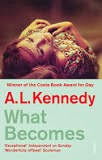
What Becomes - A L Kennedy

A L Kennedy's books aren't easy to get into. This is my third book and the result wasn't any different. That does not make it a bad book, on the contrary. Each of these stories are good, some very good. The twelve stories in this collection are something in common. They all follow the plight of individuals ( or couples) fighting their own separation from the other.  Some imminent separation, some on the verge of isolation, some even being together has the hidden bridge of separation. All the characters are young/middle aged couple and picked straight out of the daily life. No stories, none whatsoever, has a pleasant ambiance, the gloom and sadness is the feeling in the air. Thus it makes a depressive read, however effective the narration is.

The first story that bears the title of the book, reflects on a couple unable to recover from the loss of their child. Sitting in an isolated cinema hall, alone, Frank looks at the failing marriage with his wife. In an attempt ( final ?) to win her over he even makes a soup for her before her return from the workplace. The attempt however fails after he cut his finger resulting in blood stains all over the kitchen and the soup. Kennedy plays well with her writing here, trying to portray the failure of the relationship as every thing around them is deteriorating.  "Wasp"s again about the imminent separation, albeit short . Its the day of the morning when he had to say good bye to his wife and two young sons, prior to his travel on business. But there is clear signals of the widening differences between them and the difference is clearly played through the children. "Edinburgh' again is a superb build up of an affair, coming to an sad end.  An affair started at the grocery shop of Peter, took him through the realms of love, only to be disappointed in the end. Here we see a clever writing of Kennedy where she interestingly mix the voice of the mind to the voice of the body. A dual communication technique, one to the outer world and the other to oneself cleverly juxtaposed in the narration, giving it an unknown depth. Another interesting story of the collection is Sympathy. A writing almost flirting with pornography, about an accidental one night relationship in a hotel room. Mostly told in the form of conversations, despite their short lived romance, mostly sexual in nature, separate on a promise of a call and a meeting in near future, with both know is not for real and this rendezvous will end as abruptly as it started.  In 'Saturday Tea Time' a young lady recovering in a 'floating tank' remembers the time of the young days where she had witnessed and was subjected to domestic violence.

Each of these stories carry the same line. They are all melancholic, they are all makes one feel for those living it out.  The voice here plays a big role, beyond the narration. It's beyond the written words, they are layered and have various undercurrents of humor, sadness and heart break in some form or other. She uses words cleverly, there are metaphors in abundance ( the wasp for example), philosophical undertones ( in Edinburgh, especially towards the end), and social observations. The characters of these stories are tied to their destiny and do not show any attempts to shackle out of them, rather they endure them with somewhat inner pleasure of a defeatist.

A L Kennedy is a brilliant writer, fabulous use of the words and clever mix of narrative techniques. These stories, while the overall gloomy ambiance is a bit depressive, do seek in with their sheer brilliance.
 ------------------------------------------
What Becomes (2009 )

A L Kennedy

Vintage books

218 Pages
-------------------------------------------
Guardian, Telegraph, N Y Times, Irish Times, Independent

Monday, October 07, 2013

Stoner - John Williams

A novel written in 1965, almost went into obscurity, seems to have resurfaced back into fame almost 50 years since it was written. John Williams, an academic, written only 4 novels of repute, was in my radar for a while after few enthusiastic recommendations from few fellow readers. The new found rage for the book (after the NYRB republication), definitely helped me to buy this one and start reading almost immediately. At the outset a story of an ordinary professor, a common man, whom leave alone his colleagues and students, even his wife considers as a no go. What makes the story of such a man so interesting is the way the book is written.

In the real sense,  this is a simple story of an academic. Someone whom no one remembers, who walked on this earth with no impact whatsoever, to be the leading character of a story. There is nothing interesting in him that makes one want to talk about, in the typical sense of story telling. He is not remembered by his colleagues, nor his students. At best, he was a good teacher, a bit eccentric as we expect the academics to be, nothing more. Amidst these ordinary settings, John Williams tells a story which under the simple narrative, leaves you with profound impact.  The great literary achievement is not in the style or the structure. Williams is not a stylist per se, and has no special narrative techniques that leave you astonished. However, this book slowly grow on you, and leave you with such a lasting impression, refused to go even after the weeks that passed.

Stoner, comes from the family of small time farmers from Mussorie and as the relatives advised, his father put him in college to study agriculture and obtain the degree. The destiny had something else on hand, as he shifted from agricultural degree to literature and completed his education and been selected at the same college to teach the intermediate students. A life of academic that lasted 40 years. Over the years he marry a beautiful young lady, fathered a girl child, continue to teach and managed only to reach the post of an Assistant Professor, due to the internal politics within the department, and silently bade farewell to the University and to his life. Life in general hadn't treated him well. His married life wasn't one that one hoped for, nor was his academic life. He confronted issues both at home and at the workplace, as people always wanted to have an upper hand on him. His reaction to them was of indifference, he did not surrender to the outcome, but behaved as if they had no impact on them. Seldom did he react. He endured them silently with humility spending more and more time with books. A short stint of love-affair, squashed by the intervention of the authorities, was the only aberration in an otherwise, dull life of his. His classes were also similar. As he fumbled a few words , starting discussions awkwardly, slowly getting into the details and immersed himself into the topic, he slowly lived up to the image of an eccentric old professor. The losses were not his. His fight back was not up-front, it is by the consistent resistance that he offered through his indifference. It was only towards the end, did he taken up the fight to the opposite camp, and how cleverly did he manage to keep the rest to his line. Even at the death, he is not been defeated. 

Its deceptively simple, yet it unfolds multiple layers of human conditions, deliberately conceived within the clever narrative. The voice of the narration never deviate from the overall ambience of the character. It is highly melancholic, very depressive. Surprisingly, you are not sad, nor the sympathy that over shadow the other feelings towards Stoner. One witness the triumph of life, despite the pessimistic overture. Stone is not perfect, he has his own limitations, in love, in managing the complex academic network, the prejudices he carry both in the teaching and in life.

When the book was published, in 1965, it did was described as "a masterly portrayal of the life of an ordinary, almost an invisible man". Williams himself is a professor , and his portrayal of a rusty, moronic, non enchanting academic life through his protagonist is deep and realistic. I can still not pin point as to what makes this a brilliant book. I guess the fundamental criteria of literature is to "open the curtain" to the hidden truth of the human life, that wasn't brought out before. It need not be one that 'make its way' to the readers heart with astonishing skills of the writer. It can ease into the minds of the readers and stay there forever, as John Williams has managed to do with this book. 
------------------------------------------
Stoner ( 1965 )

John Williams

Vintage Classics

278 Pages
-------------------------------------------
Wiki, Telegraph, Guardian, Independent, Express, Shigekuni

Sunday, July 28, 2013

Waiting for the Barbarians - J M Coetzee

Every occupation has few common traits. It does not matter whether it's man versus nature, or man versus man. Once you set foot in a new land, its the struggle over the resources with the rest. The concept of co-existence is not known to us. We need complete control over the territory and all that it an bring us. Once you are in, then you set about conquering more and more, by encroaching into what belongs to the others. Every occupation, since the beginning of the world, or from when we have the documentary evidence, is followed the same pattern. The inhabitants of the land is driven away, by force ( most of the times) or by crooked action of cheating them. The indigenous population, not familiar with  the ways of the visitors, with their life style in perfect harmony with the universe, is now subjected to the new ways of the foreigner.  Every act of rebel, is quashed with force, by means of humiliation, torture and killing. The action is justified under various pretexts. Religion and God ( those who does not follow my God is a Pagan and uncultured),  education and culture or the approval of the authority ( empire). Even after many centuries, these fears continue to torment man-kind across the universe.

Waiting for the Barbarians, brings this fear into light. In an unnamed colony, the new occupants spread their holdings by expanding their territory by driving away the 'barbarians'. The imminent threat on the population of this border town, from the attack of barbarians continue to be the point of discussion. On the directive of the Empire, new forces are deployed to hunt and bring them to 'justice'. The expedition, mostly unsuccessful, manages to bring a few 'fugitives' as a catch. They are subjected to all those inhuman torture and abuse, and put in jail, until they perish.

On this small frontier town, the Magistrate, had been running the state of affairs for decades now, under the constant threat of war between the Official forces and the Barbarians. However, with the arrival of new sets of specialist officers for interrogation, His sympathy takes a turn towards those who were at the receiving end. His rescue of a violated girl, blinded by the interrogators, rejected and left for survival by her comrades, forced to live by begging in the street gets him on the wrong books of the Empire. The relation, kindled hidden desires in the old man, only to be satisfied with the local prostitute, gets into a strange affair of love ( very physical but not sexual) . Later,  under his authority and his ability, he decides to take her back to her people, travelling into their territories, meeting their leader and leaving the girl to her members of the clan. It did not take long for him to be named an enemy of the state and put under arrest and a subject to torture ( not physically, though). Under solitary confinement,  with more and more arrests and torture of the 'barbarians' , he confronts the authorities in public.

As time passes, the Empire, under the torments of waiting and their failure to capture the 'tyrants' make their retreat, leaving the town people to fend for themselves. Now back on control, the Magistrate, lead the remaining inhabitants, in their wait for the imminent attack, helpless, abandoned.

All the symbols of the colonialism is present here. The religion, the use of power, the need to exhibit control by all means. As the interrogator puts it. ''First, I get lies, you see -this is what happens - first lies, then pressure, then more lies, then more pressure, then the break, then more pressure, then the truth''.

The eternal struggle between the oppressed and the oppressor, the tense atmosphere there of ( Its the scare that is driving people and not the action) is brought out fabulously by the Nobel Laureate. The story has no specific place or time. Its universal and is beyond time and space. Its the same with man and nature/wild. The recent news about animals ( elephants / leopard) entering human settlements in Mysore, Bangalore, many parts of Kerala can be read along with this.

Coetzee, deploy some clever signals in here. The language for example is very interesting. collecting the wooden engraves of the inhabitants. the Magistrate tries to find the meaning of their words and a glimpse into their way of living. He even tries to interpret them , in his own mocking ways to the authorities, but  realises that language can be a powerful tool under occupation and he don't 'understand' his own people despite speaking the same language.

Under a fairly simple narrative, a very deep, fundamental questions on civilization. Profound and master class.

-----------------------------------------
Waiting for the Barbarians ( 1980)

J M Coetzee

Vintage Books

170 Pages
-----------------------------------------
Wiki Entry, NY Times, Academia.Edu,

Saturday, June 15, 2013

Point Omega - Don DeLillo

Omega Point : describe a maximum level of complexity and consciousness towards which he believed the universe was evolving, says the description. A word coined by  French Jesuit, Pierre Teilhard de Chardin , says the universe is moving towards a point of supreme complexity and consciousness at all the time. Don DeLillo, reversing the words order, trying to tell us that there is no evidence of a super consciousness, but in the 'time, space and substance' triangle its the chaos that reign. “Consciousness is exhausted. Back now to inorganic matter. This is what we want. We want to be stones in a field.”

Richard Esler, a defence scholar and consultant, worked with the CIA in the days prior to the Iraq War, is now retired and living an isolated life in the deserts of California, in an attempt to find possibly the 'point omega', a spiritual life, in search of himself and the wisdom of self awareness. Jim Finley, a small time film maker, wants to direct a documentary film about Richard Esler, and to gain insights to the world of military intelligence and war. Tracking him down the desert, Jim attempt to get Esler talk, wanting to record his film in a natural free flowing monologue, as and when and how the reluctant  Esler like to do it.  In the pages that follows is the high level of intellectual setting, where two confront each other and lift themselves to the level of complexities regarding the various aspects of life and war. Esler, was to conceptualize the war as a haiku. "I wanted a war in three lines...".  Eslers, daughter joins them a few days later, adding to the overall setting in the isolated desert, being sent by her mother( estranged wife of Esler) in order to get her out of the influence of a possible stalker( lover?). The otherwise, slow sparse narrative takes a definite turn with the disappearance of the lady and the following search in the vast desert for possible clue.

The novel starts with an anonymous entry of a movie screening of the '24-hour psycho' where a man leaning against the wall is watching ( continuously for the 6 days, the exhibition was running) the various people coming and going in the hall. As he observe the slow 2 frame per second psycho unfold on the screen, we see various specimen of the society walk in and out , which supposedly include people that resembles Esler and Jim , Eslers daughter, who gives him her contact without revealing her name among others. There are different readings into the anonymity chapters, which can in a way initiate ( in the first) and solve the overall puzzle of the disappearance and there after.

Typical to DeLillo's writing, the words are sparse, the sentences are crisp and moulded in the high intellect and complexity. There isn't strong story line to say. The interpersonal conversations are generally tense and had uneasy space in between. The silences and omitted sentenced ( I dont know if that is the right way to put it) are often provide the connection. The language and the prose are very lyrical and attractive. But, the air of uncertainty, unclear nature continue to torment the readers, especially in the middle pages where every thing is vague, directionless, pretentious and very artificial.

---------------------------------------
Point Omega ( 2010 )

Don DeLillo

Scribner

117 Pages
---------------------------------------
Wiki , Shigekuni

Sunday, March 24, 2013

Art & Lies - Jeanette Winterson

"There's no such thing as autobiography, there's only art and lies,"

Three individuals, carrying the name of more famous ancestors Handel  ( George Frideric Handel -18th century Composer), Picasso ( of Guernica fame) and Sappho ( the Greek Poet from Lesbos lived around 600 BC) are destined to meet in a train compartment.  Handel is a priest turned Doctor, Picasso, a young painter escaping her family, and the omnipresent poetess beyond the time and era. Adding to them is the presence of a forth person, in the form of a book being read, possibly a prostitute. Each of them are fighting their own past and their own future. The journey is only an escape to the unknown, there is no destination.

Handel, a surgeon, specialised in cancer, had an error in judgement. He operated the right breast , a wrong breast, instead of the left breast which was the right breast. But that wasn't the only reason, he is running away from all that is tormenting him. His troubled past, the images of his childhood at the seminary, in the protective hands of a Vatican priest, who used the young boy to his pleasure while imbibing him with the knowledge of the divine.  Picasso, on her part was abused since childhood by her brother, and after attempted suicide ( or was it attempted murder by her father) and many years in the mental asylum, did not make her life easier at home.  Sappho, has to bear the brunt of the entire womanhood for generations.

The book transcends time and place, though it is largely happens in the modern day London. On a alternating narratives, Winterson, weaves the story of the past or the present or the future in her rich prose.  The abstract nature of the narration, makes it harder to decipher, but I guess, that was the point. Often sounds forced and pretentious, may not be appealing as her other books to many readers. The writing is very moving at many places, but this is more of a structural novel, with less importance to plot. However, as is believed in these part of the world, there is a an old connect between the participants. The doctor was involved in denying an abortion, and later delivery of the same kid.

The books is about art.  "Two things significantly distinguish human beings from other animals; an interest in the past and the possibility of language. Brought together they make a third: Art." says Winterson. The names of the characters Handel, Picasso, and Sappho represent three forms of art ; music, painting and poetry.

Despite some moving narration, this book still sounds too clever and forced at times. Her strength is in her prose. While the general consensus on this book isn't all that great ( as I gathe from online reviews), I fairly liked the book in the end. Attempt was bold and different.

--------------------------------------------------------
Art & Lies(1994)

Jeanette Winterson

Vintage Books

294 pages
------------------------------------------------------
Independent, Complete Review

Saturday, March 23, 2013

A History of the World in 10½ Chapters - Julian Barnes

''I don't know how best to break this to you, but Noah was not a nice man. I realize this idea is embarrassing, since you are all descended from him; still, there it is. He was a monster, a puffed-up patriarch who spent half his day grovelling to his God and the other half taking it out on us.''

I dont know if this is considered a novel or a collection of stories. While each chapter may have a correlation with an incident in history, these are mostly read as independent stories than a full length novel.  But, what is important is its quality, and not the form. On that ground, this book was very impressive. What did I like the most is his control over the language the way he formulate the sentence and paragraphs, the way he mixes things up from one story to other by varying the style and the method of delivery. I was also impressed with the deep sensitivity with which he dealt with the subject, even in those satirical chapters, retaining the sublime humour through out..

10½ Chapters, starting with Noah's arc and ending with a dream the new heaven, are in one way or other had a stream of similarity and connection. The first chapter, where a wood worn recollect his life in the Arc, with which Noah was entrusted to save one 'breeding pair' of every specimen of the living creatures on the land ( was it applicable to the marine species, I have no idea), the wood worms manages to sneak in (despite being rejected) in slightly large quantities( 7 of them). He recounts the events and the aftermath, being critical to the Noah for his capabilities, his behaviour ( he ask why dos GOD choose a drunkard to save the living from the apocalypse), and the aftermath.  The worms comes back in another tale of a mock trail in which the reverend of the church had a severe fall from his chair, which was alleged to have been eaten by these worms, causing the legs to givaway. The argument for and against the accused,  often citing GOD as the witness, is another hilarious reading. The Visitor, is based on the hijacking of a cruise liner by the Palestine Liberation Movement,  the Shipwreck , a critical study of the the painting of Theodore  Géricault  ( the raft of Medusa) before returning to the theme of the Noah's arc ( in one journey of an Irish women in search of the Noah's Mountain in the Armenia/Turkish mountains to pay homage to her father and the other 'project ararat' where a celebrated astronaut , Spike Tiggler ( based on James Irwin) set about to find the remains of the Noah's Arc in the Ararat mountains).  In  the half chapter ( between 8 and 9) we read a serious' meditations about the authors impressions on 'Love',

Except for a couple of chapters ( especially towards the end, where the command and intensity was some what lacking), the rest of them were brilliant. He has a way with his words which was captivating.  It was often funny, and often philosophical without being judgmental.  Even with a highly politicized subject of the hijack, or with the religious aspects of the Noah or the whale,  or the fictional recounting of the shipwreck of Medusa ( French ship Medusa, sank in the Atlantic in 1816 and the famous painting by  Géricault in the year 1819) his prose is controlled and detached from the sentimental aspect of the issue.

The ship is often repeated through out the book. As Noah's arc, of survival, or in the form of disaster ( shipwreck or hijack). The quest for the Arc ( may be as a saviour of the mankind in an abstract way) and the omnipresence of 'woodworm' depicting' the decay or disaster is intentional ( or may be I am making it up, trying find some connection between the chapters). "We make up a story to cover the facts we don't know or can't accept, we keep a few true facts and spin a new story round them. Our panic and our pain are only eased by soothing fabulation; we call it history." , said Barnes.   But what is important at the end I liked the book. I haven't read any other book, but will seek out a couple more soon.

--------------------------------------------------------
A History of the World in 10½ Chapters(1989)

Julian Barnes

Picador

309 pages
------------------------------------------------------
NY Times, Wiki

Thursday, January 31, 2013

The Empty Family - Colm Tóibín

I might have started on a wrong book. Colm Toibin has been in the list of writers I wanted to read for a long time But, surely, this wasn't the place to begin, or so I believe. This collection of 9  stories not only disappointed by  this book but surely dampened my interest in reading any more for a while, at least.

As a theme, all these stories are around individuals, living an alienated life from their beloved. They are all wanderers, staying away from their homeland ( in US or Spain ) and all have a lasting longing for their homeland. In many stories, they are all back in Ireland, despite being away, for reasons such as death, that bring them closer to their motherland. All of them are linked to the others through love, desire and in loneliness trying to find their own solace in these passing relationship. Colm Toibin, play with this  basic emotion of the human, in its intimacies, in its subtle, untold but deep expressions in fairly effective way , at times too explicit and repulsive.

The last story of the collection, the longest for more than 60 pages , which talk about homo-erotic relationship among migrant workers from Pakistan in Barcelona, to me is the worst of the lot. Apart from the fact that the love and relationship are between men, it is a silly story fit for a 'bollywood flick'. Take one man out of the triangle and replace with the heroine, it had all the ingredients for a cheap 'masala' movie. Explicit , graphic gay sex scenes aren't my cup of tea. They are galore in this series, and they aren't erotic, but disgusting. One story of a young man trying to take care of his dying aunt ( The color of Shadows), is the only story worth remembering. I thought that, including its fantastic twist at the end, was a good story. Perhaps, "The Pearl Fishers" too, for its attempt to  bring out those moments which are buried deep down in the minds of the three and "the time has come to reveal", the misconduct of the Priest happened years back in their boarding school.

His writing and language is good, and there is no mistake of his capabilities. But this collection of stories, some how, did not live up to the expectations I had on this writer. Barcelona 1975 , about young gay sex party ( well that is all I could gather)(, or 'The New Spain', about a young revolutionary returning back to her family after the death of Franco, from her exile and the earlier said Pakistani story are played out in Spain. Few stories "The Empty Family", "One minus One" and 'Two women' are also fairly ok.  As the plots are centered around the US, Ireland and Spain with some connect to the land distant , the nostalgia, the sense of loss and the alienation continue to take form in every other stories.  But that alone does not make this a great collection of stories. Except for  his control over language, and the continuity of the theme of isolation and loneliness, there is nothing noteworthy in these stories.
--------------------------------------------------------
The Empty Family ( 2010)

Colm Toibin

Penguin Books

214 Pages
-------------------------------------------------------
NY Times, Guardian, Oprah , The Telegraph

Monday, August 20, 2012

Prater Violet - Christoper Isherwood

I haven't come across any other writer who portray the pre-World War II sentiments of the nations, people as brilliantly as Christopher Isherwood. Being in Berlin during the first half of the 1930s, he had witnessed the rise of the Hitler and Nazis in close quarters. His famous 'Berlin Trilogy' captures these subtle observations on the psyche of people. His writings are clear and simple, yet with profound impact. The book I just finished reading, is no less effective. To many this short novel stands above the celebrated 'Berlin Stories'.

Prater Violet , though published in 1945, is set in 1933-34 with Vienna as background. Young Christopher Isherwood, a writer, gets a call from the famous London Studio. He was picked to write the dialogue for a movie musical called "Prater Violet" being directed by mercurial Austrian Director Freidreich Bergmann. His knowledge of Vienna, where the film is said to be set in, is the single reason for him being selected. Despite his objection that he was never been in Vienna, and his experience is only with Berlin, the job was entrusted on him. Having accepted the job ( not very enthusiastically, however to the excitement of his widowed mother and brother), he now start working with the temperamental director. They hit it off well, aided by knowledge of German by Isherwood. The long association of mentor and disciple thus begun, with the working on the script.

Isherwood in his amazing simplicity with his language, draws us to the process of film making with some entertaining characters. The owner of the studio Chatsworth, the lead actors, and the supporting units. What is beyond the obvious filming process , with its ups and downs, is the gradual development of mutual admiration between the writer and director is build magnificently. Even though the filming is in London, Bergmann's wife and daughter are stuck at Austria about whom he is hugely concerned. The entire Europe is in the grip of anxiety and fear of the imminent war. The caution and precautions are evident. While the initial phases of shooting went on with out much of an issue, but as the news of German occupation of Austria and the resistance from the locals started appearing in London, the entire system had been affected. Tormented between his love for his family and the work, Bergmann lost his passion and interest, only to be confronted by the studio bosses. In the end every thing was well and Bergmann produced a classic and went on to the Hollywood to direct movies.

Chritpher Isherwood, the character, like the writer sits at the periphery with keen observation of the people and events as they appear and unfold. Unlike his character Isherwood, we the writer Isherwood, donning the dress of a director managing his cast and resources to some great effects. Isherwood's, language and style is perfect, concise , clear and efficient ( Efficiency a word he keep using in the narrative). The humour, which is in abundance is inclusive , never loud.

While the novel is a satirical take on film making, its emphasize is on the metaphorical relation between people and nations. Bergmann's constant fear of a European collapse of civilization succumbing to the Germans to Isherwood's need of living in the fantasy world of scripts and actors and more importantly his worries of the well being of his mentor Bergmann. Refined writing, well crafted, beautifully narrated book. Brilliant.
----------------------------------
Prater Violet ( 1945)

Christopher Isherwood

Vintage Paperback

122 Pages
-----------------------------------
Wiki entry , Berkely

Wednesday, August 15, 2012

The Rival - Richard B Sheridan

Rich hero and even more richer heroine. However, heroine hate richness and wants to marry someone who do it not for her fortune, but some one who loves her. She is willing to leave every thing and live with him,if need be, in condition which are not of her status. Here come the suitors, most of them undoubtedly for her wealth. Knowing her intentions, hero comes in disguise as a no one, poor in wealth but rich in charm. He play the duality of characters in his impeccable style in front of the lady he love ( however the audience is aware of his disguise, but they like to see her falling for his conceit). The plot reveals itself ( you can invent any possible reasons), there is anger and sense of cheating and the lovers fight. In the end, every thing is clear and clean and they come together again and live together happily. Haven't we seen this in various forms and style and interpretation through out many generation of artists?

Richard Sheridan's master piece, written and originally performed in 1775, possibly would be the first of the same, which numerous other less capable artists and directors shamelessly tried to give their own version. Lydia Languish, heir apparent of a huge wealth, is determined to marry someone who is not doing it for her fortune. She is currently under the suppotr and guidance of her aunt Mrs. Malaprop. If she decides to disobey and marry on her accord, half of her wealth will be lost. Mrs. Malaprop is trying to find her the right boy, as the girl is grown and started showing tendencies of rebellion of girls of her age like reading books from libraries, Baron, Sir Anthony Absolute wants his son, currently serving the Royal Army to marry her and are in advanced discussion with Mrs. Malaprop. The overall confusion prevail as he speak to his sone about the proposal while he on the other side flirting with the same lady in disguise. There are other suitors, and a villainous Irish Baron Sir Lucious O'Trigger to cause further complication. As is expected, every thing clears out in the end for the lovers to join and live together.

Reading the book after nearly three centuries, still gives you the charm of a major works. However, the impact , I think, could be more on stage, for its dramatic moments and postures than one experience while reading. Sheridan wanted to write a comedy and including the selection of names, the plot, the schemes were obvious to have a comical effect. He might have crossed the line with the Irish back ground of Lucious O'Trigger, when his first show was interrupted by unruly audience and had be stopped. The same was modified, reducing some of his rhetoric, before re-launching the same in 15 days. Since then ,this has been one of the most staged plays in the modern era, changing his fortune forever.This book also gave a new word to English dictionary as 'malapropism'.
The book does not give you enough to justify the dual role of Ensign Beverly and Captain Absolute to the readers satisfaction. The conversations, however are to the true nature of the characters. The ploy is open in the first page and no curiosity is carried. However, the dramatic moments are galore, with various conversations between Anthony Absolute, Ensign Beverly, Mrs Malaprop and Lydia. As said before, an on stage version will have better appeal than the book.
--------------------------
The Rivals ( 1775)

Richard Brinsley Sheridan

Nick Hern Books

98 Pages
---------------------------
Encyclopedia Britannica , Project Gutenberg, Wiki Entry

Saturday, August 11, 2012

The Monkey King - Timothy Mo

This writer has been in discussion for a while, with the release of his new book Pure, which I guess was published after a long gap. Timothy Mo became a popular figure along with Salman Rushdie and Kazuo Ishiguro in the 80s after few successful novels. Like the other two, he too have a mixed background. Born to a Hongkong father and a British Mother, he too writers about the duality of culture and the life spent between Orient and London.

The monkey King, is his first published work and the only one I've read so far. Set in Hongkong, following the life and fortune of a rich business family, he explains the book is result of his early days in Hongkong. Hongkong , where the Portuguese ( in Macau), Chinese, British and Indian (due to British Influence during war) culture intermix is an interesting place. The World War is ended and Japanese have returned. The Post war depression is evident Wallace Nolasco, with his Potruguese background from Macau, is now married to the daughter of Mr.Poon, a wealthy businessman in Hongkong. Moving into his house, Wallace soon realised that all is not well for him at the new place. An autocratic family , with Mr.Poon controlling the affairs with his iron fist, had no power to either Wallace( his son-in-law) nor his wife beating son. A crowded house-hold which included many Amah's for house duties and a couple of unmarried sisters, apart from the Poons and his grand children. Wallace, status and his respect in the house is directly related to Poon's behaviour and Wallace realised that he was short sold and the promised dowry was not given.

His act of rebel did not have any direct consequences with no other support to his mission. However, he slowly changed the tactic to work around his wife and Poon's grand children. Often spending time outside the house, exploring Hongkong along with his wife and few other company, which seems to have caused some disturbances in the house. However, Mr.Poon had other plans. Using Wallace's connections and his easy going nature, he wanted to expand his business. Planting Wallace in one of the state agencies, and befriending the authorities, he secured a huge contract for rebuilding. The irregularities were found out and Wallace with his wife were moved to a farm house in the country to avoid any repercussions. Working among the locals and the revelutionaries, Wallace build his clout in the country as well , before he was called back to take over from an ailing Poon. The last par of the book is the rule of Wallace, on building his empire back.

A three part book, the first focussing on the Poon house , the second on Wallace's time in the country house and the third on his return and building the empire by himself. The language and style is something very similar to the books you read from the orient. The use of Hongkong diction and the local idioms, the mix of few local expressions were interesting to note. The sly humour which is in abundance is very entertaining, especially in the early pages with Poon family. By rebelling the Poon's Wallace is not only questioning the family, but some of the age old practices and tradition of the Cantonese living. He is an outsider, hence take the liberty to continue to be an outsider.

I am not sure of the connection with the old Chinese folklore of 'Legend of the Monkey King". However, I do feel there are some strong references to the tale of Monkey King to Wallace. The book is not too absorbing and engaging. The language is such , detached san emotion. Its a good book, but nothing spectacular to talk about.
------------------------------------------
The Monkey King (1978)

Timothy Mo

Abacus

215 Pages
-------------------------------------------
Confusionism in Timothy Mo's The monkey King, L A Times,

Sunday, June 24, 2012

Mr Norris Changes Trains - Christopher Isherwood

Couple of years ago, I read " A Singleman" and I was hugely impressed with this writer. It was JP who suggested I should be reading his 'Berlin Stories'. Mr.Norris Changes Trains, is an impressive book, while I have not read the other, Goodbye to Berlin. English born writer spent many years in Berlin, in the early thirties, witnessing the rise of Hitler and the Nazis to power and his books can give us remarkable insight to the socio-political undercurrents of Berlin, prior to the World War II.

Mr.Norris changes trains also focusses on the political scene of Germany, with the increasing influence of the Nazis, the persecution of the Communists, the French and English spy works in a subtle story telling. At the outset this looks like typical fiction focusses on the idiosyncrasies of one Arthur Norris and the narrator William Bradshaw ( the middle name of the writer himself) , the English expatriate in Berlin, who acquaint Norris during a train journey to Berlin. Mr.Norris, with his classy mannerisms, his lifestyle that suits the upper class with his fine tastes of food, drink and women manages to put up a great show to his new friend with all its grandeur. Bradshaw, lives in a small room , earn his living from teaching English, it awed by Norris and his way of living. It was evident that all that was shown up front has some thing cooking up underneath. Norris, supposedly doing some business with his associate Schmidt , seems to be hitting rough weather. Leaving Berlin, norris seems to have found new home at Paris, and it was only after amassing sufficient amount of money, he returns to Berlin.

Schmidt is having his way around Norris, evidently black mailing his and threatening him. Norris, manages to convince Bradshaw for a favour with his aristocrat friend Baron Pregnitz, for a meeting with a mysterious Margot from France, in a Swiss ski resort, which potentially bring fortunes to Norris. Bayer, the Communist leader of Berlin, summon Bradshaw from Switzerland and reveals the secret nature of Norris' business with the French intelligentsia. Newly crowned Nazi leadership is tightening their hook on Norris and the communists ( who, including their leader Bayer were executed by Hitler's police) and Bradshaw prepare Norris for his eventual escape from Berlin. However, as the title reveal, the journey does not end for Norris as he moves from one continet to other from one country to other. Novel ends with a quote from the post card that was sent by Norris, from Rio to Bradwhaw " Tell me, Willian...what have I done to deserve all this ?"

It isn't the mysterious nature of Norris and the revelation of Bradshaw about the clandestine activities of him that makes the book interesting. It is the subtle moods of the situation in Germany at that time of writing the book. The book was written and published in 1935, while Hitler was rising to power. Isherwood does not try to hide the names and places of people in the political and power centers. He also observe the minute changes in the social structure, the Jews, the gaining of Aryan superiority , the dwindling influence of Communists, the spy network and the secret services.

The style and language is perfect, with the characterisation of Norris and his prudent ways. However, you are constantly reminded of the the style that was associated with the first half of the twentieth century. Good book, easy read, but I recommend 'A Singleman' to this.
----------------------------------------------------
Mr Norris Changes Trains ( 1935 )

Christopher Isherwood

Vintage

230 Pages
-----------------------------------------------------
Wiki

Saturday, June 16, 2012

The Room and The Dumb Waiter - Harold Pinter

The room, originally written and played in 1957 is the first work of Harold Pinter. The familiar absurd, ambiguous yet disturbing plots and scenes did originate from his earliest work itself. Having read a few of his plays already, I guess this was easier to get into. However, the same disturbing conversations( and monologues), the end page twists and the contradicting narratives makes it very interesting to read. While not getting into the summary, one can get the glimpses of the 'suffocating life' that Rose and Bert living in the small room. Her constant reassurance of her life with cosiness and the warmth of the room, is enough to make it obvious that the reality is the opposite. Never leaving her room, she take solace in her state of mind with the status of others. Captive and restrained her movement within the room by her husband, while he takes his evening drive, Bert is trying to protect her from something. The arrival of the mysterious man living in the basement, creates curiosity in her when he sends across his intention to meet her, through the land owner. The Blind Negro Riley, comes up to the room, while Bert was away, asking her to "come home to her father". A possible escape from her detained life to the open world, which she possibly had lived before her living with Bert. In the end, Bert returns after his evening drive and murders the Blind Negro, possibly to protect Rose from her disturbing past ( which few theories associate Rose to be a prostitute and the Blind Negro her pimp).

The dumb waiter, to me is more profound in its arrangement. Two supposedly hit-men are waiting in a room in the basement for their job assignment. The hierarchy of the two member team is clear with Ben acting as the senior member and Gus the junior. The wait is perennial, and while there Gus is questioning Ben on their job, even their role in the assignment, when Ben is immersed in the newspaper, often reading few snippets ot Gus. As the tension mounts, between them , there is a mysterious 'dumb waiter' the floor above, who sends across food orders to the duo down below. Surprised over the choice, two men, sends across the few food items that left with them, which has no co-relation to what was asked. As the tension increases with the wait, the duo gets to physical assault. Through the waiters 'talking tube' comes the signal , while Gus is in the bathroom, about the arrival of the victim. In typical Pinter style, it turns out that, as Gus enters into the room, he is the one who are to be eliminated by Ben. It is sort of evident that the instigators of violence are the victims of the game, at the end. I've read elsewhere that the caste was two Irish actors as the hit-men, giving it a political angle.

Small book, with two of his early plays, is the typical Pinter affair, which I like. Absurd, often comical conversations, the gallant twist to the end and the after effect that linger over a long time. Fabulous.
--------------------------------------------------
The Room and The Dumb Waiter ( 1957/1959)

Harold Pinter

Methuen Co Ltd

71 Pages
--------------------------------------------------
Wiki - Dumb Waiter, Wiki - The Room , Guardian, The Crimson

Wednesday, December 29, 2010

Bastard Out of Carolina - Dorothy Allison

I came to know about this book in one of the discussion on the Southern Literature. It was during that time, this book caught my eye in one of the used book sale stall. It was otherwise difficult to get these books in India. Southern Literature, from the the states  of Texas to Carolinas. These states have many things in common, from civil war , the fight against slavery and the reconstruction of the union.

An semi-autobiographical novel written by Dorothy Allison, takes us through the early childhood life of  Anne Ruth ( called as 'Bone'). Book opens with the details of her birth. Her fifteen year old mother gave birth to the daughter after a serious car accident. She was named after her eldest aunt Ruth and was nicknamed 'Bone' on some comment made by one of her cousins. Her mother's attempt to get her birth certificate made was turned out to be a failure after she could not prove her marital status. As a result, the certificate declares the girl "illegitimate". She continued her effort with the authorities for the next two years, but the result was same, apart from some ridiculing talks by her co-workers. At the age of 17, she marries another man and produces another child with him. But he too did not last long, succumbs to a vehicle accident.  She again falls in love with Glen Waddel, the youngest son of a rich Dairy trader, and after two years courtship, marries him at an age of 21.

Glen, initially take to the liking of the kids, soon taking liberties on them. Bone, was at the receiving end of his physical and sexual abuses. After Anney delivered a still baby, unable to conceive any more, the attacks become regular. The fate turns against them as Glen looses his job, unable to control his behaviour. His anger against himself and his failures in getting a decent job,  makes him turns against the girl. The atrocities of the step father did not go unnoticed, as the closed-knit family of Bone comes to know this and Glen was physically handled by her uncles. Anney stay out of Glen with her kids for some time, but the family reconcile soon. The atrocities continue and for the second time Anney moves out with her kids but an angry Glen break into the house of her aunt and rapes Bone, blaming her for the break up and her mother's anger towards him. Anney comes to fetch the girl witnessing the scene and leave the place after taking the girl to the doctor, She leave the town forever, after meeting the girl one last time, handing her a genuine birth certificate, which does not have the 'illegitimate' stamp.

The Boatwright family clan is very entertaining , men with their drinking, fighting and womanizing and the women with their loose life and stubbornness. In spite of their differences, there is a strong relationship within the clan, often jump into the support of the fellow member. The reaction and responses are often extreme, and they are thus known for their notoriety. It is the same members come to the rescue of the young girl and take revenge.

On her part the mother is one who endures all. The need for love and support on one side, but her own love to her daughter on the other side, makes her to loose both in the end. The girl is impassive on her own suffering, but is more concerned about the mothers plight. She even advise the mother to go back to her father, because she needs it, but refuses to join them.

It is difficult to write from the child's point of view and the language. In many of the novel's I've read, the voice is inconsistent and the writer sneak in with his voice. But in this book, it was consistently brilliant and appropriate. While I do not think this is a great work of fiction, it indeed had some beautiful paragraphs and literary brilliance. Dorothy Allison, personal history is almost similar to the protagonist of this story. A fifteen year old mother, abusive step father and the like, hence the intensity of writing is very high through out. Sensitive, moving and intensive book. Good work of fiction.

------------------------------------------------------------------

Bastard Out of Carolina ( 1992)

Dorothy Allison

Plume Books

309 Pages

-------------------------------------------------------------------
More : Wiki entry

Saturday, December 18, 2010

Abraham's Promise - Philip Jeyaretnam

Taking the phrase from the biblical tale, Philip Jeyaretnam brings out a good novel about a man's struggle in the independent Singapore.

Abraham Isaac, a Singaporean Tamil with his ancestral roots to Jaffna in Sri Lanka, lives through the transformation of the country after its struggle with the Britishers and Japanese. Like most of his contemporaries, he too was active in the country's journey to an independent nation, writing articles on self rule, pouring out his ideas and aspirations of a new nation. However, to his dismay, and to many of the others, he realises that the direction of the power and the rulers aren't aligned to their hopes. Though he was part of the political system and his party rose the the power of the country, he continued his efforts in the nation building with his article in the Strait Times. One of such article, wasn't accepted well with his own party bosses, resulting in removal of his license to teach ( for being a bad influence on pupil) and loosing the job. Now, left to earn his living only through private tuition, he looses his close friend and his wife to the friend. The novel begins with Old Abraham, managing to find a lone student for Latin, boy of a rich new world family.

The book starts of very ordinary, even till the midway through I was wondering why was this called such a good book. A typical old man's reminiscence of his life and the typical contempt for all that new and modern. The usual complaints of the new generation and the system, his inabilities to be in sync with the new world, and all that. However, as I progressed through the pages, the images that came out in front is very different. On a relatively plain and simple narratives, a profound work of literature is hidden, revealing subtly to the keen readers.

His sour taste of all that he had endured is evident in his perceived contempt to the new time, new ways of living and new ways of learning.

"I don't understand all these new restaurants, all these new tastes. No wonder young people are so confused today. They don't grow up on a steady diet . . . so they lack a clear reference point -- Jaffna cooking, Cantonese, whatever. It's just a jumble . . . Thai, French, hamburgers. No wonder everyone is so confused."

Victor smiles: an amused, tolerant and patronising smile. No one takes an old man seriously
Singapore as a society is multi cultural and multi ethnic. The influence of British Rule continue to linger in the society even after being a free . The citizen's of the new state is politically free, but how much of that is experienced by the cross section. As Abraham puts it , "I am not nor will ever be truly free. Why is it that I still feel this is a battle I might have won, when surely it was lost centuries ago?" It is this dilemma, the personal and political experience that Jeyaretnam brings out beautifully in this book.

Abraham Isaac, is always been on the wrong side of luck. Loosing his girlfriend to a Britisher in his young days, later loosing his job for his political views, his childhood friend, his wife and later his son ( or his love) , he endures them all not as a strong man, but one common man amongst us.

The style is very standard, the language is plain, the structure is not unusual though he deploys the multi period story intermixed effectively, and the story is straight. Inspite all this the book leaves a good impression with you for the strong underlying emotion. Even when everything goes wrong for his, Abraham is able to maintain his sanity and his self esteem. Philip Jeyaretnam, on his part get Abraham the character, the language, the sly humor and the voice aligned perfectly well. A very haunting novel, effectively written.

PS : This edition comes with a very bad front cover. The cover should do justice to the book.
------------------------------------------------------------
Abraham's Promise ( 1995)

Philip Jeyaretnam

Marshal Cavendish

162 Pages
------------------------------------------------------------
More Read : Post Colonial Web , USQ