Showing posts with label Indian Literature. Show all posts

Sunday, February 16, 2014

Sorrow of the Snows - Upendra Nath Ashk

Hasandin's life is in two 'avtars'. During the season, when tourists flocks the valleys of Kashmir, he works as a guide, renting his horses to the visitors and trekkers. During the off season, he is a simple peasant labourer.  He leads a normal life with his family and the horses , with an only intention of saving some money to afford a grand wedding of his son at the Shrine of Baba Pamdin, with whose help, he wife had borne him a son.  During season, he goes to the bus stand, with his three horses accompanied by his son and nephew, after offering the morning namaz, in anticipation of his clients and with a hope of making a a good fortune at the mercy of a generous customer . As expected in any such cases, he has to struggle his way through forces of evil and opposition within his own quarters. The fellow horse-laden guides who stoop to any tactics to win the customers, the police authorities whose only intent is to steal from the meager earnings of these poor guides, and the customers who refuse to pay the agreed sum under one pretext or other.

This tale of sorrow and pathos talks about one another such incident.  When he met Khanna Sahib at the bus stand and been selected to take him to Gulmarg, Khilanmarg, Afrabat and to the frozen lake of Al-Pathar, his heart was filed with joy, calculating the potential money he would make in the next couple of days from the wealthy tourist.  It did not take long to realise the true nature of his customer. Khanna Sahib, a shrewd businessman from Delhi, was all cunning and stingy. At the end of the eventful trip, he not only refuse to pay for the tour and service, but accused Hasandin of stealing his Camera, sending him into the Police Station, where he was asked to pay a large sum to secure his release.

A simple story of pathos in the common man where the nature, authorities, the clients and the colleagues adds to his daily struggle to live. Despite the initial hopes and anticipation, every thing in the end conspires against his poor , innocent existence. The only solace is in the hands of the almighty. Written in 1957, 'Pathar - al - Pathar', made Upendra Nath Ashk as one of the leading writers on Hindi Literature. His writing, with simple and elegant prose, the crisp characterisation, the background imagery of the place and history, the influence of the religious beliefs and the ability of the villager to submit to the Gods for all his fortunes are very typical of the Indian writers. As we experienced in the writings of the post independent literature, this too reflects the exploitation, the inequality, the inefficiency of the systems to provide justice to the masses of the nation, through a passionate, yet detached, powerful  narration.

Upendranath Ashk, a controversial figure in Indian Literature, had written numerous books in Hindi as well as Urdu. Many of his books are available in translation. This too a part satirical , part anecdotal narrative with sly humour ( hard hitting, but does not make one laugh or smile as the drama that unfolds in pathos) reflects his ability to bring the nuances of the daily life. The religion sans politics plays a key role here. The shrine of Baba, an abode for downloading all his sorrows, a guiding force whom he trust to be his savior ( despite the cunning methods of the caretakers to loot the visitors),  Baba's popularity among believers of all faiths, reflects the strengths of the social harmony that existed once in the valley, before the trouble erupted.

Translation was effective, but not without blemishes. Many a places, the unevenness was felt while reading. Thinking in Hindi and translating from Hindi to English (  as against thinking in English - or the target language - and translating as English from Hindi ) , a common handicap I see in any translation from Indian Language to English is rampant in this translation too. It is difficult to preserve the lyrical and structural beauty of Urdu and Hindi sentences to English, without loosing some of those fragrance, and that was evident in this case as well. However, any attempt to bring the Indian Literature to a wider audience is a laudable effort.
----------------------------------------------------------
Sorrow of the Snows ( 1957)

Upendra Nath Ashk ( translated from Hindi by Jai Ratan)

Harper Perenniel 

133 Pages
-----------------------------------------------------------
Taylor & Francis (not free)

Sunday, December 29, 2013

Choma's Drum - Kota Shivaram Karanth

One of the classics from the Kannada literature, Chomana Dudi ( or Choma's Drum as translated to English) is one of the major works of Kota Shivarama Karanth. Written in the 50s, this again covers the often discussed and dealt the  subject of  caste system.

Choma belongs to the Mari caste , a lower class, untouchable, limited to the job of a bonded-labourer of the Village chief. Widowed, with five children to feed, he typical to people of his type, work hard at the fields of his boss, spent half of what he earns at  the 'toddy shop' and spent the remaining to his family, which is now put together by the smart hands of the young Belli, 10 year old daughter, who grows to the responsibility of maintaining the house affairs. Choma harbors a dream of owning or renting his own farm where he wants to cultivate paddy and other crops, for a potential escape from the hand to mouth existence. Two bullocks, which he found abandoned in the forest years ago are now grown and strong, adds to the hopes and dreams of being a farmer himself. There are other suitors for his bullocks, with attractive offers, and threats, but Choma is not wiling to let go of them. The orthodox social system prevents Choma from getting his land for he being in the low class. The Christian missionaries offer him support, but he is reluctant to join the pastor's community.

To pay off his debt, Choma had to send his elderly sons to the Coffee Estates in the distant hills. They did not manage to pay off the debt, but one succumbs to cholera and the other desert the community and join Christianity to marry his lover, leaving his family and the estate. Now the girl had to go to the estate and work her way out to pay the debt, which she manages by allowing to be abused by the estate manager and the owner himself. She returns back clearing off the debt, but loosing herself.  Choma also looses his young son, drowned in the river, in front of a watching crowd who refuses to save him for being an untouchable. Lost and defeated time and again, Choma find his daughter in a compromising position with the estate manager. He kicks her out of the house, set the bullocks free in the forest, shut himself inside vigorously beats his drums until his life escapes him.

Choma is destined to fail from the beginning. The life beats him time and again. One after the other his family members are lost. His girl, the one he loved the most and only person he respected or feared is also managed defeat him.There are others like the estate manager who loot them with increasing the debt and interest. To the society he is a low class, his dreams and hopes have no standing in their life. Even the sympathetic land lord had to adhere to the social norms ( his aged mother make sarcastic comments about the low-class), there are promises of freedom from this by accepting the ways of the Christ, but Choma is not ok to leave his 'GODs' and the other deities. Choma continue to cherish his dream of owning  a piece of land. There are government offer for a piece of land, but he does not know the way of getting it done. He realises that his status being a low class, will come in between him and his dream. He even contemplates joining the Christianity just to fulfill his dream.

Drum, plays the role of symbolic oracle. For him, the only way to express his inner most feelings, anguish, anger, joy or sadness is through his drum. The drum represent his vocal output, which is curbed by his social stature being an untouchable. The novel starts with the drum beats, listened by those returning back to their homes from the village festival. One of them remarks, "It's Choma again, and it looks like he had a drink too much today". The echoes of his self expression, is ridiculed as the naughtiness of a drunkard. The drum is omnipresent, as much as the part of his physical extension. It remained so, until the beats stopped, for the drum and Choma.

Karanth writes in simple language, befitting the protagonist of his tale. The narration is straight forwards which become profound as it progresses. There are some touching moments and brilliant passages towards the end. He doesn't take the propagandist stand, but does it through his characters. Probably a bit dated for today's generation, but interesting and absorbing read.

-------------------------------------
Choma's Drum ( 1958)

Kota Shivaram Karanth ( translated from Kannada by P N Moodithaya & Gopakumar in 2007)

Green Books

108 Pages
--------------------------------------
Wiki, Our Karnataka,

Wednesday, November 20, 2013

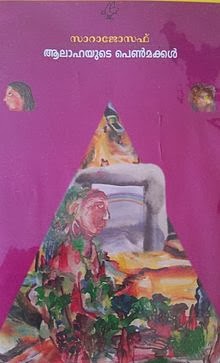
ആലാഹയുടെ പെണ്‍മക്കൾ - Sara Joseph

Urbanisation needs people to who work the dirty things behind the 'every thing is good clean and shining' life of the city dwellers. These people, who work non-stop in the background, live in the  hidden quarters, work at odd hours, are the necessity of any growing city . Forced to live outside the city limits, their land and their life is encroached and driven away by the ever expanding need of the  city, forced to shift themselves away, as the city grow. Sara Joseph in her short novel write about these marginalised people, whose culture, language, voice, thoughts and life are encroached by the pretentious mass of urbanised, mainstream population.

Invasion through out the history had those who control and those who suffer. The economics, religion, and physical and organised power always played a key role in colonisation and control. The invading power , however, need the service of these sidelined populace for their daily affair. The exterior brilliance of the society needed the dirt and filth to be cleared.  Thus, every city, every social setting has people who are termed and identified to be the 'cleaners' for long time. These people, scavengers, the washerwomen, the cart pullers, the maids , gardners, security agents  are 'housed' just outside the social strata. They have to be available at a calls length, but not within their 'identifiable community'. Sara Joseph, reflects our conscience to these people and their life in the mid 20th century Thrissur.

Kookanchira, in the outskirts of Trissur, was once the dumping ground of abandoned bodies and carcasses, before the group of people, scavengers and other low life settled in. Annie, now eight years, is born in this place among the other low class, after her family moved into this place. Her father had abandoned the family, leaving her and her mother among many aunts , the aging grand mother and a crippled uncle suffering from TB, bed ridden, spitting blood. His whereabouts are not known and the family is resigned to the fact that he is not to be expected. Kookanchira is infamous for its past glory, its criminals ( the gang of 14 rowdies), the other people of ill-repute. Even at school, a place for progressive thoughts and teaching, students from Kookanchira is looked upon with disgust and contempt. Annie, through her childish eyes, witnesses the slow but definite changes that takes place in her outskirts. The place, where many houses stood, was being taken by the rich from the city, producing documents from authorities to show ownership of the property. The fights and the resistance, can easily be soaked wet by alcohol, by brute force, by the might of authority or the ruling class. Hence, the place, which was once a grave yard, a place of wandering ghosts, of numerous legends is now become history. So is the history of kookanchira, a history of the place is the history of its people.

One of the attributes of colonisation, or invasion, of encroachment is the structural destruction of what existed. The culture, the way of living and the language in particular. It was so from the early days of invasion. The Spaniards and Portuguese in the South America, the English all over the world. It is the same within the country by the rich over the poor. Brahminism, dictated the standards, the structure and the style of language (sanskritisation) and the way of living and thinking. What is followed by the upper class people become the norms of the society. However, those sidelined and marginalised community, find their own identity through their language, their rituals and customs and even physical appearance.

Sara Joseph uses the language to an outstanding effort. The identity of the people is in their language. Language is the character here.  The legends, the folklore, the politics, the daily life of the inhabitants unveiled through the natural progression of language. The language of the elite, is viable only for Annie's uncle, who is always bed-ridden. Annie, complains that she cant understand her uncle when he speaks in this language. This uniqueness in the narrative is that it often hard to understand ( even those who speak Malayalam) and makes it all the more difficult for translation. This is a hold no bar way of communicating. The idioms, the ample use of foul and unparliamentary language, the care a damn attitude for grammatical correctness the referential contexts and the other 'characteristics' of their spoken words make this an enriching reading experience.

While the focus is shifted to the narrative, one should not take the attention away from the story telling. Sara Joseph, cleverly weave the story, of the families shifting fortune, and through them the society that they belong  and the larger population and the changing social and political scene of Kerala. A family of 7 women ( mother, grand mother and five aunts), a young girl and an invalid bed ridden male of past fury  of rebelliousness, under one roof. Apart from the sporadic interjections, the voices are all of the women. Its the women who moves the daily score, with men busying themselves with alcohol or quarrel. Their might and demonstration of power are restricted to the public arena, but the control in the real sense ( despite a few beating they suffer after an alcohol induced reaction) is with the women folks. For Annie, her uncle is some one who is beyond her world. She know he taks about profound things, but have no connection with the world they live in. Its through her grand mother ( and her stories) she know the worldly wisdom. The men of her town, the women, the religion ( her grand mother is switched to Syrian sect while her mother remained Roman Catholic) , the authorities, the money lenders, whores, the neighbours and the ancestors are opened to her world through these womanly conversations and experiences.

Sara Joseph, uses these varied facets of story telling to some great effect. The language, the sociao political structure, the worlds of women, the perils of the new capitalists system, the issues of growing urbanisation, the prevailing caste struggles, the rich and political nexus combining their might against the unorganised, low class into a memorable little book with her insightful narrative. Brilliant in both style and technique, very refreshing reading experience.

------------------------------------------
ആലാഹയുടെ പെണ്‍മക്കൾ ( 1999)

Sara Joseph

D C Books

152 Pages
-------------------------------------------
Samyukta , Wiki

Saturday, October 19, 2013

It Rained All Night - Buddhadev Bose

This book caught the attention of the public after the government banned it on its publication for obscenity. The authorities, not only destroyed the printed books, but also managed to remove the manuscript. It was much later, that the high court removed the ban on the book. Now, I did not know all these details upon buying the book. On my attempt to read many post Tagore Bengali writers, his name also figured and this was the first book that I could get my hands on. It is surprising that the book is banned for obscenity, as it does not dwell into any descriptive scenes or writing of pornographic nature that calls for ban for obscenity. I am reading the translation and have no idea of the original in Bengali, to comment on the ban.  However, I can understand the furor it could have created in the 'externally' conservative and prejudiced Indian society. It explores the subject of extra-marital affair, infidelity and questions the fundamental believes of the institution called marriage. 50 years back, an explicit take on these subject, and in a way not condemning but sympathising with those suffocating within the constraints of family life.

It’s over—it happened—there’s nothing more to say. I, Maloti Mukherji, someone’s wife, and someone’s mother—I did it. Did it with Jayanto. Jayanto wanted me, and I him … How did it happen? Easy. In fact I don’t know why it didn’t happen before—I’m surprised at my self-restraint, at Jayanto’s patience.'.. starts the novel.  Maloti and Nayonangshu (Anghshu) are married for over 14 years and are living in a Kolkata apartment with their daughter. Both are now into their thirties and the drift in their married life has culminated at the above sentence.  Anghshu, a man of words, translator, writer and academic ( which he resigned for a better paying job at the advertising  world), married Maloti, who was his student once upon a time. Highly polished man, in thoughts and manners, with friends in the high and intellectual circuit, who frequent his house. Maloti, whose admiration for his intellect , his social status and his attractive physical features ( good looking young man, whom her classmates competed to win over) , found herself disappointed with him as the time progresses. Her needs as a women and wife, the need of mind and the body to be cajoled and caressed, to have her desired addressed and met, found no reciprocation from her husband. As it can be expected, a friend of her husband, who one among the many who frequented their house, was the one who seems to have understood her and her needs. His moderate look, shabby dressing, a social status of not so great value , did not deter her from pursuing the relationship.

Angshu returns home late that night amidst pouring rain, only to find his wife in the bed post her misadventure with her lover. Her dress in disarray , 'saree' inadequately covering her body, her jacket and inner garments thrown around over 'his' bed. Man of wisdom ( or of cowardice) , he strategically move into the bathroom, giving her ample time to recover her modesty and regroup.  The sleepless night that followed, with both husband and wife staring into the void, with rain lashing on the outside,  each trying to find solace in their own reminiscence trying to justify their position. Alternating the narrative voice between the husband and wife, Buddhadev Bose travel through through their minds and their life with such sensitivity and empathy. Each persons point of view is so convincing, as the readers swing from one position to the other sympathising with both husband and wife.

Buddhadev Bose has done a tremendous job in treating this subject with utmost care and capacity. It is easy to get carried away, making it a tear-jerker or a silly writing on sexual infidelity. Instead, he portrayed the sensitive area of husband -wife relationship, the question of marital love and intimacy, the onslaught of desire and passion, the need of body and mind in any married life. These are the subject a conservative society of India refused to discuss for a long time ( Well, not in the early ages, but mostly towards the second half of last millennium ). While the situation is much improved of late, as a society, we are much reserved even today on matters related to such. Millions and millions of silent sufferers continue to live even in the modern days.

It is not the then controversial theme, that is the real attraction in this book. It is the might of his pen, the smooth silky writing of restrained and sensitive portrayal  of two tormented souls. The writing  (translation included) is very balanced on both the sides, never once breach the lines of decency, yet retaining the sensuality as needed. No glorifying of the actions, nor being judgmental. The translation retained most of the fragrances of the Bengali Language.  Fascinating short novel.

------------------------------------------
It Rained All Night (1967 )

Buddhadeva Bose ( translated from Bengali by Clinton B Seely 1973)

Penguin books

138 Pages
-------------------------------------------

Saturday, August 24, 2013

വാസുദേവ കിണി - മാടമ്പ് കുഞ്ഞുകുട്ടൻ


An year and half back, if I remember right, when I met Sri Matampu Kunjukuttan at his place, among various things he spoke, a hint about a new novel came out. Story of an old Konkani Brahmin, put in the jail for over 70 years, was shot at, on the day of his release. An old vengeance, an old settlement of score, by a member of the Portuguese (converted )  family, was behind this. He said, the story has to begin from here and he hasn't thought beyond this. During the evening, a small 200 page notebook, was opened in fron of me, and in his impeccable, clear and classically styled  hand writing, the letters and words came out of these pages . "വാസുദേവ കിണി" with an underline, and the first chapter of the proposed novel , sprang up .  Thus, I can probably boast, of having witnessed the creation of this new novel, before anyone else had seen. On every visit, I made a point to enquire about the progress, and I came to know that the same is then given to a magazine, "Kesari", for publishing it , a chapter a month. Publication in a book for was imminent and it is now available for a larger audience ( I am not sure what is the circulation of Kesari and how many of its readers has taken notice of this novel).

From the initial dramatic set up, begins the new novel. 90 year old Vasudeva Kini, released from the jail after 70 years , 10 months and 1 day, was shot at exactly 30 mins of his freedom. Francis Dsouza, descendent of the family who served the Portuguese army on their days of power, had delivered the task entrusted in him by the generations. His father, waited for 50 years at the gate, and Francis took over the charge after his death. The task is clear, you have to shoot the man in 30 mins of his coming out in the open; one shot, not one less or more. The fate had another outcome in mind. The bullet, probably due to the weariness of the shooter, and lack of concentration there of., did not cause the intended damage. It managed only to caress the newly liberated man before giving up its plight. The curiousness of the reader is now ignited, as one expect the writer to get into the flashback of the DSouza - Kini affair and the rivalry resulting in the 70 year jail and the shoot out. However, the canvas which Matampu, is exploring is beyond the family feud , but the cruel and ethnic conflict suffered by the earlier generations at the arrival of the colonialism in the country. 

For many centuries, the shores of Kerala was known for its trade, mostly the spices, largely controlled by the Arabs, en route Istanbul and to Europe and by China in the east. Barring a few skirmish, these trades by and large had been peaceful and was within the spirit of trade ( give and take). The scenario changed with the arrival of Europeans, and as is their greed, they wanted to take control of the trade barring the rest, and going a step further, wanting to control the area and its resources. Now,  the tradesmen become owners and rulers of the land.  The first mission of the Portuguese ( Vasco Da Gama)  was with the intention of trade, but the next one led by Kabral, paved the seed of colonisation in the land of spice. Keki N Daruwalla's novel 'For Pepper and Christ" is an interesting account of these early days of Portuguese. The Portuguese control did not last long, as they were defeated by Zamorin and by Dutch  and were forced to leave Kerala, settling up north in Goa ( Gomantak, the original name, as Matampu refer in his book). A rule lasted more than 400 years, until 1961 when Indian Army marched into Goa to liberate it from Portuguese. The early days of their rule was marred with large scale conversion of the people into their belief ( the Bible, the Coin, the Gun: Holy trinity - Petal of Blood ,  Ngũgĩ wa Thiong'o ). Forcing the people to eat cow-meat, a taboo for the cow-worshipping Indians, holding them by force and using all the means to stuff the meat inside their mouth. Once you are eaten the meat, you are outcasted from the society, by the rigid Indian Social norms. Having no other option, most of them had then converted themselves and followed the belief system of their masters. A few who resisted, escaped from Goa, and moved south towards Kerala and settled in and around the area of current Cochin and Trissur districts. A large settlement of konkani Brahmins, in Kerala, had a history of fleeing from  Goa.  on a similar case study, there is a sizable amount of Tulu Brahmins ( Embranthiri), from the South Canara District , ran away from their home land to escape forced conversion by the Mysore Sultan's Hyder Ali, and Tipu Sultan. The Tamil Brahmins, from Tanjavur area apparently came into Kerala , during the invasion of Malik Kafur. Interestingly, all the conversions are largely directed at the higher strata of the Social life, mostly the Brahmins. The lower caste, were usually left alone for they have no financial or social power.

Matampu's hero, represent this group of migrated Konkani Brahmins who settled in Karuvannur, a village in Trissur District near Arattupuzha temple. Apart from the attempted murderer Kini, had another person waiting for his release. 71 year old Sheetaladevi, widowed on the day of her wedding ( the last day of the wedding ceremony). Widowed but virgin, Sheetaladevi had a divine dream , in which she was to join Vasudeva Kini in the remaining of her life. Taking him along to her small house, she took the responsibility of rejuvenating the old man. 71 year of silence, made the old man to loose his words, but his thoughts are reconstructed from the grumble of his stomach by Sheetaladevi. The rest of his life, is to establish a kingdom which  is free from the clutches of all religion. Karuvannur, the middle of Kerala, the river, at the centre of the 44 rivers that divide the land of Kerala, has become the  symbolic center of transition : the old to the new, the history and reality, the cruelty and the compassion, the confinement and freedom, the thought and action. A new beginning has to happen at the middle and spread like a wave in the pond.

Vasudeva kini is the liberator. He has emerged from the dungeons of darkness ( self inflicted) to show the light to the world. A new world order has to begin from the ashes of the history.  The wise man has no words as the 71 year old silence is muted his voice. Its left to your intellect to listen to him, and understand him. The meaningless vengeance has to end with the firing of the gun. Neither the hunter nor the hunted knows the reasons behind the rivalry, and its the same with the readers, as the novelist does not indulge in the reasons of the rivalry. It is senseless, and what is needed is a world beyond the historical learning. The perpetrator is now dead at the feet of his victim after seeking pardon for the undoing of the generations of his ancestors. The new world, the new Karuvannur, is free from all those black pages of history. Its a new beginning.

Largely told through various flashbacks, Matampu develop his theme of colonisation and conversion, with historical perspective and social importance. A subject, which not many historians ( leave alone writers) attempted to put their hands on.  Matampu's gifted ability with the language, those 'old school' way of forming polished sentences, is the strength of the book. The structure is not flawless, the plot per se is not strong, but the context with which it has to be read is important.  His reading of these hidden pages of history might be subjective. It is his interpretation of those pages and as a fiction writer, he uses his freedom and flexibility, to the best of its effect. This might be controversial if one decides to look through the narrow angle, but this is worth the effort.

--------------------------------------
വാസുദേവ കിണി ( 2013 )

മാടമ്പ് കുഞ്ഞുകുട്ടൻ

Green Books

216 Pages
-----------------------------------------
പുസ്തക വിചാരം

Thursday, August 15, 2013

The Shadow of the Tiger and Other Plays - Chandrasekhar kambar

Kambar's plays have to be absorbed through the stage performances, they aren't the literary kind of plays, they are for performances, and the words and language have importance over the substance or the macro level content that one look for. Most of them aren't profound from the style and substance point of view but from the folkloric style of adaptation into the Indian context of  theater ( those familiar with Sanskrit playwrights of last millennium) while staying true to the roots of folklore and local myths with modern realities.

The collection of three plays, have these clever mix of selection. The first is an easy adaptation of the Persian classic, with the indigenous introduction and screen setting. It did not create any special interest in me as a reader, but I could visualise the original kannada version and the 'conversation' and the lyric used in the original creating an impact in the audience.  The drama, begin with a setting of Ganesha Festival with a boy stealing the 'laddoos' kept for the lord in the play to be enacted, and brilliantly easing his way to the Persian Alibaba and 40 thieves. Ganesha the God , who had hidden large number of laddoos under his 'cloak' is kidnapped by the leader of the thief and switching the plot from here shifts to Alibaba, and a clever closure with the reappearance of Ganesha in the end, mixing Indian myths to the Arabian tale.

The second, which carry the title of the book is an outstanding play. Playing along the thin line of 'truth and deception' he create an atmosphere of magically build up realism. This by far is the best play of the collection. The village chief, decides to go and capture the tiger that causes havoc in the lives of his village folks. Despite the warning of the stars, the anxiety of his wife who had a bad dream, the offer of his son to accompany and support him, against all bad omen, he set forth to lead the expedition ( . However, the failed attempt gets him lost in the wild separated from his supporters. However, he returns magically to the village, claiming to have killed the tiger whose carcass he supposed to have disposed off at an abandoned well in the forest. He ban his followers to go and look for it as ill fortune is sure to befall on them if anyone dared to go and peep inside.  Kambar, writes :

         Gowda returned after everyone else.
          He was tired.
          He had come carrying something on his back.
          The hunted tiger, we said, perhaps.
          Or perhaps not, we felt.
          For into the disused well outside the village
          He threw it and came.
          Not a call of a horn
          Nor band and music!
          It wasn't as if the tiger was hunted
          Nor as if it hadn't been.
          He's got in like a thief
          And we accepted him as such.

However, the situation in the village change drastically post the event. The idol of the village goddess is found split into half and other misfortune one after other befall on the villagers. An old lady , incarnation of the goddess herself possibly,  unveil the 'vision of the reality' to the son of the chief. The 'demon'ic influence in the life of the villagers is represented through the Chief himself, who is now under the influence of the devil ( the devil himself is come in the chief's body after killing and dumping him in the forest well). Chief's son, who is now entrusted to clear the air, is as confused as the rest  'Now everything appears to be split into two. I am seeing two of myself. How can I put both truths to test?...What is truth? Which is false?' . It is here the mastery of the writer comes out in open. Brilliantly traversing between illusion and reality, he creates an ambience with his magnificent wordplay, lifting the reading experience to a higher level. And in that context, this lift itself above the Kannada proximity to a larger global relevance.

Thukra's dream, takes us to the days of British Raj. Symbolically representing the nameless, wordless millions of India, all Thukra has in control is his dreams, but in reality he is forced to suffer and in the end face death. As the resources of the land is held under the control of the wealthy, and the authorities are hand-in glow with those with money and power, poor Thukra and the likes has one one way forward. To rebel, and use the identity of the rebellious folks elsewhere to their own. But before doing this, he tries to escape the land of his misdeeds, and tried to be par with the land lord, by travelling far and wide to Bangalore, attempting a few jobs and more thefts. But on return he realises that the hands of the mighty is stronger and his attempt to equal them is only short lived. In an interesting tragi-comic narrative, often bordering the silliness, it leaves a lasting impact in the end.

I write. In writing I build what I feel. My feelings are my experiences and I build with words, which are stories, pictures, pieces of tales, all off of which have been part of my experiences" says Kambar in his foreword to the  book. His plays are part of the same process of "relate to environment both in time and space,  through  stories, the fantasies, the images". Neither his characters not his plays are for the upper segment of the society. They seems to be aligning with the common man, the non pretentious , those in his words 'he celebrate'. To me, reading this in Kannada and seeing it in Kannada will have much more deeper impact on me. Having said that the efforts in translation is commendable, despite few unevenness one observe as we read on. Interestingly, each play is translated by different person(s), and probably that was one reason of the unevenness.

--------------------------------------
The Shadow of the Tiger and Other Plays( 1980 / 984/ 1991)

Chandrasekhar Kambar ( translated from Kannada by Sandhya S, Padma Ramachandra Sharma ,O L Nagabhushana Swamy  in 1999)

Seagull Books

162 Pages
-----------------------------------------
C K Meena, Purushothama Billimale

Sunday, June 09, 2013

പ്രണയത്തിന്റെ മൂന്നാംകണ്ണ് - K V Mohankumar

Dropping off his education, in search of 'nirvana', the ultimate truth , Rahulan starts his journey away from his dear and near. He need to find a Guru, who could guide him to the path of 'nirvana'. At home, in Muchiri, the preparation of his return, as 'graduate' is in full swing. His father was working for the biggest trader of the port. Upon his death, Rahulan and his mother was living under the protection and support by the Trader. Jabala, the daughter of the trader is pursuing her love for Rahulan and their wedding is on the cards, awaiting the triumphant return of the boy after his studies. He is expected to lead the team and the ship on its scheduled journey and Jabala, preparing to join him on his right side. However, the wait is of no positive consequences. Rahulan had different plans. He is now a wanderlust, in search of the path to 'Buddhahood', seeking direction in his path to nirvana and looking for someone who will lead him there. His journey ends at a 'black-smith' girl, who takes him through the spiritual journey of 'ultimate love and desire' interpreting this as the union of souls and bodies in the supreme coherence of power, through which you approach the divinity and 'nirvana'. In completion of her prescribed task of guiding him through this phase, she return to her folds, saying all that is to be learned in the 'paths of 'tantra' is now been imparted to him and hehas to fend for himself. Rahulan continues his travel through the world for the final salvation and the one-ness with the universe. In this phase of his life, he continue to meet people whom he was encounters in his pre-yogic days, including his mother ( who dies in his hand, savouring the last drops of water poured by him) and finally Jabala herself, Captaining the ship on his absence.

The book is inspired by 'tantric Buddhism', and an attempt to merge the mystical and spiritual world of Buddha to the world of  'Osho'. At one side, the quest for 'nirvana' and on the other the 'liberation of self through fulfilling the desire of the physical body through the five sensory organs'. The premise and the context of the book is interesting.

I would like to look at the book ( and his writing) in two parts. The Two parallel tracks he was trying to carry through the book, with a possible and predictable convergence. The parts of Muchiri, with ever waiting 'soul mate', his mother and the port and trade community in general was beautifully written. On the other part, the one with Rahulan's quest for 'nirvana' and the resulting spiritual 'endeavor' in general wasn't as free flowing. At many places it felt forced and superficial. The inner turmoil, the constant doubt on himself and the path he has chosen, the uncertainty regarding the 'Guru' and 'karma' ( in the real sense of work) oriented learning of the 'truth' instead of 'dhyana' oriented approach etc are written and accounted very well. How ever, the tight narrative, to me looses its sheen, when it comes to the 'sensory love', the one-ness of body and soul, the spiritual emancipation of the desires, living the physical and sensual life to the extreme under the guise of mystical reunion of  the plough and the land ( a metaphor appear through out the book ): while it looked good as a theme, it wasn't very appealing in the end.

K V Mohankumar , IAS Officer and presently the District Collector of Kozhikode. He is not new to literature, having published many books already. I haven't read any of his previous books. From what I seen in this book is that he is good at his work. Though the theme he choose to explore is a bit vague and in the end did not deliver to the promise it created at the beginning, the parts of Muchiri and parallel track were beautifully written.

-----------------------------------------------
പ്രണയത്തിന്റെ മൂന്നാംകണ്ണ്  ( 2012 )

K V Mohan Kumar

D C Books

184 Pages
----------------------------------------------
The Hindu, Penmai

Thursday, May 30, 2013

The Book of Bhima ( Krishnavatara IV ) - K M Munshi

The fourth book of the 'Krishnavatara' series, came into hand after a while. Surprisingly, it failed to impress me. Unlike the earlier ones ( especially the second), this was way too light and least insightful of those read thus far. It appeared as a plain and simple retelling of the story, with Bhima being the action man, as the name suggests.

Starting off from where the previous book was left, K M Munshi takes us through the intial days of the Pandava clan with Draupadi. Having to face the reality of five husbands, each a hero on their own right, Draupadi quickly had to device a system and method, to prevent the disintegration and infighting among the brothers. A method, did she device, in the form of time-share and had her way with Yudhishtira to get that accepted by the brothers.

Bhima stood out from the rest, not only by his physical strength and the gigantic size. He was the most innocent, most lively, full of pranks and notorious, despite his age. He has his way with the world, which goes beyond people of his stature. He managed to win over the man-eating  'Rakshasa tribe' ,married to Hidimbi , ruled them as King Vrikodara, single handedly rescued his family and protected them against all the forces. He believed that his role in the family is that of the protector and he takes pride in it, which often makes him upset with his elder brother for his decisions which he does not in agreement with. However, behind the facade of the giant structure and often ridiculous shows, remain a shrewd and highly intelligent mind. A mind constantly work towards the betterment of the family. It was his clever maneuvers that won half the a forces of his father-in-law , accompanying them on their march towards Hastinapura. It was his handy work, that saw Krishna and the Yadava leaders to join the journey. It was his ploy and work that saw Bhanumati's sister and brother from reaching early to Hastinapura.

The meticulous plan laid by Bhima seems to have worked well on the Pandava's arrival at Hastinapura. There was only one man, who could think beyond the measure of Bhima. Krishna, went a step ahead and made sure that the Kaurava King made announcement of Yudhishtira as the new King. He, in order to fulfill the promise he gave to Bhanumati, to retain Duryodhana as the king of Hastinapura, managed to rally the opinion around moving the new Capital to Khandavaprastha, not before securing the large number of resources towards this goal. The book ends with the new city of Khandavaprastha  being in force.

The book does have few interesting moments. What strikes me the most is the 'adolescent like' love affair between  Jalaandhara ( sister of Bhanumati) and Bhima ( Bhima with all the lovers traits) and the Krishna-Bhima rendezvous and the way he managed to persuade Bhima to return to his brothers. The writing in general was a continuation from the previous books. This did not have the same impact of the previous books.
--------------------------------------------------------
The Book of Bhima - Krishnavatara IV  ( 1967 )

K M Munshi

Bhavan's Book University

253 Pages
-------------------------------------------------------

Monday, April 29, 2013

Bhavni Bhavai - Ketan Mehta

Bhavai is the popular theater form prevalent in Gujarat, which is said to have roots in the fourteenth century. Associated this art form to Asait Thakore, a brahmin from Siddpur,  He was excommunicated from the caste after an incident involving lower caste member, he married from that community and targlas , born out of this union of two castes, became famous for these traditional performance of Bhavai folk theater. Asait Thakore,himself supposed to have written more that 360 plays.

Inspired by this tradition of story telling Ketan Mehta, directed a film in 1980 ( in Gujarati) called Bhavni Bhavai ( A tale of Life), which went on to win many awards and accolades. The celebrated movie screen play was later reconstructed and translated to English by Shampa Banerjee.

The familiar theme of caste struggle, the system of untouchables , one which made Asait Thakore an outcast continue to be the point of discussion here. The story is being told by a old man, in a travelling 'low class' group of people, to his grandson, as they rest during the journey. A folk tale, concerning the king and the well is planning to dig. According to the astrologer, a human sacrifice is needed, and only a person with the 32 qualities to see water in the well. The man is found in a lower class family , who as we all know, is the son of the king himself, who was a victim of a clever palace power game between the old and young queens. The old queen is blessed with a son after many prayers and offers, but the clever treachery by the young queen made sure that the infant is taken out of the palace and be killed. The soldiers entrusted with the task felt pity for the infant prince , and instead sent him floating in a basket in the nearby river. The turn of the events saw that the boy was rescued by a low class family and after many many years, the prince, now a young boy was again fallen as the victim of the clever plots of the young queen and the minister.

Classical absurdist theater with a clear influence of Brecht's ( the movie is dedicated to him ) , Ketan Mehta build a very visual representation ( even in these words) of the socio-political issue of caste and religion. As is the tradition with folkish theater, this is filled with classical humour, often silly and comical. While we are discussing the book here and not the movie, one is to observe the clinical precision of the scenes including the physical presence of both people and objects. As one can see, the movie is noted for its structural brilliance, and the treatment of the taboo subject of untouchability, with the nice mix of current day socio-political aspect, being told through the folktale. The translation is impeccable and never once one felt the issues related to the idioms, expressions or the anglicized use of Indian words.

------------------------------------------------------
Bhavni Bhavai ( 1986 )

Ketan Mehta ( translated from Gujarati by Shampa Banerjee )

Seagull Books

121 Pages
----------------------------------------------------

Wednesday, April 17, 2013

Pandita Parameswara Sastry's Will - Tripuraneni Gopichand

Keshavamurthy is a writer of repute, living with his wife Sujatha and his son in Warangal. He works as a teacher in the nearby school, and writer novels of critical acclaim. Any normal life has to have a twist, and thus a story to retell. It comes in the form of a telegram from one of their acquaint stating the critical illness of Sujatha's foster father 'Pandita Parameswara Sastry'. Sujatha, starts at once, to be with her ailing father, despite his disapproval of her marriage to Keshavamurthy.  Sujatha was abandoned at birth by her mother, in front of a school and was brought up by the school attendant until she was discovered by childless Pandita Parameswara Sastry, who then taken charge of bringing the lady up in his household ( later we realise that she was his illegitimate child).  When she decided to get married to Keshavamurthy, a writer and man of intellect, but who belongs to a lower caste, Sastry vehemently opposed to the marriage. The couple however decided to go ahead and get married and started living on their own. Sastry had never spoken to his foster daughter ever since, and refused to acknowledge them. 

The fame and status of Keshavamurthy had created a group of jealous writers. It was known to us ( through multiple repetitive anecdotes) that all of them at one point or other had been the beneficiary of the favour from Keshavamurthy. Too, filmy and too good to believe  Keshavamurthy, continued to help and support those who betrayed him and worked behind his back for the downfall of him. Many a pages were devoted to the good deeds of Keshavamurthy and the misdeeds from those co writers, who never been able to come to terms with the growing popularity of Keshavamurthy.

The coterie worked in injecting the venom of hatred even in the mind of Sastry, or so we were to believe. As the end of Sastry neared, they worked with him to prevent the inheritance from going to his daughter and thus to Keshavamurthy. They, under the pretext of opening a Sanskrit School bearing the name of Sastry, wanted to hive off those money to their personal benefit.  Making them believe that he is towing their line, Pandita Parameswara Sastry, had other plans.

That summarises the book in its story. However, Gopichand, uses his narrative techniques and voices to a great effect to bring out a fairly good novel. Since I couldn't read the original version in Telugu, I had to depend on the translated version. Somehow, I get a feeling that a great deal of its original fragrance and strength seems to have lost somewhere in translation. The impact and effect of the Telugu version, should have been greater, going by the recognition it received in terms of Sahitya Akademy award in 1963 a year after its publication.

Even in the translated version, one can get the glimpse of a strong writing of the solid social undercurrent. The politics of caste and sect, the influence of the communist and liberal thoughts and the strong philosophical stream mingled through out the book is noticeable. Despite being felt as an add-on , the Aurobindo Ashram and the pages discussing the philosophy of Aurobindo was impressive. The balancing act of spirituality and communist thinking, its non- contradicting existence in the thoughts of Keshavamurthy is one aspect I see the author dealt beautifully.

The rivalry among writers ( or people among same profession competing for the limited attention of the readers/listeners or audience) is not uncommon. Gopichand, takes a dig at his own profession exposing some of the obscene and often cruel tactics to demean the fellow writer. The malign include financial accusation, extra marital affairs, anonymous letters, yellow press, direct confrontation and similar methods are deployed by his foes. Keshavamurty though affected by these puts up a brave front even when his wife has a moment of distrust and an act of stupidity ( in her own admittance).

It is a good book to read, may be profound one if you are a Telugu reader. The story per se, is too filmy and ends in the typical triumph of truth over evil. But it is the connecting aspects of narration, voice and the philosophical aspect gives it the weight to be considered as a major work in Telugu Language.

--------------------------------------------------------

Pandita Parameswara Sastry's Will (1962)

Tripuraneni Gopichand ( translated from Telugu by Uma Alladi and M. Sridhar 2010)

Sahitya Akademy

265 Pages
------------------------------------------------------
The Hindu, Tagoremarg

Saturday, March 16, 2013

Re-Envisioning Socialism - Prabhat Patnaik

Capitalism, considered to be a 'self-driven, self-managed, self-acting  economic order as envisaged or described since the time of Adam Smitth, and spontaneous , as added later by Oscar Lange. However, the recent incidents seems to have been shaking the fundamentals of this belief as the leading capitalist economies of the world are witnessing stagnation and many are struggling.  The question has been "What next?'.This had been the leading economic  system of the world since the end of Feudal days, notwithstanding the attack for a short period in the form of Socialism. However, the future is gloomy and the quest for alternate has to begin.

This book, a collections of essays published between 2005 - 2008 , by Prabhat Patnaik, a left thinker and political economist, looks at the topics concerned to the contemporary Capitalism and the relevance of 'Socialism' in the future. Though it seems prophetic ( these papers were all written before the sub-prime crisis and the recession that shook the world), it does look at some of the issues of the world of capitalism, through the eye of a leftist -economics. It, there fore, has a pessimistic view of the current economic world, and trying to find an answer through the envisaged 'new world order' driven by the principles of Socialism.

His argument centered around two major factors. One is on the 'Capital' itself. He calls this as the "International Finance Capital' which through the controlling hands of the neo-colonising powers, try to decide on every socio-economical and political transactions of the world.  To its credit, Capitalism triggered giant leaps in productivity and the progress of society post the second world war, where the measures like labour productivity, employment rates, welfare measures were at the best. This period called "Golden Age of Capitalism" continued over two and half decades, attracting lot more economists in favour of this system.
"The boost to demand created a strong inducement to invest and hence rate of growth unprecedented in the history of capitalism. These were accompanied by high rates of labour productivity growth, resulting in high rates of growth of real wages. These together with social security measures induced by few Social Democratic Governments, made capitalism appear as a humane system."
The contradiction within the system, soon become evident as the period of de-colonisation  ( large number of countries sought independence from the European colonial powers post the second world war) is paved way to the globalisation and the new phase of imperialism( he seems to have meant no political or military control, but control through economical order) order for the control of natural resources.
"Emergence of the globally mobile, international finance capital, there comes into being a 'global financial community'. This community, presiding over vast amount of money capital through its control over banks, and using the capital for diverse purposes as industry, speculation, real-estate business, and buying bonds, including foreign governments. "
"The process of capital accumulation can be conceptually envisaged as occurring in two distinct and alternate ways" a) Accumulation through expansion  b) accumulation through encroachment.

*

One of the key aspect of the modern capitalism is about the freedom of individual and the democratic order , that is the political choice. Patnaik, argues that ( repeatedly through out the book) that under the capitalism, the individual is treated as an 'object' or as a resource. The 'objectivisation' of the individual according to him is one of the perils of the capitalists order.

The basic point is the incompatibility of authentic democracy where the people are the political 'subjects' with capitalism where they are the object.

It is interesting to note observe the aspect of democracy in this light. As may be noted, the electoral choices in many advanced countries tend to limit the option to a few streams or to two in the case of US. More so, it was known that the democratically elected representative in general are 'the representatives of corporates ( read 'International Finance Capital') in most of the capitalist countries. The case of India is no different, where 80% of the post independent India was ruled by a single family, albeit democratically elected. It is said about the newly liberated or de-colonised countries in Asia and Africa, it was the bourgeois elite, who filled in for the evacuating European power, and not the representatives of the people.  On the other side, we see the individuals in  political power ( in the communist countries, especially China),  gets into the area of industry and business, a 180 deg shift from the capitalist democracy. 
"All the traditional virtues assigned to the bourgeois order, namely democracy, political choice, individual subjectivity and hence freedom, paradoxically, are conspicuous by their absence within this order. And the basic reason for this lies in the fact that in bourgeois societies economics drives politics, and that economics is marked by spontaneity rooted in 'objectification' of the individual."
and elsewhere he quote:
 "The phenomenon of globalization, which many have seen as a means of expansion of freedom and democracy, has the exactly opposite effect, at least in countries like India with functioning democratic institutions in the post colonial era : of constricting the democratic gains already made by the people." 

He summarises :
"The mans of attenuation of democracy in a bourgeois society are several :
1. Ossification of state where the bureaucracy and the standing army become the core of the state apparatus
2. Fragmentation of people into ethnic, linguistic or religious groups
3. Denial of meaningful choices to the electorate
4. Inculcation of insecurity among people
5. Deliberate promotion of the mindlessness among the people by the media and the peddlers of popular culture

"Ideological projection has the advantage that it can use the already existing, substantial racist prejudices in the metropolitan countries. Racism has always been a part of imperialism, Even when it has been driven underground under the weight of democratic assertiveness."

*

Rooting for a new world order, he says it is time for an order in line with the socialistic thinking. Notwithstanding the earlier experiments and its deduced failure, the situation which the world is today and the future of capitalism, does demand a new deliberation on the possible new thinking in this direction. He says,  "the prospect of such a deepening associated with a transition to socialism are much brighter in todays context, even as the material condition for such a transition are becoming more favorable because of the very phenomenon of globalisation".
"The theory of socialism however grew out of the philosophic, historical and economic theories elaborated by the educated representatives of the propertied classes, by intellectuals. Since the theory of socialism stands on its own; since the class analysis upon which it is based has a general ( though concrete) applicability not circumscribed by the class configurations of a particular society or set of societies ; in short, since it constitutes a method of scientific analysis of any society, it has a universal applicability, irrespective of how close the societies in question are to a socialist revolution."
If the demise of capitalism will be triggered by its own internal contradictions, whose signs are already seen,  there has to be a few changes that is witnessed within the same system. He says , most of the ""working class struggles within capitalism could at the best produce trade union consciousness among the workers but not revolutionary class consciousness."

 "The case for a revolution in 'modern times arises from the fact that capitalism as a mode of production is not only based on exploitation, but in also a spontaneous, non-malleable, non-reformable system."
According to him a failure of finding an alternate political and economical order which will grow out of the current capitalism, will yield to the strengthening of the destructive elements in the society, thrived and fuelled by anti-capitalist sentiments, taking shapes in the form of terrorism.

"The question may well be asked: why should we bother about these issues which were debated so long ago by people long dead and gone ? ".....  "But if these issues are shut out of the terrain of discourse , then anti-imperialist praxis will continue to take the destructive and unproductive forms, such as terrorism, that we see before us today."

*

His points on higher education is something worth considering in the Indian Context.   According to him the current higher education system in the country is aimed at producing what he called 'organic intellectuals'.  It is known that " global capital, after all, is keen to employ Indian skilled labour not out of charity, but out of hard economic calculation.
Ways of producing  Organic Intellectuals of the people can be undermined by the context of globalisation, via the overwhelming need for, and the apparently tempting prospects of, producing what can almost exclusively be called skilled foot soldier for global capitalism."
While it is essential to have a state control on higher educations, the ability and capacity of state to make this large transition in short time is now exploited by the business, giving way to a large number of private institutions to come up, only filling in the demand for quantity, compromising heavily on quality, for lack of trained and skilled teachers. This in turn, is justified by the demand and the reputation of  the State run/managed higher education institutes. On the other hand, even these institute, ended up producing highly skilled 'organic intellectuals' for the world market, seldom being available for the need of the country.  Thus he says, the higher education agenda should have a strong Indian reality .

 "Modelling our institutions after Harvard and Cambridge, which would entail copying their curricula and syllabi, would there fore necessarily means sacrifying to our great cost, the conceptual frame work and the perspective . Quality does not come from aping others. Some of our finest institutions, which indeed have acquired global attention, have done so because of their systematic refusal to ape others, and their strong connection with the Indian Reality.................
*
The argument for capitalist economy also comes from the argument on the overall improvement of the life, measured by the absolute GDP and eradication of poverty. It is now been clear that despite all these years, we are far from achieving these objectives.

"Even when the rate of growth of output gets pushed up, as in India and China, the rate of growth of labour productivity gets pushed up as well, so that labour reserves remain unexhausted and income distribution continue to worsen.
We also see continued systematical destruction of he peasantry in the under developed countries, mostly driven with a propaganda of improving efficiency and competitiveness in the world market.  On one side, the ever increasing 'urbanisation' takes away large areas of cultivation, converting them in to urban land for housing and industries.

"What is remarkable about the new phase of imperialism is that it justifies the adoption of neoliberal policies, which is a euphemism for bringing countries under the hegemony of international finance capital in the name of 'eliminating poverty'. State-sector assets are privatised in the name of improving efficiency, which is supposed to usher in faster growth and eliminate poverty; state assistance to peasantry is done away with in the name of making peasantry adjust better to the market opportunities opening up, so that it can experience higher growth and hence reduce poverty...."
These steps in countries like India seems ot have produced an opposite effect. "In fact income deflation has taken its toll on the peasantry to a point where even simple reproduction of peasant economy is no longer possible in countries like India, as is evident from mass suicide of peasants." . The statistics put the count of peasant suicide near 200000 over last 10 years..

On his arguments for the new order he says, "The tendency of capitalism as a social system is to dispossess the vast mass of the peasantry. The alternative social system that a transcendence of capitalism must bring about , should be one that defends and promote the peasantry instead of making it destitute."

*

As the growth in the traditional capitalist world slackens the 'Financial Capital' has to look at other ways of survival. Hence, the need for looking at other frontiers towards accumulation of resources ( capital enhancement through encroachment)  and business.  Which saw the raise of new type of colonisation, by finance capital themselves, or by capitalist states sponsored by the finance capital.

"As the Golden Age of Capitalism passed, not only did the growth rates of the world capitalism plummet, unemployment in the advanced capitalist countries approached double digit figures and remain stuck there, the absolute real wage rate shown a virtual stagnation, the tendency towards decolonisation got reversed, with imperialism making a determined attempt to reappropriate the worlds natural resources, especially oil, for itself.
These expansion of the capital, often called as globalisation, interestingly had gathers a lot of support around the under developed world. On one hand, it gave a momentary increase in the flow of capital, technology and reduction in unemployment, despite the real increase in wages. However, in this excitement to attract capital and creating job opportunities, each of the under developed economy compete with each other, thus constantly bringing down the wages, even if the productivity is increased

In summary the aspect of Capitalism can be made under these seven features

a) International Finance Capital
b) The capitalist state
c) Curtailment of public investment
d) Slowing down of growth in the capitalist world
e) Crisis of petty production
f) Expropriation of land from peasants
g) Systematic attempt at recolonization of the world

*
The case for Socialism is explained under these lights focusing on the aspect "International Finance Capital" and the 'Objectification of Individuals" and 'true democracy'. He re-iterates,
"The case for socialism is that it alone creates the condition for human freedom by overcoming this objectification, for which a necessary condition is social ownership of the means of production."
and
"On the contrary, socialism, which aims to overcome the objectification of the people in bourgeois society, is alone compatible with democracy; it alone can create the conditions for the full flowering of democracy".
However, this subject is often dealt with taboo by all. For the capitalist thinkers and supporters any discussion in these lines of social and individual aspect or about humanisation , is immediately identified and associated as communist or leftist thinking. Once marginalised as leftist, it is easy to discount its effectiveness and its open discussion in public. The effective use of religion and race add to the alienation of these thoughts. On the other hand, the 'traditional leftist' ( there are exceptions, Of course) refuses to look at the past and make the necessary changes in the ideology with the new world realities and the potential hazard in terms of destructive tendencies.
"Devalues the theoretical endeavour on the left and discourages creativity. The attitude becomes : Since Marx has said everything of importance that is there to say, what more can I say except finding more evidence of his correctness."
As a social order, one need to see what drives the people to work ?  " In feudal society, people work because of the pressure of customs and tradition, backed by force ( punishment or starvation). In the capitalist society, people work because of the existence of the reserver army of labour, which acts as a coercive disciplining device. If you are not measuring up to the expectation, you are dismissed and someone else takes your place." Patnaik gives the example of the old Yugoslavian method, which work around the peer pressure, which is far from convincing.

"The socialist agenda therefore remains as relevant today as ever. The choice before us today, is between socialism and barbarism, between a solution where the predatory imperialism remain locked in perennial combat with equally ruthless groups of terrorists, thus threatening the very survival of our civilization."
The essay on "Destruction of thought", which might stand on its own in this collection is one which need a lot more discussion. One of the aspect of the modern living, with the overdose of information, which is controlled and manipulated, has its direct impact on free thinking.

"Thought in my view, is informed by social energy and is meant to stimulate social energy aimed at changing the human conditions. Thought is not routine ; thought is context-transcending. Submergence within the empirical reality is the denial of thought.
My knowledge in economics and politics is zilch. Hence, my understanding of these subjects discussed at greater length is constrained by my incompetence. While, he dwelt in detail about the current scenario of the Capitalist Economy and its internal conflict ( lack of growth, the need of survival, the competition within) making it no more an attractive regime with longevity, I for one do agree with him on finding the next alternate. However, I did not find his arguments for the socialist society as attractive and convincing.  What was impressive was the prophetic nature of the book. Very intense book, demands a lot more attention to the aspect and points of discussions. Though I am not in agreement with all his arguments, I found them very informative. Despite it's left leaning ideology, one must read this book, for the shear power of its arguments.

-------------------------------------------

Re-Envisioning Socialism ( 2010)

Prabhat Patnaik

Thulika Books

271 pages
------------------------------------------------
Frontline

Thursday, February 28, 2013

The Kinsmen of Ugna - Surendra Jha 'Suman'

Maithili, a language spoken by the people of Mithila ( north-eastern Bihar and adjoining Nepal) isn't one of those languages known for its literature as is with other leading languages in India. Once a mighty empire, the region lost its prominence over the centuries and has become the part of the state of Bihar post the independence. Surendra Jha Suman, is considered one of the leading writers from this language and Sahitya Academy has done a commendable job in making it available for the larger reading community by this translation.

Modern Maithili literature, claims it roots to the celebrate poet Vidyapati, who lived during the 14th-15th century. A staunch devotee of Lord Shiva, he was known for his love-poetry and his dedication to Shiva. Legends has it that the lord himself was pleased with his devotee, and incarnated as Ugna, a man-servant to the poet's house. The book had the origin of its name to this Ugna, the lord himself. Surendra Jha Suman, quotes and uses the poet through out his novel, as one inspiring the people of Mithila through his words and life.

Kinsmen of Ugna, paves the same path of caste struggle and the upbringing of the downtrodden. The protagonist Tulsi, born to a poor backward caste, had the typical upbringing, that is prevalent in the early days of independence. The issue of social injustice, untouchability, servility was rampant and the young Tulsi himself was victim of few unpleasant experience. It might be these early experiences that made Tulsi into taking up the cause of the people of his caste. Discontinuing his studies and the possibility of a better paid job, Tulsi instead decided to work among his people to bring education and better living to them. The effort did receive support from a few forward thinking leaders and the enthusiasm of the members of the community. The small gathering of the people paved way to a bigger school and proper methods of education to the underprivileged. The wind of change was coming to the closed quarters of the 'backwardness' of the tribe. They were more positive and collective and the unity saw them through few tough times. Along with the social changes, the calls for the resurrection of the Mythili language and culture was on the raise. While the community elites were divided, they organised two separate events - one for the upper casts and the other for general public, the voice of the people were heard and acknowledged. The book however, do not focus its energy on the caste conflict or the local power struggle much, barring a few attempts of jeopardy by his upper-caste friend and classmate. So much was his popularity, that he was elected to the regional administration through election beating his erstwhile friend. The book ends at a high note with the newly crowned people representative decided to get married to an invalid from a lower caste.

I'm not sure of the date of publication of the original works, but the language and the setting give me pointers to the early 60s. Surendra Jha Suman, manages to portray the social fabric of the region and the sentiments, without getting propagandist, pretty effectively. He also focusses his mirror to the 'alternate reality' of the neo-rich Urban metropolis pointing us to nastiness behind the glowing curtains of the city. May be he is wanting us to appreciate the local life.

I have seen the 'class struggle' , not in the same sense as the Marxian thinkers project, as a key theme in many a writing across various languages. The 'caste' struggle , the continuous efforts of the backward classes to bring themselves out of the poverty, chaos of life and the need for social equity has been a major topics of many yesteryear writers. While for most of the Urban modern day readers, this might be a subject that is as over used as the 'holocaust' stories of 40s. but it did have a major effect in shaping the modern India, post independence.

One of the qualities I find attractive about the regional language literarature, is its simplicity. The innocence and earthly narrative. There is no pretentious writing and no superficial ideologues. It may be too simple and not carry any profound intellectual debates nor follow some of those established western norms of literature. I like some of them for the same. The book has been translated amicably, without loosing the flavour of the local language. Does it read as smooth to a non-Indian as it is to an Indian ? I think, in this case it does. In comparison to the other heavy weights of Indian Literature, this might not be one that stand out. But, in the context of the Mythili literature, and in bringing out the post independent social changes in the Mithila region, this must be a significant work of fiction.
------------------------------------------------------------
The Kinsmen of Ugna

Surendra Jha 'Suman' ( translated from Maithili by Ratneshwar Mishra 2010)

Sahitya Academy

104 Pages
----------------------------------------------------------

Saturday, January 26, 2013

Sivaratri - Chandrasekhara Kambara

"On that night, in Kalyana, nothing was in the right place and right order. None had any trust in others; and each one listened to others with suspicion. Every one's words had two meanings; the apparent and the hidden. On that night, the dark night of Shiva, Kalyana didn't sleep; but it wasn't awake as well, as the rituals required...."

It was the time of great turmoil at Kalyana, the capital city of the King of Bijjala, of Kalachurya dynasty. The man hunt for the Sarana's are at the full swing, after the fall out of Basavanna with the king. The struggle of control, or the changing power equation has made them fall apart. The once trustworthy and beloved minister and the King. Basavanna ( as he is now fondly called) and his clan of Shiva devotees are spreading in size and in influence. Basavanna, himself as established the 'mahamane' ( or big house) and is now a gaining popularity as a social reformer with "his preach against casteism, blind rituals, animal sacrifice and other such social evils".

Chandrasekhara Kambar, one of the masters of Kannada Literature, is turning his attention to the life of 12 century reformist, the leader of Shaiva sects ( the Lingayats) in one of the important events of the history of state. The 6 act play focuses on the manslaughter of the Saranas ( the followers of Basavanna) by the Kings men, and the resulting murder of the King on an eventful day. The build up through various insignificant events through out the evening, the play culminates at the place of the local prostitute, whom the King frequent, in a verbal dual between the King and his once trusted minister who turned a foe.

"I can't believe this, Basavanna ! The king anf the respectable minister of the country, meeting each other in the house of a prostitute ! Is this just a coincidence ? Or Does it signify religion and politics coming together ?"

Damodara, son of the court priest was prompted by his father to steal the Gold necklace of the queen from the palace, disguised as a 'Sarana ( desciples of Basavanna). The 6 act play, moves along the gold necklace from place to place as Damodara escapes the guards taking refuge at a Dalit's house, later at the house of the prostitute. The lady refuses to accept the gift as it is not earned by her labour. The visiting King see the lost necklace as the events unfolds. Kambar, managed to compress the historical events into a single night without loosing its significance , despite shifting actual times.

Kambar's skill and craft come at best here. It is a tricky subject and is sensitive in nature. One has to know the historical and religious background of the life and times of Basavanna, to appreciate the play in its power. Kambar uses these symbols cleverly. He builds up the play in shorter acts through the lives of common people, associated with the kingdom or with Saranas. The social structure is changing. Basavanna, defying all the earlier religious norms, encouraged inter caste marriages and social living. The followers of Basavanna is now increasing. It was important for the higher ups in caste and in power to control the growing influence of his people, hence the act of arson and murder. It is to this scene, Kambar turns this mirror towards us, to our present days and era,with clever intentions.
"That's true, My lord. Fresh breeze had begun to blow; and thouse who breathed the fresh air of new life desired change. They declared they were also human. The sacrificial victim got voice and sang 'vachanas'. But your system continued to breathe the same stale air of thousands of years. How can it survive ? Won't you think on these line, my loard?"

The translation (The English translation of this was released in December during the Bangalore Sahityotsava) was smooth for most of the part, and I can guess the difficulties to translate some of the local idioms to English. It did occur a bit vague at places, but was commendable on the whole. The book was written an year ago, and Kambar continue to use the traditional Indian style of Stage act using the time tested methods of old Sanskrit plays of Bhasa and the rest. The "outsiders" ( the mad women in this case), the traditional sutradhara and the vast members of support actors as we see in the plays in India, a vast difference from the modernist drama of the west. As a result, its with large number of cast for this short play, and hence the leading characters Basavanna and the King are thus reduced to a smaller part of the book. Hence, as an act you wouldn't have scope for on stage charisma or improvisation, but as a book, it gives a greater value and strenght to the character of Basavanna, and the importance of the play in the present times.
---------------------------------------------
Sivaratri ( 2011)

Chandrasekhara Kambara ( translated from Kannada by C N Ramachandran )

Abhinava Imprints

116 Pages
------------------------------------------
The Hindu , The night of Awakening