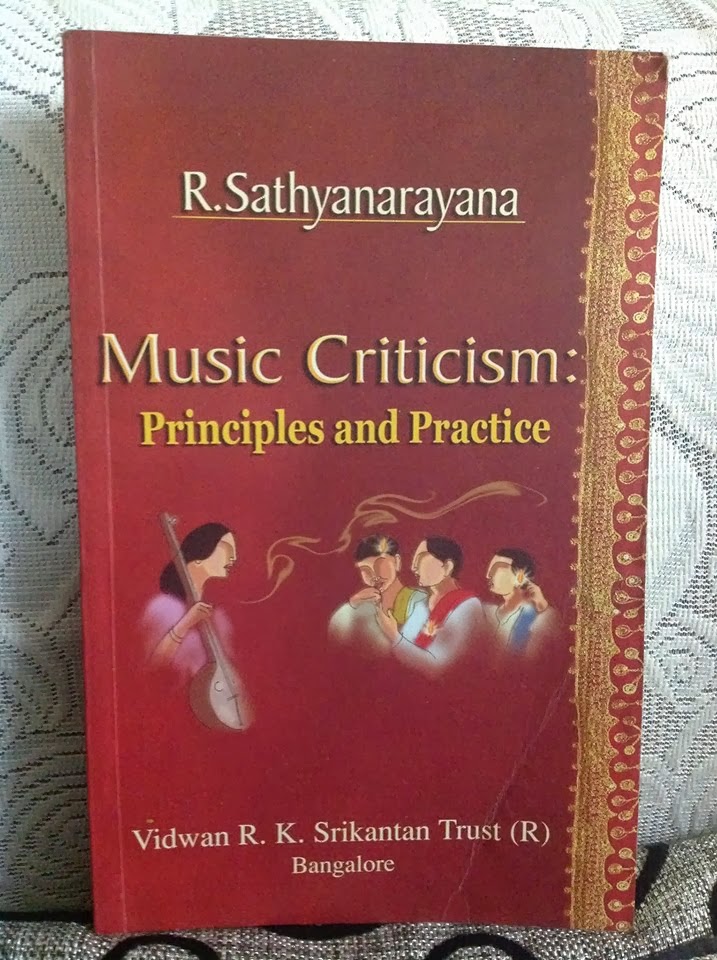
I have been following the south Indian Carnatic classical music for a while. For the past 7-8 years, I am attempting to writer some of my concert experiences in a blog, more as a reference than being a critical review. Because I have no formal training in the music, all that I could do was to cover the superficial aspect of the concert from a 'rasika's point of view, than to do an in depth critical and analytical view of the music that was presented to the public. I had a correspondence with one of the leading artist in Bangalore, around 6 months back, and while discussing on the subject of concert review, he said, this form of hasn't been explored to the fullest with the current generation of writers and press. We were to discuss this aspect at length, but it hadn't been materialised until now. In the meanwhile, this book was recommended to read.
R Satyanarayana, a leading musicologist with a number of highly acclaimed books and lectures under his name, is also a musician, a Veena exponent. His articles on various aspect of music has been very popular. He has been awarded by the Sangeetha Nataka Academy in 2009 among various other recognition. His scholarly research and publications are largely on the aspect of creativity in music and the interpretation of various schools of music and his study of umpteen manuscripts. However, in this book, he decided to look at the aspect of music criticism for a detailed study.
The book, as the title says, is divided into two parts ( or three with a study of a composition at length). the initial part looks the music criticism in its principles and the key aspects of music criticism. The second part is largely a collection of critical essays on music by some of the stalwarts in the scene, which provide the testimony of the theoretical aspect that was discussed in part one. The second part ends with a critical analysis of a composition ( SrI subrahmaNyAya namastE in kAmbOji by Muddusvami Dikshita').
Art Experience
"The primary concern of the music critic is understanding and explaining, interpreting or commenting upon musical experience". Experience for a grown up person a complex and multilayered, says Satyanarayana. It is dynamic to multiple factors. It has both conscious and subconscious state or the describable and undescribable content. The knowledge or awareness element is derived from sensory sources. These are then structured into definite patterns shaping their awareness. All conscious experiences are referential, its either external or internal. This experience is objective..from 'object to sensory organs, to the mind and to the soul is the progress of the perceptive experience. However, art experience if non-referential. Art experience results form 'contemplation' ( charvana) of the imaginative situation created by the artist. Artist contribute his power of creative activity. The listener ( connoisseur ) offers his share of imaginative contemplation , sympathetic understanding and feeling which are akin to the artist ( sa-hrdaya) and reproduces the art product within himself, before sharing his experience with the rest of the world.
Sri Satyanarayana, uses a vast of references from the ancient texts and scriptures and establish the connection of art experience and aesthetic value associated with art. He compares the tradition both in the Indian context and western context. While the western form of aesthetics are largely taken as beauty, the Indians use a much more complex word ' rasa' to describe the same. Aesthetic experience is conditioned by both objective and subjective elements. Moreover, aesthetic elements focusses on the feelings and emotion rather than reasoning and intellection.
The most important responsibility and duty of the art critic is to develop, propagate and sustain good taste in the arts in the members of his society. Taste may be defined as a faculty of mind by which it perceive beauty. While taste can widely differ from person to person, it may be possible to enunciate some fundamental criteria for good taste for the art in general. The ideal of art experience that the artist's practice of the art and the connoisseur's response to it.
Art Criticism
Criticism can be defined as a skill involved in evaluating , reviewing or judging the quality of a literary or artistic work which includes the implicit and explicit interpretation of the meaning and value of such art form. There fore aesthetics, art philosophy and art criticism together constitutes one single system of thought. A critic can improve the scope and quality of his criticism by exposing himself continuously to the aesthetic experience of his choice.It helps him to develop insight into the nature of the art as well as to the working mind of the artist. A work of art is significant in many ways, it is a reflection of aesthetic ideals, concepts and imaginations of its author, the representation of the cultural milieu of its time and the social demand and aspirations of the society. Art criticism is always contemporary and relevant. Art criticism ( for that matter the art form itself) can not escape from the 'cultivated' versus 'mass' conflict.
History of art and Music criticism in the West and India
Moving on from here, he discusses the aspects of music criticism in the West and in India. The music criticism in the Europe begun with the raise of new world of creative composers, in the 17th century. Germany, once the breeding ground for composers were again lead the way in the musical criticism. Germany produced numerous journals on music in the last quarter of 18th century, which not only published the new compositions of Mozart, Haydn and Beethovan, but also the first criticism on them. In the later centuries, the field of music criticism improved over the years shifting from the romanticism to the aesthetics and creative techniques. This period also produced the "composer - critics" in the field. Composers like Wagner, who wrote critical essays mostly for boosting or defending his own compositions. Tchaikovsky was the music critique for Gazette of Moscow. As is the case today, there were conflicts between the critic versus the artist /composor. For eg comments like' the immoral profession of music criticism should be abolished" ( by Wagner himself) were regular against the critics. Many literary bigwigs of Europe were also noted for their music criticism. Play Wright George Bernard Shaw produced some excellent , often witty, critical essays on music.. Anatole France and Roman Roland were few other writers who contributed to the music criticism scene. In the US, this was caught up in the second half of the 19th century and for now, they surpass the Europe and other parts of the world as the centre of musicological and historiographical scholarship.
In India, the art criticism can be linked to as early as the time of Bharatamuni. He is the earliest known authority on the model of art criticism. His writing ( naatyashaastra) covered all aspects of the performing art and was the pioneering effort in this aspect. On the subject of music, the first known writing is the 'Sangeetha Ratnakara (AD 1230) of Shaarangadeva, describing the qualities of the composer, the performer and the percussion artists. Various other writings in Sanskrit and other Indian Languages covers various aspects of the music, dance and craft forms over the years.
Musical Forms
Musical form is central to all music activities - composition, performance and experience. The process of musical criticism there for consists of analysis of the musical form and its structure. Art is created when form emerge out of symbols signifying beauty under trained and rational workman. Indian music by and large are textual , comprising of word ( pada), tone(swara) and duration (taala). They are lyrical or poetic based compositions. Few forms like mallari, jatiswara and rare cases thillana are without meaningful words ( they use unintelligent syllable for rhythmic pattern). As a consequence there are very few instrumental compositions in Carnatic music. In the recent past a few instrumental performers are trying to experiment with this aspect, creating compositions suiting their style while adherence to the grammar of the raaga or scale ( the western styled notes popularised by Madurai Mani Iyer, the 'raagapravaaham' seen in the concerts of violin duo Ganesh and Kumaresh are few examples, apart from the mallari usually played by Nagaswaram vidwans).
The music forms of Carnatic music can be summarised into 16 style : geetham, swarajathi, jatiswara ( without saahitya) , varnam, kriti, devarnama, ugabhoga-vachana,padam, javali, pallavi, ashtapadi, daru, tarangam,tillana,raagamalika and shlOka. In this the kriti, which typically written and performed in 'pallavi', 'anupallavi' and 'charanam' (PAC) format contributes to the majority part of the concert. From the musical form we move to the presentation form as the artist choose to align and structure his repertoire to be presented to the audience within the stipulated ( stated or assumed) time.
The Music critic
The criticism is the process of translating and grading the aesthetic experience, in line with its impact it created in the critics mind. The musicians task is to create with music and the critics role is to re-create the same experience with words. Critic means to judge, but in the real sense he functions in the role of an interpreter.
He continue to describe the role of a critic and the need to be truthful to the music and not the performer. A music critic faces many a problem as the art form unlike painting, sculpture or architecture are not fixed in time or space. A music that is delivered ( especially to Indian music) can not be repeated exactly. While we can record and listen the same again, it can not reproduce the same ambience, same state of mind and same cohesion of all that contributed to the experience in the same way. Hence memory plays an important part in the perception and appreciation of the performance. There for the concept, principle and rules of aesthetics vary for music over other forms of art. There is also this subjective-objective dilemma. While criticism is largely subjective ( based on the aesthetic experience), under the guiding principle, it is important to have a balance of subjective and objective element.
Sri Satyanarayana says ( in detail) the moral obligation of the critic should be, first and foremost, to the music itself, followed by the listener, the composer and then the performer. He also list down the qualification of a music critic.
- he should possess a knowledge of technical and theoretical principles of music
- knowledge of history of music and music scholarship
- general education coverving as many subjects as possible as cognate with music
- able to think clearly and write lucidly
- an insight into the workings of creative imagination
- have an integrated philosophy of life of his own.
- an endless curiosity and willingness to learn
- should know his own limitations and limitations of his profession
- a mythical superman ( who combines in himself at the same time the qualities of total absorption, yet distance, consonance with musician yet critical acumen)
- avoid being a cultural broker, a mere translator, or a public relation agent
- evolve an aesthetical theory of musical experience.
- should not fall prey to temptations of money, influence and power.
- insight into the creative states and mood of pre-expressional and expressional phases of the performer
- more than livelihood, it must be a way of living, a commitment , a dedication
- sensitive to the artistic values of the medium
- must have a command of language adequate to express his ideas
The second part of the book looks at the practice of music criticism in India, largely on the carnatic musical arena. Indian Musical criticism developed into the current state largely during the mid 20th century. The newspapers , as can be imagined, lead the way by publishing brave, venturesome critical reviews with little or no encouragement from the public or music fraternity. From the nascent stage of musical reviews , this has now grew multi folds with regular reviews in almost all the leading dailies and few limited musical journals ( shruthi magazine, for example). These reviews included portraits of the musician, critics on music criticism, views of the artist on music critic, reviews of the performance itself ( both live and recorded) and reviews of music books.
The rest of the pages is filled with notable reviews from the established critics in South India ( and a few from West as well, in which the essays of George Bernard Shaw were awesome) - Tamilnadu, Karnataka and Andhra- appeared in various publications.
Critical essays of E Krishna Iyer, N R Bhuvarahan, BRC Iyengar and concert reviews of SVK, Subbudu, Ranee Kumar, S V Seshadri and Interviews of artist and critics 'Gowri Ramnarayanan', of artists T N Seshagopalan ( who was very critical on the critics) , K S Mahadevan a book criticism by Sulochana Pattabhiraman , On a music sabha ( Mysore V Subramanya on Chowdiah Memorial Hall) were few notable inclusion. The section concluded with a brilliant study of the music of Gangubhai Hangal by Sri R Satyanarayana himself.
The last chapter is spent on the critical analysis of a musical composition. While we see lesser study in this aspect, with most of the musicians prefer to perform the well established compositions, I was wondering why wasn't there any serious study done in this aspect of the music criticism. The only critical, usually with admiration and praise, study of the new composers and their compositions are limited to the lecture demonstration by one of the performer, who uses this to sing and introduce the creative aspect ( historical background) of the composition, rather than the creative merits and demerits of the product. Sri Satyanarayana chose a well known composition of Muddusvai Dikshita, in kAmbOji ( Sri Subramanyaya Namaste) to introduce this aspect of critical stud
A first of its kind book, dedicated to musical criticism is treasure for the likes of me. The highly informative and deep understanding of the aspect of art and music in the initial part is not only scholarly, but a very well thought out presentation. The second part is not as dense and elegant, but it provided ( some of them at least) a better understanding of the subject that was discussed in the part one. Despite the abundant use of Sanskrit words ( with English equivalent), inevitable due to the references to the ancient texts, this was very readable and easy to understand. The structure, the language used, the examples and references were appropriate. A few spelling errors that crept in could have been avoided.
A great reference to creative writers and those writing about arts in general and on carnatic music in particular. I am expected to do a better job with my writing armored with new understanding of this genre of writing.
------------------------------------------
Music Criticism: Principles and Practice (2006 )
R Satyanarayana
Vidwan R K Srikantan Trust
277 Pages
-------------------------------------------
The Hindu,


