Showing posts with label Scotland. Show all posts

Monday, October 14, 2013

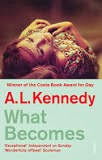
What Becomes - A L Kennedy

A L Kennedy's books aren't easy to get into. This is my third book and the result wasn't any different. That does not make it a bad book, on the contrary. Each of these stories are good, some very good. The twelve stories in this collection are something in common. They all follow the plight of individuals ( or couples) fighting their own separation from the other.  Some imminent separation, some on the verge of isolation, some even being together has the hidden bridge of separation. All the characters are young/middle aged couple and picked straight out of the daily life. No stories, none whatsoever, has a pleasant ambiance, the gloom and sadness is the feeling in the air. Thus it makes a depressive read, however effective the narration is.

The first story that bears the title of the book, reflects on a couple unable to recover from the loss of their child. Sitting in an isolated cinema hall, alone, Frank looks at the failing marriage with his wife. In an attempt ( final ?) to win her over he even makes a soup for her before her return from the workplace. The attempt however fails after he cut his finger resulting in blood stains all over the kitchen and the soup. Kennedy plays well with her writing here, trying to portray the failure of the relationship as every thing around them is deteriorating.  "Wasp"s again about the imminent separation, albeit short . Its the day of the morning when he had to say good bye to his wife and two young sons, prior to his travel on business. But there is clear signals of the widening differences between them and the difference is clearly played through the children. "Edinburgh' again is a superb build up of an affair, coming to an sad end.  An affair started at the grocery shop of Peter, took him through the realms of love, only to be disappointed in the end. Here we see a clever writing of Kennedy where she interestingly mix the voice of the mind to the voice of the body. A dual communication technique, one to the outer world and the other to oneself cleverly juxtaposed in the narration, giving it an unknown depth. Another interesting story of the collection is Sympathy. A writing almost flirting with pornography, about an accidental one night relationship in a hotel room. Mostly told in the form of conversations, despite their short lived romance, mostly sexual in nature, separate on a promise of a call and a meeting in near future, with both know is not for real and this rendezvous will end as abruptly as it started.  In 'Saturday Tea Time' a young lady recovering in a 'floating tank' remembers the time of the young days where she had witnessed and was subjected to domestic violence.

Each of these stories carry the same line. They are all melancholic, they are all makes one feel for those living it out.  The voice here plays a big role, beyond the narration. It's beyond the written words, they are layered and have various undercurrents of humor, sadness and heart break in some form or other. She uses words cleverly, there are metaphors in abundance ( the wasp for example), philosophical undertones ( in Edinburgh, especially towards the end), and social observations. The characters of these stories are tied to their destiny and do not show any attempts to shackle out of them, rather they endure them with somewhat inner pleasure of a defeatist.

A L Kennedy is a brilliant writer, fabulous use of the words and clever mix of narrative techniques. These stories, while the overall gloomy ambiance is a bit depressive, do seek in with their sheer brilliance.
 ------------------------------------------
What Becomes (2009 )

A L Kennedy

Vintage books

218 Pages
-------------------------------------------
Guardian, Telegraph, N Y Times, Irish Times, Independent

Tuesday, April 16, 2013

The Prime of Miss Jean Brodie - Muriel Spark

"Gold Biscuits" were one of my junior batches would loved to identify themselves trying to establish their association with a rather nutty professor we had. Every professor would have his favorite batch in College. Typically, it would be the batch he or she is entrusted with in his initial years. They are typically known as his pet team. The team, continue to identify themselves around the same group nearly after 20 years. The most known work of Muriel Spark is around the same theme. 1930s  Miss Jean Brodie, came to the Edinburgh school to take care of a batch of young girls. She was responsible for their early leaning for nearly 2 years. But the 'Brodie gang' remained a group beyond those two years and came to identify themselves as Brodie set. Its a different fact that it is one of them who became a traitor and was responsible for her ouster from the school.

Miss Brodie, who claim to be at 'her prime' was different from the rest of the teachers. She is known for her open nature and trying to bring out fresh thinking to her pupils. She was sympathetic to Hitler and had a liking for Mussolini's men. She had returned to Scotland after her stint in Italy, a sight of the marching of the Soldiers she cherish even now.  Her stories of her travel during vacation, her love affairs and her rebellious nature of living was a great influence on the young girls. As the girls grew, the bonding continue through occasional meeting at Miss Brodie's place.  The gossip around her affairs with the one handed art teacher, and the music teacher added to the overall mystic nature of the lady. The others weren't in agreement with Miss Brodie, especially the young Principal of the school, who waited for a reason to remove her foe. It had to be one of the members who betray their beloved teacher.

The character of Miss Brodie is said to be based on Christina Kay, a teacher of Spark for two years at James Gillespie High School for Girls. Miss Kay supposed to be a conn osier of renaissance paintings and a fan of Mussolini's fascist Army. I haven't read any other book of Spark , hence can not comment on her style. To me it was a simple straight forward read. She has a way with her narration which eases into you. If you read it from a feminine writing angle, I guess this as more relevance in the 30s. A character which rebel against the set norms of the social structure, some one who is open and try to inculcate the similar nature of thinking in the girls. As you see, some of the girls later develop their own identity ( "Rose famous for sex, Jenny Grey famous for her beauty, Sandy with small eye, Eunice famous for her gymnastics) as they grow old. This is done in a curious flash-forward technique, Mary McGregor , At the age of 23 she dies in a hotel fire, etc.

Nice little novella, with certain significance in the time it is released and is  considered to be one among the best of 100 English novels. To me, this was a nice little fast read, but will probably look for a couple more of her works to get a feel of her style.

--------------------------------------------------------
The Prime of Miss Jean Brodie (1962)

Muriel Spark

Harper Perennial

150 Pages
------------------------------------------------------
Guardian, Wiki

Sunday, May 20, 2012

A Chancer - James Kelman

James Kellman's books aren't an easy read. Most of them around the working class life in Glasgow and around are gloomy in general and hardly with any optimism. His heroes while being part of the larger working class fraternity, are loners and and aloof. This is my third book of him and I was more prepared to this time with his style and the overall outlook.

Tammas, is a twenty something compulsive gambler in Glasgow. His world , after leaving his job, revolve around betting dens. From race courses, to Casinos, to Dog racing tracks and often with cards. Typical to the stories in such cases, he win occasionally and looses more often. Usually, with no money, he lives with his sister and brother-in-law, often being at the receiving end of their displeasure on his indecisiveness in life. Its the alcohol and the betting that drives him through out the day. His couple of attempts to get back to normal way of living, by joining the factory did not last long - less than a day in his last attempt. The closed environment of the factory set up suffocates him, making him leave that for good.

There is no real motive in his life and he has nothing to look forward to. The wandering from pub to pub, from one race tracks to Casino is what tick him along. His friends, are now taking serious steps in life, one leaving for Hull city to play in their Club, while another is migrating to New Zealand, yet another planning for his eventual move to Manchester, where he is expected to get jobs in the mills. All these do not affect Tammas, nor is he persuaded to join them. He is also passive to his girl friend Betty and avoids her. The 'Giro' that comes in the weekends are hardly enough and he is usually 'skint' by Tuesday. He then has to pawn his 'suits' or any other items from his sisters household to run the rest of the week, until the next Giro.

The book progresses through these lines, slightly getting repetitive and dull to some extend. This book is not plot driven nor it is a great story telling. It moves through the life of Tammas at uneven pace. It is only in the end pages, that Tammas likes to take his chance with life, after he falls in love with a lady whose husband is in prison.

This book will bore most of the readers, unless you are familiar with James Kelman's style. There are no events unfolding which are significant. There are no dramatic moments. The writing is different and the page is full of swear words. The language is with Scottish dialect ( I am used to this after reading Kelman and AL Kennedy) .You often get a feeling that the writer has abandoned you with his protagonist and you both are left to find your own way. Once you are used to this, you find the reading much more relaxing. Having said that, I preferred his short stories to his novels , from what I have read.
-------------------------------------------------------
A Chancer ( 1985)

James Kelman

Picador

308 Pages
---------------------------------------------------
Read: Here is a profound essay on James Kelman, and particularly on A Chancer.

Saturday, September 24, 2011

Day - A L Kennedy

Working as an extra in a war movie, being shot in Germany post the World War II, Alfred Day trying hard to get back to the mainstream life which seem to be alien to him. His life as he recounts in bits and pieces isn't been one that he would look back with happiness. Early days of life with his alcoholic father physically and mentally abuses his mother bore the memories of his troubled childhood. It is to escape this situation at home, he decided to join the RAF during the war. He volunteered to be part of the Airforce and was happy to take the position of a tail-gunner.

He camaraderie with his bomber mates were to compensate for all that was missing at home. Even that seems to be short lived after a crash and him being detained as PoW. His accidental meeting and the love that budded with joyce, a married woman whose husband apparently missing in action in the east somewhere, is the only colour in his life, which he again looses on his return post the war.

Unable to find himself in the society, he find himself a job as an extra in a movie. Its here again, he find himself alone. Effort to be in connection with fellow artists ( a Ukrainian wanting to migrate to UK) also ended up in bitter physical fight.

A L Kennedy is able to recreate the sentiments and the after effects of war on individual. Dark and gloomy and often hopeless plight of individuals are brought out pretty well.It is only at the PoW camp ( even if it is a mock set up for a movie ) he find his place. Day is a internalised , non socialising , tormented man and the style and structure of her writing depicts the exact nature of her protagonist.

Her style is not easy to cope with. Its extremely demanding and require utmost concentration. In that way, the reading wasn't very pleasant. It moves from first person narrative to second person ( you, type) and the third person in the same paragraph/page. The writing is abstract and stingy. Once you get over these obstructions, the book is pretty good and intelligent.
------------------------------------------------------------
Day ( 2007 )

A L Kennedy

Vintage Books

280 Pages
-------------------------------------------------------------
Other Reviews : Independent , Guardian , NY Magazine

Sunday, September 26, 2010

Now That You're Back - A.L.Kennedy


A L Kennedy's ( Alison Louise Kennedy) name have been coming up in my reading circle for a while and I haven't  read any of her works. This book, one of her early writings was the one I could get hold off. A collection of short stories as the blurb say "exposing and exploring the sinuous undercurrents of violence, anguish and love" is a good introduction to this gifted writer.

The collection of 13 stories has its own draw backs. Most of the stories are of people living in isolation, trying to find their own feet within the society and within themselves. These are not the characters you feel closeness or sympathy. There is a level of detachment and possibly that could be one of the inhibition in approaching this book. The later half of the book, I somehow found to be more interesting especially stories like 'Mixing with the folks back home  ( about a serial killer), warming my hand and telling lies ( a retired writer ), and friday payday ( about a prostitute) .  She has also experimented with the form in 'Mouseboks Family Dictionary'.

She has incredible style of writing and with sly humor. The prose is very moving at places and seldom loud. I find each emotion, be it anger, love or friendship is treated tenderly with balanced approach. This alone is enough for me to hunt and buy one of her full length novel. 

Unlike James Kelman (another Scottish writer), I find her characters away from the mainstream society. Personally I find more closure to Kelman's characters than to this one.

------------------------------------------------------------------------
Now That You're Back ( 1994 )

A.L.Kennedy

Vintage Books

248 Pages

Rs 525/-
------------------------------------------------------------------------
Other Reviews : Independent 

Tuesday, March 16, 2010

Not Not While the Giro - James Kelman

Considered as one of the leading exponent of Working class literature, James Kelman's first collection of short stories, published in 1983 was a huge success. Stories about these working class people, who live an abandoned life in rented cottages and the dreaded factories. The work in the day time at stupid conditioned, the evening usually spent in the pub over a pint, some gambling. The concerns of every one is the same. The hand to mouth kind of living, no luxury whatsoever. Most of them live out of the weekly unemployment money they receive or the meagre wages, spending the money in first couple of days on 'pint' , on gambling ( dog races, horses, on cards, on pool table) often defaulting on the rents, living last few days starving.

Most of them are alone, living in small cottages, along with co workers , isolated from the near and dear. Few occasions of being near to the fairer sex, they are often confused and does not know how to proceed ( Stories like 'Ten  guitar, the hitch hiker and Jim Dandy').

This collection has some fantastic stories. Not Not while the Giro the story carries the name of the collection, is the best for me. Over the perennial wait for the Giro ( the unemployment benefit), the lavish living over the weekend, the struggle for the last 4 days, before the next payout. But he never stopped to dream of his life out of this. He is not happy with the free money, he has his on dreams and plans

    Seriously, I am fed up with being fed up. What do I wish

             I shall not entertain day dreams
             I shall not fantasise
             I shall endeavor to make things work
The situation is so bad, that there is a scene, where he suck his own thumb, hoping for some traces of nicotine taste.

Acid, a one paragraph, half a page story talks about an accident in a chemical factory, where a young worker falls into a tank of acid, screaming for help before he succumb to death. There is nothing can be done to save him, when an old man comes over using a mopping stick to push the still floating head the remaining down to the acid, who happens to be the father of the dead.

In the house of old women, we see three young men in a newly rented house, fighting over small comforts and see the deterioration of the friendship. Jim Dandy, contrary to his image seems to be struggling with himself when the opportunity arise. Nice to be nice is one story took ages for me to complete. Written completely in the local dialect, had be reading it for four hours. 'Ten Guitars', 'The hitchhiker' and 'Double or clear plus a tenner' are other important stories.

There is an undercurrent of anger, by the writer while the up front is detached. The society, in general and the authorities in particular aren't in sympathy with them. Though they do not rebel against the system, they do so in the ways and means they are familiar with.

James Kelman uses the swear language liberally in his writing. I was amazed at my first reading of this writer ( A Disaffection) on the number of four letter words per page. I heard form othere too that the initial reaction for them wasn't any different. But as you get used to his style and his writing background, you starts appreciating this writer. In this collection too, the people are the working class, and they have the right to speak the language and Kelman uses it to its best effects.

Acclaimed collection of short stories, one of the first to be published by Kelman, who later went on to win the Booker in 1994.

-------------------------------------------------------------
Not Not While the Giro ( 1983 )

James Kelman

Vintage

207 Pages

-------------------------------------------------------------

Sunday, January 17, 2010

A Disaffection - James Kelman

Patrick Doyle is bored in life. Frustrated with his work as a teacher in the local school, he wanted to leave it all and go for a trip to the south. An alcoholic, to the level of self destruction, he does not have much of life outside the school and the pub. Staying alone, with rare visits to his parents ( forced to watch the telly with nothing to talk to them) and his elder brother ( married with two kids whom he adore) to a an occasional coffee , he has no social circle. Already twenty nine, un-married, with no girl friend , he is an outsider to the society. However, he relishes a silent on way infatuation to his colleague Allison, who is married and supposedly leading an unhappy family life.

Patrick feels himself as a victim of the hypocrisy of the society. He goes through the routine of predictable life. The working class pubs, take-home dinners, lonely weekends. The only solace is the two pipes he finds in front of the pub, which he brings home and plays to drown his sorrow and frustration. Finding himself entrapped in this society, he goes through the thoughts of suicide and of going for a long journey down south ( in the pretext of meeting his old friend). The imminent transfer of his job to a suburban school adds to the feeling of rejection and victimisation within him.

Very depressing novel, the clever use of language and the often funny Scottish dialect is one reprieve from the negative mood through out ( highest count of F words per page). This book was short listed for the Booker price ( he won Booker in 2004 for a later novel). Very powerful, detached narrative, rarely straying from the theme, portraying the inner turmoil of a troubled youth.

-------------------------------------------------

A Disaffection (1989)

James Kelman

Vintage

337 Pages

--------------------------------------------------
Read More : Glasgow Guardian , Interview with James Kelman at Barcelona Review