Saturday, December 11, 2010

The Good Man Jesus and the Scoundrel Christ - Philip Pullman

...But this is the tragedy; without the story, there will be no church, and without the church, Jesus will be forgotten... Oh, Martha, I don't know what I should do.'

' You should eat your supper', said Martha.

Part of the myth series published by Canongate, this book by Philip Pullman is already making some news. Looking at the most retold story of Jesus Christ, in a different angle, Pullman offers his version of the story. The back cover insists that "this is a story".

" I've always been fascinated by the two parts of the name of Jesus Christ, and by the difference between them. Another thing that's interested me for a long time is the way in which the Christian church began to formulate its beliefs and establish a canon of scripture: there were many more gospels than four, but why were those four chosen and others left out? When did Paul begin to write his epistles? Was what he said different from what the gospels say? Do the gospels even agree with one another? Was there a difference between Jesus and Christ? My version of the Jesus story doesn't attempt to solve these questions, but I hope readers will find it interesting " - from his website

Mary, young girl married off to an old carpenter Joseph. Joseph left the young Mary at home and was often away with his job. It was during this time a messenger came to her and told her about the divine life that is going to take shape in her womb. She was worried about the controversy, being pregnant while Joseph is away. As we all know, when the time arrived, fearing the rulers anger, Joseph takes his wife on a journey to Egypt and the give birth to Jesus in a make shift shed amongst the animals . Here is the twist to the story. Mary gave birth to twins, one was Jesus and the other Christ. The angels and the other omen pointed out Christ as the saviour of mankind. Jesus grew typical to any young boy, strong ,often naughty and hardly showing any signs of intelligence. Christ on the other hand was thin and frail, showing early signs of maturity and intellect. During the adolescent days Jesus runs away from home, and it was Christ who manages to bring him back with reasoning. The early stages of miracles were demonstrated by Christ.

However, towards baptism by John, there were changes in Jesus. He left home and spent time in the forest praying and identifying himself. As the rest of the story goes, Jesus now have a followers of himself. It was Christ who advises him on the importance of performing miracles, the need of healing the ills, the need to preach. During this time an angel in the form of stranger make an appearance to Christ and ask him to document all that is done by Jesus. Christ, follows Jesus without his knowledge and writes down all that is spoken and performed. At place where he cant reach, one of the disciple help him by recounting the events.

The rest is known to all. The growing popularity of Jesus is not welcomed by the authorities. To their dismay, Christ defeats the arguments of the Law makers at multiple times. His followers belongs to every walk of life, from whores to taxmen to the people of meagre means. Unlike the biblical story, it was Christ who betray Jesus here, Of course under the instruction form the angel. The crucification and the resurrections are then described in very realistic terms , may not be to the agreement of the believers. It was Christ , who appears in front of Mary of Magdela and to the disciples. It was his version that then discussed and spread amongst the believers.

While I am not a great fan of such novels. It leaves a lot for debates and discussions and the freedom of the writer to deviate from the known story. This book too suffers from the influence of the original. The necessity to abide by the flow of incidents that is of importance, but the need to include in his version of narration, it looses some of the initial steam in middle. However, he finishes this brilliantly. I found the passages of Jesus contemplating his actions and their results, and his doubts on the God and the role he has to play, written beautifully.

Fast read, large size print ( lesser strain to your eyes) and short chapters make it easy to finish. Very average book, except a few brilliant passage and two twist to the tale ( the twins and the concet of Christ betraying Jesus). If you are interested in these kind of books, I would recommend Nobel Laureate, Jose Saramago's Gospel According to Jesus Christ to this one.

--------------------------------------------------------------
The Good Man Jesus and The scoundrel Christ ( 2010 )

Philip Pullman

Penguin Viking

245 Pages

Rs 499
----------------------------------------------------------------
Other Revirews: Wiki , Guardian ,

Poory Made in China - Paul Midler

Known as the world's factory, China is the epicentre of every manufacturing activities of the universe. China's undisputed growth to the leader of the manufacturing had been carefully and methodicaly orchastrated over the past 30 years. There are many economic and financial studies available on this exponential growth, most of them written by academics. However, there aren't many that gives us the inside story of the phenomenon. Paul Midler, who spent a large part of his early career in South China - the hub of the manufacturing activities- tells us a story of the typical manufacturing business and their relationship with the western world.

Off shore manufacturing is now inevitable for every business, if they want to remain in business and be profitable. Midler, stationed at Guangzhou, working for various US and European corporates as their consultant, takes us through the interesting journey of his experiences with some of the manufacturing companies and their clients.

One of the initial question which pops up the mind of the readers is why China. ? Many of the other south Asian economies are equally competitive if not cheaper.
"One of the questions many were asking was: Why China? Why weren't importers looking to other markets ? The answer most often given was the low cost of labor, but that was only part of it; factory labor in other economies was actually cheaper. Speed and convenience were two other important areas where China performed particularly well."
He also says ( with a soft 'below the belt' remark on India ) the difference between Chinese approach to the business and interaction with foreigners to that of some of the other economies..

"China was exotic, but it was not bizarre. Chinese did not dress in native costumes, they wore no headdresses or long robes, they did not go around in sandals. They did not have the habit of sitting on the floor. Chinese did not bow or require that visitor make unfamiliar hand gestures, and the people were pleasantly irreligious...The Chinese were traditional, but not fanatical. They did not paint their faces or tattoo or pierce their bodies. Such colorful native traditions made for interesting tourism, but people or business were not vacationers."
Getting into the thick of the action, he explains some of the methods used by Chinese Manufacturers to win business. As one of his client wondered, how are they manage to produce them so cheap. Its only later he realise the terrain he is getting into. To win business, the enterpreuners are willing to go to any extend. However, once the manufacturing contract is signed, the ball is now on the importers court. The original specification is often tampered with , without any consultation and confirmation from the client. It starts with the packaging, the quality of the bottles used, the measure and quality deviations, etc. Quality cost then passed on to the importer. The importer is now in a fix. Sitting on a larger order from the retail chain in the US, he is now forced to concede. Any changes to the original plan is to be paid by the importer. By now, the manufacturer has already know the 'product specification' and can be reproduced on his own. He could eve by pass the importer and deal with the retail chains directly. The game of one up-manship continues until the importer concedes and often goes out of business.

Some of the smarter ones gets into a joint venture agreement with their Chinese counter parts. This is often turns out to be a bigger mess. Invariably loosing money in the JV, while the local manufacturer continue to build newer factories at the expense of is global JV partner, it usually ends in bitter separation.The local authorities and the law aren't very supportive, hence most of the fooled ones wind up their operations and return.

There are issues of counterfeit, the perennial issue of quality, the arrogant attitude once the business is secured, managing the books of accounts, the fear of bypassing the importer; issues are many. "Chinese manufacturing had serious issues, and these were not very well understood while looking at them from a great distance."

But, why is that the world is still going to China for manufacturing. Mostly because, there is no alternative. Moreover, it is now globally accepted that goods made in China is the cheapest. As he mentions..

If an item was quoted at 65c and made in the USA, the buyer figured it could be purchased somewhere cheaper. When the same product was quoted 65c and was said to have been made in China, the buyer figured it could not be found for any less.
The extra focus and development in the manufacturing leaves lot of the other areas a lot to be desired.

At one time, China had a reputation for innovation, having invented paper, gunpowder and the compass; but in more recent centuries, that spark of discovery was replaced by an instinct for copying - not just technologies, but also entire business model"..
He says this model is not sustainable. "No economy could ever win a race by merely catching the wind off another's sail.."

Having said all this, where are they headed. Midler says, over the years it will be difficult to sustain the same level of growth. Domestic consumption is heralded as one of the alternate growth story. There are other political and economical issues and related tensions between states. But there is no change expected in the near future. On a long run, Milder says it could be "The rise and fall of China ?"..."More like the rise and stall of China"

Very very interesting read, very curious for me as an Indian. Fast paced, funny and and easy read.
-----------------------------------------------------------------
Poorly Made in China ( 2010 )

Paul Midler

John Wiley & Sons

242 Pages

Rs 395
-----------------------------------------------------------------
Other read : INSEAD , Danwei

Sunday, November 28, 2010

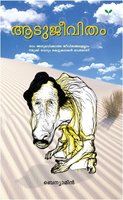
Aatujeevitham - Benyamin

There hadn't been many novel that caught the readers attention in the recent years as this one. Many have been recommending this to me over the last one year. It is only now, that I could get hold of a copy. This book was again in news after it won the prestigious Kerala Sahitya Academy Award.

Fictional account of a real life story of Najeeb, one of the millions of Keralites in the Middle East. Like many , Najeeb was also offered a Visa to go to the Gulf by one of his friends relatives. The relatively large sum of 30000 was managed with the help of well wishers and friends, and he reach Saudi Arabia, leaving behind his anytime expecting wife and mother. Hakeem, a young boy from nearby town to his company. The wait at the airport was long, and the Arbab ( his sponsor) did not turn up at the arrival terminal. The wait was long, until they saw an old, almost into pieces, truck arrive and the driver jumps out. They were put behind the open truck, without any communication and drove out of the city and the crowd into the wilderness of sand.

In the midst of the desert with no visible places of habitat, they were dropped at two separate places. It was night and the stench coming out of the place was unbearable. The rest is one very disturbing tale of survival. Forced to look after goats and camels, with near nothing to eat and no proper accommodation, The only other human, who was at the place while when he arrived, went missing the next day ( it was much later, he discovers the bones and torn dresses buried in the desert). With one days experience of managing the herd, Najeeb starts his eventful life with the Animals to communicate. There was no other human in the vicinity and the only contact wih the outside world was limited to the weekly truck that arrive with fodder and water. Najeeb endures the place, the beating with the belt, the often uncontrollable animals. The rare hopes of escape was ruthlessly crushed by the Arbab. The servile life continued more than 3 years ( there is no count of days and months in desert) until he was rescued by travelling Arab who brought him to the city.

While the incidents are real, Benyamin asserts that he morphed himself with the real Najeeb while writing. The sequence stay to the truth, but a fiction can not be a biographical essay. To his credit, Benyamin, does this job brilliantly creating a beautiful novel.

The narration is simple and very ordinary. It does stay to the emotional and sentimental side of the readers. There is a detached style of writing, with the humour of a defeatist. He is able to look at things with such an open mind with no regret or anger. The structure, language and method is not something that of a masterly work , however the novel connects with the readers at very personal level. One of the better Malayalam novels I read in the recent past.
---------------------------------------------------------
Aatujeevitham ( 2008)

Benyamin

Green Books

212 Pages

Rs 130/-
-----------------------------------------------------------
Other reviews : webmalayalee

Sunday, November 21, 2010

Conversation in the Cathedral - Mario Vargas Llosa

Month of November is for reading the newly crowned Nobel prize winner. Unlike the last couple of years, this time it wasn't some one new to me. Having read 10 odd books by Mario Vargas Llosa, I wasn't looking forward to a new revelation of an author. However, there is many of his books, I haven't put my hands on. That could be a lie, if I talk about this one. Having bought this in 1995 and started a couple of times, but never going beyond few pages ( I do not abandon books, but this book was an exception). The reason for putting it aside was not because it was not interesting or I do not like the writer, but was some stupid house moving etc. The announcement of Nobel Prize, thus became an inspiration to take this up again.

Written as conversation between two people on one afternoon in a local pub, this giant book of Mario Vargas Llosa, take us to the 50s of Peru under the dictatorship of Manuel Odria. Santiago, an editorial page journalist with La Cronica, goes in search of his missing dog on the insistence of his wife. The dog was forcefully taken from her by the dog catchers, who are paid by the authorities by the count of dogs. It was during this recovery of his dog, Santiago met with Ambrosio, an old time associate and driver of his politician cum Industrialist. Over the next few hours they discuss the period of the dictatorship and their life during those times over few bottles of beer at a shady pub known as the Cathedral.

Young Santiago, an idealistic young boy in his early twenties, move out of his house with differences with the family and their association with the power, leading a nomadic life there after. He gets into trouble with the authorities with his involvement with the Communists and APRISTAS ( members of APRA another rebel outfit who ruled Peru before Odria) and soon get disillusioned with politics, gets into the life of a journalist.. "My whole life spent doing things without believing, my whole life spent pretending""And my whole life is a lie, I don't believe in anything." His low paying job is just enough to make his ends meet , but he refuses to take any support from his super rich family.

Through Ambrosio's narrative, Santiago understand the complex and dangerous life his family is leading. At the high level of political circle, no one is safe. As he explains, his father has business interest than political. Having dependency on the Government orders for his business, he was suddenly left to nothing when these were suspended by fellow minister. The political quagmire and the unrest in the society lead to the elimination of many a powerful leaders changing the fortune of the family

This is a book on Power and Politics. This is not about dictatorship and cruelty, It examines the life of people closely associated with the power and however close you are to the power you are not any different from the people on the street. Every minister is corrupt, some of them run prostitute ring, they are low in morality and often spend evenings with their mistresses and wild parties. Political manipulations and repression is rampant and most of the close associates of the powerful men do the dual roles ( chauffeur as well as henchman ). To his surprise Santiago realise the involvement of his father in a murder and his unnatural sexual tendencies. Despite his trouble relationship with his family, especially his mother, his relationship with the father was always courteous and with respect. His father was always concerned about him, while respecting his decision to be independent, while the rest of the house consider him as a looser.

There is depth in every character and the interlink is strong and methodical. Be it the wife of Ambrosio, the cook in the family of Zavalitas or be it the mistress of the ministers. Llosa deploys a very complex structure of narrative. There are 3-4 conversations simultaneously, between different people at multiple places and different time period. Hence it is demanding on the reader. The book is long and fine printed. But this is very engaging, and never a dull moment. The secret or the story is revealed gradually and the build up is done phenomenally brilliant. Llosa's mastery in story telling is at the best. This book is considered by many as one of his best works.

------------------------------------------------------------------
Conversation in the Cathedral ( 1969)
Mario Vargas Llosa ( translated from Spanish by Gregory Rabassa 1975 )

Faber and Faber

601 Pages
------------------------------------------------------------------

Saturday, November 20, 2010

The Tipping Point - Malcom Gladwell

Last month, in an educational program, we were running a simulation of a sales call. My team, consists of 5 people from 5 different nationalities( Korea, Taiwan,Thailand and Indonesia), were seemingly ahead of the rest of the groups. After converting each of the so called leaders there were roars of success and high fives. The early stages were very difficult and halfway through the task seems to be easy and the conversion happened at a faster pace. The professor , peeped in to check our progress, muttered 'tipping point'; and vanished. Next day, we were given this book for being the best among the rest.

Not that I haven't heard of this book earlier. I am not a great reader of management ( or similar genre) books. Few of my collegues ( Tobby , especially) was very vocal on this book. That prompted me to read this after a heavy dose of Mario Vargas Llosa.

Malcolm Gladwell says that in the acceptance and implementation of every idea, product, decease or service, the graph follow the 'early adopters, majority and laggards curve. However, during the phase of its journey comes a stage where the 'conversion' become an avalanche ( a word of mouth epidemic). This point, where the rate of conversion become the fastest, he calls 'the tipping point'. Citing numerous examples from Hush Puppies to the Aids Epidemic, he explains his theory in detail in this book.

Connectors are those with innumerable contacts. They are sociable and can recall many names at any instance. They are extraordinarily good at making friends and acquaintances. Mavens are those with lot of information and with a mind set to help others. He reach out to others to solve their problems. Sales men are capable of negotiating and getting what they wanted. They manage to get people agree with them.

There are three rules of the tipping point : the law of the few, the stickiness Factor and the Power of context , which explains us the cause of the epidemic. Law of the few says that there are exceptional people who are capable of starting the epidemics. He catagorises them into three : The connectors , the Mavens and the Sales Man.

It is not only important to have the right people as your front end guys ( the connectors, mavens etc). The idea has to stick , it has to be compelling and should have value. The lessons of stickiness is the same. There are simple way of packaging information that, under the right circumstances , can make it irresistible.

However, the whole thing has to be looked at with "the power of content". The human behaviour is to a considerable extent influenced by the environment . The epidemics are" sensitive to the conditions and circumstances of the time and place".

The concept is very good, so was the delivery. However, the book is very verbose, with too many examples, some of them wasn't connected that greatly with the subject. Probably a bit too long. Otherwise, this has been an interesting reading.
-------------------------------------------------------------------
The Tipping Point ( 2000)

Malcolm Gladwell

Abacus

279 Pages
-------------------------------------------------------------------
More : Wiki

Sunday, November 14, 2010

Tomorrow is One More Day - G Nagarajan

In line with the world literature during 60s, there had been many writings in Indian Languages with their influences. Some of the young writers who started writing during those ages weren't free from those leftist, realistic and existential influences in their writing. G Nagarajan, I understand is one of the proficient writers in Tamil during those years. Tomorrow is One more Day originally written in 1974, has been one revelation to me, thanks to the recommendation from JP.

Kandan is a simpleton, lives his normal life. This short novel takes us through one day in the life of Kandan. His day starts with a beautiful dream of the vision of Goddess. To him she had the features of his mother. Kandan is a small time pimp, an agent or a middleman. The fate hadn't been too good on him. He does not remember his father, his mother died and the small property had was taken from him . He sold it, but was cheated. But, soon he had to go work for the same person, who cheated him. . He now lives in the slums, with his wife. We understand that his son ran away from home, his girl died in the government hospital, after the local remedies and the astrologer failed to save her. However, Kandan is indifferent to his fate and his current conditions and does not carry any ambition in his life.

"What is your goal in life, anne ?", Muttuswamy asked.
"What do you mean" ?
What do you want to achieve in life ?"
Kandan laughed. "What did I want to achieve in life when I happened to be born to Sornattammal ?"

The set up is typical Tamil Nadu village. All the characters you see in the daily walk of life appear in the novel.  As the day begins, he search for few pennies to have his days first fill of Alcohol. Sending his wife on 'duty' ( he does not have any regrets, neither does she), he flirts with the local lady. Their fortune depends on the business done by his wife, and most of the days, they survive by the grace of the local shop keeper. The day progresses through various errands, but happens at an arms length, with Kandan participating with a level of self detachment.  All days are similar to him, with nothing worthwhile happens in his life.  "Wherever you looked there was development; wherever you looked there was a change. Only in his life, it seemed, nothing at all changed."

However, as the day ends, Kandan witnesses a murder, the murder of Solai Pillai, his well wisher.  The reporter/witness now was framed as the murderer. The inability to garner support or the financial difficulties to get a proper legal help gets him into prison. As Kandan tries to explain himself at the court, making himself a laughing stock to the 'educated' in the court room. He was cheated again and was duly sentenced.

The book comes with a detailed introduction by David Shulman, giving us the glimpses of the life and times of the writer. Book is translated by Abbie Ziffren, and for once I found an Indian book with amicable translation into English. Strong influences from the western existentialists and the communist belief ( Nagarajan was a member of the Communist party at the time of this writing) is evident in the writing, as he is called Tamil Camus.

A surrealistic short novel of pathos, indifference and about the marginalised section of the society, people who matters only in the ballot boxes.  Very moving and very touching..
--------------------------------------------------------------------
Tomorrow Is One More Day (1974)

G,Nagarajan ( translated from Tamil by Abbie Ziffren with A Julie)

Penguin Books

99 Pages

Rs 199
---------------------------------------------------------------------
More read :  Deccan Herald , Jayaprakash

Sunday, October 31, 2010

For Pepper and Christ - Keki.N.Daruwalla

The arrival of Europeans to India began with Vasco Da Gama, landing near Calicut in 1492. The quest for pepper and other spices turned the tradesmen to rulers for the next five centuries. Before the arrival of the Europeans, Arabs and Chinese were doing the trade for centuries and their activities were restricted to trade. However, the Europeans had other interests, they want to control the trade and own the resources. The rest is known to us.

The search for a way to reach the land of pepper was very active by most of the European nations. The trade with India were controlled by Arabs who bring the goods the their shore, move it by land to the Mediterranean shore and take them to the Italian ports for further trade. It was estimated that the price appreciated more than 10 times, between the purchase at the source, to the time it reached the European Market. Spain and Portugal, two of the pioneers in the sea voyage were the front runners of this. Christopher Columbus reached the Americas, mistook it for India, Amerigo Vespucci reached Brazil ( later he found the northern part of America), trying to find a new path to India.

It was during this time, Vasco da Gama, decided to find a way to India. All they knew was the way to cross Africa, through what they called the Cape of Good Hope. Europeans need the help of Arabs to reach India. Vasco da Gama's team was small and was more of an expedition to find way, than to to trade. It was equipped with few soldiers and armoury. The team also consist of Brother Figueiro, a young priest, who is one of the protagonist of the novel, looking for the legend of Pester John and his Kingdom. The novel was set at 3 locations. apart from the voyage- Calicut , Cairo and Lisbon. Three protagonist, looking at the eventful journey through their point are the priest, Taufiq , the sailor and Ehtesham, an artist in Cairo.

Taufiq, who now studying inear Cairo, had been to India with his father at a very young age. They had even lived near Gujrat for a while before returning to their land. It was here that he was introduced to the legendary sailor Ibn Majid and learned and sailed with him. It was this experience , that got him the job of taking the White men across the sea to India.

Their arrival wasn't received with enthusiasm. The request for meeting wasn't heeded early, the wait was long. Even the meeting with Zamorin was a damp affair. Their gift to the King was ridiculed. The influence of Arab traders were overwhelming. The situation turned worse after some skirmishes with the local traders. There was attacks on the visitors and they had to retreat in a haste. As we know , Vasco da Gama, lost his brother and many of his sailors. However, they reached back to Lisbon, to give the good news to the King. Taufiq, was retained at Lisbon, to guide them in their next journey. Admiral Kabral, who lead the next expedition was prepared. A fleet of 23 vessels, with many soldiers and ammunition was an eventful journey spreading venom and destruction on its way. The situation at Calicut was no different. They were welcomed by the angry mob and was refused trade permits. The situation turned violent and the Portuguese turned to revenge on the Zamorin and the people of Calicut. The bombardment and slaughter was enough to destroy the kingdom, people including the Zamorin escaped to the interiors. The localites was ill equipped to face the superior armory of the White. They had not used to guns and other explosives..

Taufique had the toughest time, on one side, he was the guide and sailor of the Portuguese, on the other side, he did not like them. His heart was in Samina, the local girl at Calicut. Though he had to return with Gama the second voyage saw him deserting the Portuguese and taking shelter in the land of his beloved. He continued to be tormented by his involvement in the attack, and for bringing the Portuguese to India. In the end, he console himself by saying “They would have come in here all the same, by sail ship or steam boat, via Madagascar and Milind or through the Suez. And the darkies would have gawked at them as they walked down the gangplanks, in doublet and hose or coat and tie . . .”

The powers are divided between three worlds, the Europeans , the Arabs and the Zamorin ( or the Eastern civilisation). This novel also examines the thin line between religions and societies. To the Portuguese, every one who is not a Muslim is Christian. They believe the Zamorin to be a Christian King and the people to be Christians. They were puzzled by the monk from Ceylon, who claims to be a Buddhist. En route, they expect the African kings to obey the rule of the lord, and they take the papal blessing for every endeavour of theirs. The Muslims population of Cairo ( and in general) are always been attacked. Various rulers through out the Arab world have ruled them , and was often attacked by the Turkish ( even before Ottoman), Italian and Greek forces. Ghengiz Khan and the Mongols almost captured them. The social fabric hence is very fragile and any unconformist behavior was thought to be an attempt to de-stabilise the kingdom and was dealt with cruelly. The informers and spies we controlling the life.

Ehteshan on his part was caught in this tussle. An artist, and a lover boy, he was on constant observation and had been warned for his work. Creation is reserved with the God and mortals are not allowed to imitate him. Accepting to paint the Church, however secretly ( even his wife did not know it) did not save him. Forced to abandon his town and his wife he escapes the place just in time leading a nomadic life until he board the unlucky vessel MIRI.

“A historical novel is neither history nor fiction, Or, perhaps it is both" clarifies the author in the prologue. One of the issue is with this is written with the foreigners view point and there is none from the Calicut or the localites. It also takes a de tour with the story of Eshtehan, the artist which do not have any direct consequences in the story, except for the in the sea mishap of the MIRI and being a friend of Taufiq. Notwithstanding the short comings, I think Keki Daruwalla has done a good job. The writing style is clear and sensitive, as you can expect from a poet. The language ( even while using some of the localised wordds) and styling is interesting, the description and emotive content is appropriate to the protagonists view. This book is highly recommended.

----------------------------------------------------------------
For Pepper and Christ ( 2009)

Keki N Daruwalla

Penguin Books

354 Pages

Rs 399
------------------------------------------------------------------
Other Reviews : Hindustan Times, The Hindu, Warwick Review , Tribune India

Sunday, October 24, 2010

The Housekeeper and the Professor - Yoko Ogawa

Old Professor, retired...to add to the woes he has lost to remember things, due to an accident way back in the 70s. His current memory last only 80 mins, and he can not remember anything beyond 80min. The near time memory is as of 1975 just before his accident.

The house keeper was assigned to help this doctor after the 9th person left the job, by her agency. The sister- in- law of the professor, who live the next door, gave the instructions to the new housekeeper and asked not to be disturbed. The routine is fairly simple, to keep the home clean and cook food for the professor, who spent majority of his time in the study.

The initial interaction was very interesting, asking for her date of birth and linking to the day and noting that these two are 'amicable numbers'. The initial curiosity grew into learning about the wizards, who spent his time, solving puzzles for International magazines, winning prices ( but never cashing them). Through her inquisitiveness and the professors interest, the new world of mathematics is opened in front of her, A school drop out, she now try solving puzzles herself..

Soon her son joins her in the evening on the insistence of the professor, (a young boy should never be left alone in the house) , whom he calls roots, for the flat surface of the boys head, Now, the professor has a company, whose return from school he waits in anticipation. There are definite progress in the professors life, having a hair cut and look clean, learning table manners, and most importantly, developing few human feelings. The homework is now the joint responsibility.

But, the going is not smooth as it seems.. the doctor fell ill following an outing to a baseball match. She was unceremoniously ousted from that place and was replaced by a new house keeper by the agency on the advise of the sister-in-law. Well, the rest can be guessed by anyone...

While the book was interesting in the initial pages and soon it got into the predictable path. I found bored beyond 50 odd pages of the same sequence. While the premise is exciting and the subject is great, somehow the book did not strike a chord with me. I have heard high recommendations for her books, but this was not the case with this book. I prefer "Uncle Petros and Goldbach's conjecture' to this one.

-------------------------------------------------------------------------

The House Keeper and The Professor ( 2003)

Yoko Ogawa ( translated from Japanese by Stephen Snyder 2008)

Vintage Books

180 Pages

--------------------------------------------------------------------------
Other Reviews : Complete-Review , NY Times

Sunday, October 10, 2010

The Earth and Sky of Jacques Dorme - Andrei Makine

This book, the third of the famous Russian Trilogy ( Dreams of My Russian Summers; Requiem for a Lost Empire) is again set in the WW II Russia. The war is at the decisive phase, with Stalingrad was under siege and the out come of this war decide the future of World War II ( as we all understand later). The trains carrying soldiers - singing and playing accordions- are moving towards the western front, while those injured with broken limbs and broken spirits are returning eastwards in the silent slow trains. Alexandra, a nurse,is helping the injured soldiers arriving in these trains in the outskirts of Stalingrad.

Jacques Dorme, a pilot with French Troupe in the WW , was arrested after a heroics in which he shot down an important German Flight in one of the calculative and intelligent maneuver. He managed to escape the German Cap with two of his fellow Polish prisoners. Wandering through the battlefields of Poland and Ukraine he ended up in the Soviet Camp, wanting to fight the Germans. It was during this journey, he came to the place Alexandra. The encounter too was dramatic, shouting and pushing among the burning trains. The initial interaction gradually moved to admiration and love, though it lasted only a week. Jacques was posted tothe Eastern Siberia and was entrusted to fly aircrafts in the Alaska-Siberia route, transporting the US aircrafts to the use of Soviet military. It is among these vast snow clad mountains , he met his death.

Alexandra, a French by birth, came to Russia marrying a Russian Soldier, whose husband was killed by the authorities, in one of the trials as traitor and was now helping the young children in an orphanage, where the narrator spends his childhood during the early 60s. Young boy, whose father was killed by the authorities as a traitor, slowly acquaint Alexandra, and spend his vacation in her library, learning French and reading books. It was then, he came to know about the story of Jacques Dorme, which he investigates and write about years later.

The novel is set in three time zones. The WW II era of Jacques Dorme and Alexandra, the early 60s with the protagonist in the school where he is aquainted with Alexandra and the writer ( now grown up and is settled in Paris) who is attempting to recreate the life of Jacques Dorme. In the very moving end chapter, he meets the brother of Jacques Dorme , after making a trip to the mountains in search of the wreckage of the flight that made the last trip of Dorme.

This is my third read of Andrei Makine.I am as impressed as I was with the first book. The language is poetic, very picturesque and very moving especially while the writings are on Alexandra or Jacques Dorme. Beautifully written.

-----------------------------------------------------------------

The Earth and Sky of Jacques Dorme (2003)

Andrei Makine ( translated from French by Geoffrey Strachan 2005)

Arcade Publishing

206 Pages

------------------------------------------------------------------
Othe Reviews : The Age , Guardian

Saturday, October 02, 2010

Letters to a Young Novelist - Mario Vargas Llosa

Umberto Eco talks about the craft of writing novels in this short book. Written in the form of letters to an un-named disciple, he explains the nuances of writing the novel. This is not an analytical book, nor it looks at the literary genre 'novel' in any different light. Its a short book and the scope is limited. I find this an interesting book and can give us some insight on the craft of writing fiction. He uses the examples from the masters of fiction from medieval writers, to the superstars of 20t century to explain the points he is writing in his letters.


The rest of my writing will be in the form of study notes for my quick reference.


  • What is the origin of this early inclination, the source of the literary vocation, for inventing beings and stories? The answer, I think, is rebellion. I'm convinced that those who immerse themselves in the lucubration of lives different from their own demonstrate indirectly their rejection and criticism of life as it is, or the real world, and manifest their desire to substitute for it the creation of their imagination and dreams.
  • All fictions are structures of fantasy and craft erected around certain acts, people, or circumstances that stand out in the writer's memory and stimulate his imagination, leading him to create a world so rich and various that sometimes it is impossible to recognize in it the autobiographical material that was its genesis and that is, in a way, the secret heart of all fiction, as well as its observe and antithesis.
  • Writing novels is the equivalent of what professional strippers do when they take off their clothes and exhibit their naked bodies on stage. The novelist perform the same act in reverse. In constructing the novel, he goes through the motions of getting dressed, hiding the nudity in which he he began under heavy, multicolored articles of clothing conjured up out of his imagination. 
  • The novelist does not choose his theme, he chosen by the them. He writes on certain subject because certain things have happened to him. In choise of a theme, the writer's freedom is relative, perhaps even non-existent.
  • The separation of form and content is artificial; it never occurs in reality, since the story a novel tells is inseparable from the way it is sold. The way is what determines whether the tale is believable or not. 
  • To equip a novel with power of persuasion, it is necessary to tell your story in such a way that it makes the most of every personal experience implicit in its plot and characters; at the same time, it must transmit to the reader an illusion of autonomy from the real world he inhabits. 
  • Good novels - great ones- never actually seems to tell us anything; rather, they make us live in it and share in it by virtue of their persuasive powers.
  • Style : Novels are made of words, which means that the way writer chooses and orders his language determines whether his stories possess or lack the power of persuasion.
  • "Reading 'One hundred years of solitude' or Love in the Time of Cholera' we are overwhelmed by the certainty that only in these words, with the grace and rhythm, would these stories be believable, convincing, fascinating, moving; that separated from these words they would not have been able to enchant us as they have: his stories are the words in which they are told.
  • For practical advise, I'll give you this: since you want to be a novelist and you cant be one without coherent and essential style, set out to find a style for yourself. Read constantly, because it is impossible to acquire a rich, full sense of language without reading plenty of good literature, and try as hard as you can, not to imitate they styles of the novelists you most admire and who first taught you to love literature....Imitate them in everything else; in their dedication, in their discipline, in their habits; if you feel it is right, make their convictions yours. But try to avoid the mechanical reproduction of the patterns and rhythms of their writing, since if you don't manage to develop a personal style that suits your subject matter, your stories will likely never achieve the power of persuasion that makes them come to life.
  • Basic Structure of the novel consists of Narrator ,Space,Time ,Level of reality
  • The narrator ( the person who tells te story) must not be confused with the author( the person who write the story). This is a vey serious error, made even by many novelists who, having decided to tell the story in first person and deliberately taking their own biographies as their subject matter, believe they are the narrator of their fictions.
  • The narrator is always a made up character, a fictional being, just like all the other characters whose story he tells.
  • The first problem the author must resolve is who will tell the story. There are many possibilities, but in general terms they can be classified into three: A narrator character , an omniscient narrator outside and separate from the story he tells, or an ambiguous narrator whose position is unclear.
  •  If the narration is in the form of an I ( or we in some cases), the narrator is inside the narrative, interacting with the characters. If the narrator speaks from the third person singular, he is outside the narrative space. An omniscient narrator is modelled on an all-powerful God, since he sees everything.
  • Time : There are tow kinds of time, chronological and psychological. The time in the novel is based on the psychological time.
  • Time in all novel is, a formal creation, since in fiction the story unfolds in a way it never could in real life; at the same time, the passing of fictional time, or the relationship between the time of the narrator and what is being narrated, depends entirely on the story's being told from a particular temporal perspective.
  • Qualitative Leaps : A shift is an alteration in any of the points of view.This may be spatial shift, temporal shift or shift in the level of reality.
  • Given the existence of innumerable levels of reality, the possibility of shifts is correspondingly immense, and writers of all era have learned to exploit this very versatile resource.
  • A narrative undergoes a similar transformation when a radical shift in the point of view in terms of reality occurs, constituting a qualitative leap.
  • Chinese Boxes : Another technique of narrative is to construct the novel like those traditional puzzles with successively smaller and smaller identical parts nestled inside each other, sometimes dwindling to the infinitesimal. Eg: The thousand and one night ... 
  • The Hidden Fact : The hidden Fact, or narration by Omission is another technique employed by many authors, It is vital that the narrator's silence be meaningful,that it have definite influence on the explicit part of the story,that it make itself felt as an absence, and that it kindle the curiosity , expectations and fantasies of the reader. According to Llosa, Hemingway was one of the strongest exponent of this technique, most of his best stories are full of significant silences.
  • Communicating vessels :Two or more episodes that occur at different times, in different places, or on different levels of reality but are linked by the narrator so that their proximity or mingling causes them to modify each other, lending each, among other qualities, a different meaning, tone, or symbolic value than they might have possessed if they were narrated separately: these are communicating vessels.

This book, as I mentioned earlier has a treasure of references and explanations from the classics, most of them are very interesting. What impressed me most was the take on the famous one line story called "The Dinosaur" by Guatemalan writer Augusto Monterroso. "When he woke up, the dinosaur was still there." This book is fun to read and fairly simple.However, as a parting note Llosa gives the best advice possible to his friend ( and readers ) :   
My dear friend: what I am trying to say is that you should forget everything you've read in my letters about the structure of the novel, and just sit down and write. 
If you are an aspiring write, you will find this book useful.
----------------------------------------------------------------------------

Mario Vargas Llosa ( translated from Spanish by Natasha Wimmer )

Picador

136 Pages
----------------------------------------------------------------------------

Thursday, September 30, 2010

Meerasadhu - K R Meera

Contemporary Malayalam Literature has some interesting writers. K R Meera's name had been one of the prominent young women writers for some time.  That prompted me to check out this book.

Meera Sadhu's are those women, living in the Vrindavan at Krishna Temple ,Mathura ( the place of Krishna's childhood), abandoned by their relatives. They are considered "married to Krishna" and have been living out of the meagre pension ( Rs 10 per day) given by the temple authorities as charity. Their life have been of rejection and are forced to earn their living by begging in the streets. Often molested by thugs, with no one to take care , living in dreadful rooms with many stuffed into one, many sick and almost all dirty. Adopting the name  from the legendary poet/singer Meera who spent her lifetime singing in praise of Krishna, the new age meerasadhus, flock the Lord Krishna temple chanting his name.

Tulasi, an IIT first Rank Holder, ends up in the 'galis' of Brindavan as a meerasadhu after going through some torrid times in her married life.  Tulasi, during her final years of IIT, acquaints Madhavan, an enterprising journalist , during one of his visit to write an article. The acquaintance become friendship to a level that he started influencing her decisions in life, including her own marriage. The love grew, in spite of her realisation that Madhavan boast of having an affair with 27 girlfriends, All those were not lasting, as they had been approaching him for help. Tulasi, run away from home on the eve of her wedding with old friend and another IIT-ian Vinayan, now an working in the US.

The initial days of marriage was filmy and the couple settled in Delhi where Madhavan now works, and soon she delivered her first kid. It did not take long, for the old Madhavan to come out of the shell, and the visit of one of his erstwhile girlfriend caused the initial drift in the family. Forced to lead a life of housewife, Tulasi now isolated from her family and husband ( who spent more and more time in Office), taking solace in her two kids.  The final nail in the coffin of the failed marriage came in the form of a request for divorce. Tulasi's revenge starts at this point. She poisons both her kids and the ending up in the mental asylum before her final destination of Brindavan.

This is a novel of love and revenge. The vengeance is turned against her husband, take a form of self inflicted insults, torturing herself, causing damage to her own self-morale, thus executing her revenge on her husband. While she claims moral victory over her husband, by refusing to visit him at the hospital ( while in a very filmy style he returns to her in the end), in reality she succumbs to revenge that continue to torment her. 

One of the issue of this book could be that it feels like an extended short story. Instead of attempting to write a full-fledged novel, she seems to have attempted to tell a story, into 56 pages. As a result, some of the characters that could have been interesting and possibly developed ( Vinayan for example) did not get enough attention and thus become pedestrians in the whole system. While the language is brilliant and maintains the same tone of anger and frustration ( converged in the form of revenge), that alone does not make this a good book. This short novel does not remain in the memory of the reader for too long, for its narrative sounds  forced with no depth whatsoever.

I have the second edition of the book, and I don't understand the cover. Apart from causing some curiosity,I doubt if it depicts the real character of the book.

---------------------------------------------------------------
Meerasadhu ( 2008)

K R Meera

D C Books

56 Pages

Rs 40
---------------------------------------------------------------
Other Reviews : Cutewriting

Sunday, September 26, 2010

Now That You're Back - A.L.Kennedy


A L Kennedy's ( Alison Louise Kennedy) name have been coming up in my reading circle for a while and I haven't  read any of her works. This book, one of her early writings was the one I could get hold off. A collection of short stories as the blurb say "exposing and exploring the sinuous undercurrents of violence, anguish and love" is a good introduction to this gifted writer.

The collection of 13 stories has its own draw backs. Most of the stories are of people living in isolation, trying to find their own feet within the society and within themselves. These are not the characters you feel closeness or sympathy. There is a level of detachment and possibly that could be one of the inhibition in approaching this book. The later half of the book, I somehow found to be more interesting especially stories like 'Mixing with the folks back home  ( about a serial killer), warming my hand and telling lies ( a retired writer ), and friday payday ( about a prostitute) .  She has also experimented with the form in 'Mouseboks Family Dictionary'.

She has incredible style of writing and with sly humor. The prose is very moving at places and seldom loud. I find each emotion, be it anger, love or friendship is treated tenderly with balanced approach. This alone is enough for me to hunt and buy one of her full length novel. 

Unlike James Kelman (another Scottish writer), I find her characters away from the mainstream society. Personally I find more closure to Kelman's characters than to this one.

------------------------------------------------------------------------
Now That You're Back ( 1994 )

A.L.Kennedy

Vintage Books

248 Pages

Rs 525/-
------------------------------------------------------------------------
Other Reviews : Independent 

Saturday, September 25, 2010

The Mysterious Flame of Queen Loana - Umberto Eco

The subject of memory loss has been discussed over many books and movies ( Aki Kurismaki's masterpiece 'A Man without past' is one that comes to mind).  What was interesting to me is that Umberto Eco is taking up this as the subject for the last novel he had written, thus far ( I understand a new novel is expected this year in  Italian and it will be a while before we could get it). I had the book with me for four years and it was only now,  I could take it up for reading.

Yambo ( nickname for Giambattista Bodoni) , nearly sixty , dealer of ancient books in Milan,  suffered a stroke and loses his memory. However, he manages to remember all that was words and he had read and his daily routine. He is able to quote from the books he had read with precise memory, but unable to recall his own name. He does not recognize his wife, his children and grandchildren ( he was very fond of them according to his wife). Every thing that are autobiographical and personal to him is erased. He is now educated with the fundamentals of his past by is wife. But the  wife, friends, subordinate, and children are nothing but the names for him, unable to relate emotionally with them.  He also understand about his business, and his probable affair with his assistant, Sibilia, which he says "I made an advance, and she put me in my place, kindly, gently, firmly. She stayed because I was a gentleman and behaved from that day on as if nothing had happened.''

Advised by his wife, he retreats to their ancestral home at Salora, which still has a large number of books , papers, Gramaphone records and the photographs of his family, with the hope of regrouping himself.  Now abandoned, this will be the perfect place for Yambo to bring back the memories childhood days he had spent there, in building up his own . Though the initial days haven't been of any great help, slowly the place and its abundant collection of memorabilia, takes him to the days of his upbringing.

Yambo, opens up boxes after boxes, goes through the old newspapers, magazines, writings. Slowly he gets immersed into the task of learning the past of his family and himself. Those school days, his secret infatuation for his classmate Laila, who during the schooling left Italy and migrated to Brazil with her family.. He is apparently looking for the same face in every women he meet ever since. His own involvement in the resistance movement, his guilt of witnessing something unpleasant to a child and the fragmented memories of those days are now coming back to him.

The book is filed with illustrations, posters , book covers, poems, cartoon characters. Eco takes us through the days of his childhood, Yambo, tries to find his own identity through these, while connecting the missing points in his personal recovery.  The name of the book itself is adopted from a picture book.

Umberto Eco takes us through the days of second world war, with people living out of fear. Fear of both the allied forces bombing and that of the suspicious eyes of the 'black shirts' ( Mussolini's police). His family themselves had soft corner towards the internal resistance forces and the people secretly nourished a hope of allied forces arriving and ending the war. This has some of the best writings in this book, including few poems.

Dear Papa, my hands are shaking some,
but you will understand what I am saying.
It's been so many days since you left home
and yet you haven't told me where you're staying.
As for the tears that trickle down my cheek,
you can be sure they're only tears of pride.
I still can see you smile and hear you speak,
and your Balilla waits for you, arms wide.
I am helping in the war, I am fighting, too,
with discipline, with honour, and with faith.
I want this land of mine to bear good fruit,
so I tend my little garden every day
( my own war garden!) and ask God each night
to watch you, to make sure my dad's all right.


Yambo suffers another attack and his delirious time, bring him back to the life that he lived in his young days. It is also becoming clearer to him as the 'fog' that covers the truth is now clearing.

Interestingly, the language and style changes in each of the parts. The first part, with Yambo in his present with loss of memory , Yambo through the pages at Salora and the last part with Yambo back in Coma but able to comprehend and remembers everything clearly; each written with a style suitable to the part. Typical to Eco's book, this too appeal more to your intellect, that to your emotive side. Brilliant , nonetheless.

Here is an interview with Eco where he talks about this book.

-------------------------------------------------------------------------------------------

The Mysterious Flame of Queen Loana (2004)

Umberto Eco ( Translated from Italian by Geoffrey Brock)

Vintage Books

458 Pages

Rs 429/-

-------------------------------------------------------------------------------------------
Further read : NY Times Review,  Times

Saturday, September 18, 2010

Invitation to a Beheading - Vladimir Nabokov

Cincinnatus C. ( sin-sin-at-us?) has been sentenced to death by beheading , for some crime classified as "gnostical turpitude". As is the customs, the judge whispered the sentence in his ears with all smile. The smile was in the room and nobody seems to be bothered in particular. Cincinnatus has now been moved into a fortress for his confinement until his head is placed on the 'chop-block'. The wait as no time limit. It is now for the authorities to prepare and execute the order. In the solitary cell, Cincinnatus is trying to come to terms with the surroundings. All he wanted to know is how much is the time left.

However is the attempt by the prison warder, the librarian, the fellow jailer to bring him back to the reality does not yield result, he refuses to get into the routine of their life. The appearance of the 'executor' as a fellow prisoner, to acquaint with his 'victim' ( some pages of faster reading), does not make any impact on him. All he ask is for a few blank sheets and the pen. In confinement, he thus starts writing. But he is not sure if he will be able to complete all that he wanted to say. Even before he was taken to the final destination, all he ask is three more minute to complete what he writing.

Within all these, he refuses to believe the system and the existence of reality. There is nothing he wanted from the meeting of his family. He even refuses to talk to Martha, his wife, rejects her offer to perform whatever he wanted, as he has already been away from all these.Even at the moment of the axe falling on his neck, his real self has already been departed and 'with a clarity he had never experienced before".

Invitation to a beheading is a difficult novel to read. Very Kafkaesque ( though Nabokov denies in the foreword , of having any influence by him) world where the individual is not able to fit himself in the society that is being forced upon him. In his world only he is real and the rest of the cast is a parody and living false life. The attempt to mingle and be part of that is extremely difficult. Nabokov, would have written this possibly with respect to the new Soviet society in mind. State runs and controls everything, the individual has no reason to be, but a part of the society.

"when I first understood that things which to me had seemed natural were actually forbidden, impossible, that any thought of them was criminal."

On the other hand, he is the prisoner of his own fortress. The alternate world that he is building in the self imposed confinement, is the one which crumbles in the end along with the execution of his ego. The build up collapses, the surrounding looses it significance, the people becoming two-dimensional. "Every thing was coming apart, every thing was falling. Cincinnatus made his way in that direction where, to judge by the voices, stood being akin to him".

Nabokov is a master of writing, and it is obvious in his prose. Having said that, this book somehow failed to connect me with the 'hero' and the theme in general. Haven't read any other work apart from Lolita, which stands much above this one.

-----------------------------------------------------------
Invitation to a Beheading ( 1939)

Vladimir Nabokov (translated by Dimitri Nabokov 1959)

Vintage International

223 Pages

Rs 485
------------------------------------------------------------
Reviews : Conversational Reading,

Tuesday, August 31, 2010

Rice Without Rain - Minfong Ho

Four young students from the university arrives at a village during their summer holidays, wanting to spend their time with the farmers and to understand their life. The year had been bad, as draught hit the farmers with another low harvest. The livelihood has been on few roots picked up the nearby hills. There isn't the usual happiness around the harvest as they will be left with almost nothing after the rents are paid. The arrival of students with rice and fish, had been a welcome change at least to a few households.

Jinda, the daughter of the village henchman Inthorn, did not anticipate the changes that are about to happen in her life post the arrival of the students. Students won the trust of the villagers against their fear of them being communists, manages to put across their idea of social reform and democracy. So much was the effect, the villagers refused to pay the normal rent, which is 50% of the harvest. Inthorn, the headman, was arrested and was subjected to torture and humiliation in the town jail.

Its now left to Jinda to try for the release of her father. Only support she seems to have is Ned, with whom she, by now, develop a close friendship. Its on his invite she moves to the town, with a hope of seeing her father. Her sister, discarded by her husband, now moves in with the rent collector. However, the situation in Bangkok is very intense. Students are rebelling against the government and is demanding further democracy. Jinda, now show cased as the daughter of farmers resistance leader, gets into the group of activists planning the agitation under Ned. The preparation was in full swing, but the event turns a catastrophe, as the police starts fire as soon as Jinda starts her speech. Jinda is estranged and had to flee, Ned is overseeing the rescue operations, he himself injured. The death of her father, greets her on return. Dejected and lost, she returns back to her life back in village, to take care of the last rites of her father.

The story line is promising, but the writing and language is not powerful enough and is too disjointed. Somewhere , it reduces itself to an ordinary story, not elevating the readers to the level of literary excitement. May be it was addressed to the 'young-adult' ( as per amazon.com catalogue) and I am too old for that.

Her wiki entry says, Minfong Ho spent two years in Thailand and this novel is the result of her experience with the villagers she had worked with.

She left two years later for Chiang Mai University in Thailand, where she worked as a lecturer in English. The subsequent two years she was going to spend in Chiang Mai had a deep impact on her. Together with her students and colleagues, Ho spent several periods living and working in nearby villages, as part of the ongoing student movement to alleviate rural poverty. While the student leaders were preoccupied with organizing the peasants into a political group in their search for democracy, Ho became more aware of the emotional world of the women and children there. She later commented that there was "so much beauty and so much pain in the world" around her that she wanted to write about.

I haven't read any other works of her, but going by this book, I am not too impressed. As I said earlier, this might not have been addressed to my kind of a reader.

---------------------------------------------
Rice Without Rain ( 1986)

Minfong Ho

Andre Deutsch

184 Pages

---------------------------------------------

Sunday, August 29, 2010

Yalo - Elias Khoury

"Yalo did not understand what was happening. The young man stood in front of the interrogator and closed his eyes, as he always did."

Yalo( Daniel Jalu'u) being interrogated for multiple crimes, including robbery, rape and storing arms and explosives. Under trial he was forced to make confessions by the interrogator. Each time he makes his speech, he was interrupted by the interrogator, asking him to fill the gaps of his narrative as it is incomplete. Thus Daniel alias Yalo goes over his confession over and over again, giving us further insights into the character and his life. Repeating the often told story, Yalo under torture and interruption by the authorities, goes through the same story with its subtle variations and view points again and again.

Interrogation is not new for him. In his childhood, he remember his grandfather, a priest, forces young Daniel to confess of crime he did not commit. After his confession, the priest changes back into grandfather and beat up the child. The history is repeating now in the form of interrogator.

Yalos life is complicated. His father has left his mother after the insistence of his grand father that the newly wed should stay with him. His grand father takes control of their life, stopping the new found love of his mother. His grandfather, enrolls him in school as his own son and surname, mentions his mother as his sister. But Yalo insists that " His grandfather is not his father and his mother is not his sister."

Yalos spends long time in the Lebanon's sectarian civil war ( not a good soldier though), escaping to Paris towards the end living a refugee life. He was found and rescued from the basement by a rich Lebanese business man, who bring him back to be the bodu guard of his wife. Yalo, paid back to his rescuer by seducing his wife, and later using loop holes the Lebanese law, looted and raped innocent victims. The victims have turned up against him in the court of law, including Shireen, whom he loved and spent a lot of time together.

Yalo is a complicated character. Hence his narrative is also contrived and often contradicting. He does not give out the details in one instance. It becomes clearer and missing links were added of every repetition of the confession. Using Daniel (the alter ego) and Yalo ( the prime accused) Khoury presents the story of a city in real life.

The history of Beirut is riddled with war. The Syrians, the Kurds, the Turkish and the Arabs were all part of the people who invaded. People trying to hide their origins ( like his grand father who does not acknowledge his Kurdish ancestry), people trying to find their own identity. Story of Yalo is not an isolated story. Its the religious , political and historical back ground of the current day Beirut.

Elias Khoury's name has appeared in the Nobel speculation for this year. The book happened to attract my attention while waiting for the connecting flight. A brilliantly constructed novel, with some fantastic writing. Depicting the current life of Beirut. Though the story per se is very complicated and not detailed for a narration, the intricacies related the to the duality, and the unreliability of the person telling the story makes the reading very interesting.

----------------------------------------

Yalo ( 2002)

Elias Khoury ( translated from Arabic by Humphrey Davis in 2009)

Maclehose Press

344 Pages

-----------------------------------------
More read : Quarterly Conversation, L A Times, Archipelago Books Review , Interview with Khoury

Friday, August 27, 2010

Purge - Sofi Oksanen

Meet Aliide Truu, living an isolated life in a remote Estonian Village in 1992. Her only daughter is moved to Finland an year ago and haven't visited her since then. The village is becoming less inhabited, as more and more people are leaving the country side moving to the city. Apart for a  few hooligans pelting stones at her house, there isn't anyone interested in her living in the country. To this setting, lands Zara, a young girl running away from her captors - the Russian Mafia men , dirty, bruised physically and mentally.

It was made obvious to the readers that the young girl, running away from the Russian Sex Trafficking Mafia, after going through some of the worst time of her life since leaving her home at Vladivostok. But, how did she end up at this remote village ?  It is not by chance, but there is some definite connection between the old lady and Zara, which is not revealed to Aliide. The girls speaks very crude form of Estonian, "Older, yellow and moth eaten". Zara produces an old photo of Aliide and her sister Ingel, without explaining how she happen to possess it, only to receive the denial from Aliide, about having a sister.

But, this photo triggered, the chain of thoughts in Aliide, taking us to the days of German siege, end of World war and the occupation by Soviet Forces. This parts takes us through some of the best writing in the book. The upbringing of the sisters, the rebellion against the soviet militia, the underground resistance organisation which they are either part of or supportive of, surviving torture and humiliation. Both Aliide and Ingel fell in love with the same person, Hans Pekk , member of the resistance organisation, but it was Ingel who won his heart. The situation soon turned worse after the Russian invasion,  Hans had to escape to the woods evading which hunt. The sisters spread the story of his death around the village, but the authorities are not convinced. They were summoned often to find the whereabout of Hans, and the authorities didn't even leave the young child, torturing and abusing them hoping to find a slight variations in their stories. Against all the rapes, beatings and torments, they stood tall. However the story turns bitter after Aliide, marrying Martin, a member of the Communist Party and the eventual extradition of Ingel along with her daughter. Aliide, under the cover of a communist husband, continued her clandestine support to the resistance organisation, sheltering and providing the necessary means to Hans, trying to win back her long lost lover.

On her part Zara's story is no different, as she seeks her own independence and financial freedom, but ending up tortured and humiliated by the new masters using her in their sex trade. After enduring horrible life as a sex-slave in Germany and other part of the new world, she manages her escape, killing one of her client. But she is certain that she will be traced and taken back to the cartel. Expecting the black luxury car to take her back, she is terrified of any noise that heard in the compound.

The arrival of Zara, would have provided Aliide with some redemption. Making amends to her action, which probably would have ended up Ingel and her daughter in Siberia, by providing shelter and protection to the grand daughter of Ingel.

Alternating the narrative between the early Soviet Occupation of Estonia, and the Newly separated Estonia, Sofi Oksanen, brings out a fantastic tale of a society continued to be occupied and humiliated under different time and regime. The book can be read as a thriller ( there is enough suspense till the end) or as a historical and political novel.

Estonia has to suffer the after effects of both the invasion and the collapse of Soviet Power. During the initial days of occupation they had looked towards west. To help them from the German Occupation and then against the Russian invasion. Hans, was very sure, that British or the US will come and save them.
     "Roosevelt will come !"
     "Roosevelt's dead."
     "The West won't forget about us !"
     "They already did. They won, and they forgot."
     "You have so little faith."

Its the same story after the independence from USSR. To the power vacuum came in the new Russian Mafia. The new generation of Estonians are leaving the country ( or the country side to the cities) leaving the interiors left to the older generations. The writing isn't graphic with the descriptions of torture and humiliation, but powerful enough. There is no judgment nor any biased views.

Originally staged and a play in Finland, later developed by her into a full-fledged novel. The book is brilliant and highly recommended.

---------------------------------------------
Purge (2009)

Sofi Oksanen ( translated from Finnish by Lola Rogers )

Atlantic Books

490 Pages

Rs 299/-

---------------------------------------------
Other Reviews : Complete Review , Wordwithoutborders

Friday, August 20, 2010

The Consequences of Love - Sulaiman Addonia

The streets of Jedda resembles a black and white movie. Men in White 'thobes' and women in their all covering black ' abaya'.  Into this Black and White streets come in the pink shoes, symbol of love. The colour not only symbolises the love, but that of danger.

Young Naser, Eritean migrant working in a small car wash shop, does not have the means and mind to take vacation like his other friends. The only place he wanted to go is to his mother, back in Eritrea. Whiling away his time, during the long in-active days, by taking a nap under the tree. In one of such days, he finds a piece of paper being dropped by the moving column of black abayas. And that was an invitation to the world that was forbidden. A love letter, from some one unknown. The letter continued to come in various ways, taking him into a world of thrill, excitement and danger.

Against the odds, the restrictions and the omnipresent religious police, lo ve itself find ways to prosper. Through the 'pink shoes', the exchange under the pertext of accompanying the Imam for his weekly sermon at the women's university, taking advanced step of escaping to the  open 'westerner's free zone' and to the extend of disguising as a women wearing 'abaya' and getting into her room. As in every love story, this too has to end. It wasn't long before he was caught, cheated by his close friend whom he seek help for getting forged passport for permanent escape.  The torture and interrogation continued, imminent death by stoning was on the cards, but some timely intervention by his well-wishers got him a relatively lesser punishment of deportation.

A society, where young boys like him are often used for the carnal satisfaction of the men ( 'you be my boy until my marriage), where the migrant workers are exploited by their sponsors and the other powerful men. Naser himself was a victim in his young age. A refugee from the war tron Eritria, brought into Saudi Arabia by his uncle from the refugee camp in Sudan. Sulaiman Addonia, himself had an early life very similar to Naser. Born in Eritrea, he was brought up in Jedda in his early years, before settling in London.

A regular love story, had it been in any other part of the world. But this is Saudi Arabia, and he is a migrant. Addonia, using very controlled language, with out getting into the glorification of the sacrifices manages to tell a story pretty well. The writing and language is good particularly towards the end. He is able to get me beyond the usual 'curiosity factor' and into the shoes of Naser.

---------------------------------------------

The Consequences of Love ( 2008)

Sulaiman Addonia

Chatto & Windus

346 Pages

Rs 534

---------------------------------------------

Other Reviews : Independent, Times,  Book Around.